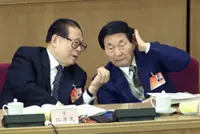
SINGAPORE: Memorials for two of China’s most transformative late leaders – former president Jiang Zemin and ex-premier Zhu Rongji, who served alongside each other at the turn of the millennium – have invited reflection on a bygone era while prompting questions about the country’s future.
China on Aug 18 bid farewell to Zhu, who died at the age of 97 on Aug 12. Flags flew at half-mast across the country for his funeral.
The mourning came a day after China marked Jiang’s 100th birthday with a high-profile ceremony in Beijing attended by thousands. He died in 2022 at the age of 96.
President Xi Jinping presided over Jiang’s commemoration ceremony, delivering a 40-minute speech at the Great Hall of the People during which he hailed the former leader’s “indelible contributions”.
Xi was also at Zhu’s funeral at the Babaoshan Revolutionary Cemetery. Xinhua reported that Xi, along with members of the current Politburo Standing Committee – the Communist Party’s top leadership body – and others, bowed three times before Zhu’s body and shook his family members’ hands to express their condolences. Xi’s predecessor, Hu Jintao, sent a wreath.
Together, the twin memorials sparked nostalgia for an era of reform and opening-up that was closely tied to Jiang and Zhu, who were partners in governance from 1998 to 2003.
However, the renewed spotlight on this era, marked by rapid economic expansion and China’s growing international profile, has also surfaced a quiet tension between how the past is remembered and what the future holds.
Timing
The commemoration of Jiang’s birth centenary is in line with longstanding political norms in China, and an event of such scale is not surprising given his status as one of the country’s former top leaders.
In addition to the ceremony held on Aug 17, commemorative stamps were issued to mark the occasion and a 12-episode documentary series chronicling Jiang’s life and contributions aired nightly on national television in the lead-up to the anniversary.
This is similar to how Deng Xiaoping’s 100th birth anniversary was commemorated in 2004.
The difference is the timing of Zhu’s death, which has given Jiang’s commemoration added resonance, said Lee Jong-hyuk, an associate professor at South Korea’s Sungkyunkwan University who studies Chinese politics.
“Their legacies are not identical, but the temporal overlap will inevitably encourage reflection on the broader reform era they represented,” Lee noted. He added that this may be sensitive at a time when China faces slower growth, difficulties in the property sector, local government debt and continuing tensions with major Western economies.
Observers said the official narrative around Jiang has been one of continuity. This places his legacy within a historical sequence that culminates in the present era under Xi, to whom political watchers say Jiang had given his blessing for the top job.
Lee said: “In this narrative, Jiang is not presented as an alternative to Xi but as one of the leaders who contributed to the party’s continuing historical mission.”
This is also the case for Zhu, whose official obituary stated that he had “resolutely supported” the party’s central committee with former president Hu as general secretary, and later with Xi as the committee’s core.
During Jiang’s commemoration ceremony, Xi lauded Jiang’s political conviction and loyalty to the party, his dedication to people’s well-being, his innovative spirit; his far-sighted and strategic thinking, and his courage and vision to make decisions amid domestic and external crises, such as the 1998 floods and the Asian financial crisis.
These qualities were framed as lessons for the “new journey” that China has embarked on – a reference to a political slogan denoting a push towards national rejuvenation and Chinese-style modernisation that gained greater emphasis in 2022 as Xi began his third term.
Xi called on the Communist Party to carry on the former president’s legacy in a rallying cry for the nation to close ranks as it confronts mounting economic and geopolitical challenges.
Rose-tinted lens
Yet outside the Great Hall, there are those who view Jiang’s and Zhu’s tenures through a different rose-tinted lens, pining for what they perceive as the halcyon days of wealth creation and hope, despite the hardships of the time.
Over the past week, old photos and videos of Jiang and Zhu have resurfaced and been shared on Chinese social media, with some posts depicting the two leaders leaning towards each other and smiling, while others highlight Jiang’s colourful persona and Zhu’s straight-talking nature.
But in a sign of the political sensitivities around displays of public mourning that draw comparisons between past and present, many who paid tribute to the two leaders on social media used subtle references or nicknames such as “the Elder”, as Jiang was known, to get around the internet censors.
One example was an essay about Zhu’s death by notable economist Zhao Jian, who lamented a feeling of emptiness and anxiety today, compared with a sense of security and “a glimpse of tomorrow” 30 years ago. The article was quickly taken down from messaging platform WeChat within a day, according to Sinification, a China-focused newsletter.
Observers also noted that the remembrance of Jiang and mourning of Zhu come at a touchy time for Beijing as key leadership reshuffles are likely to take centre stage at the Communist Party’s next party congress in late 2027.
“The leadership will be concerned about image management in the lead-up to the party congress,” said Daria Impiombato, a senior analyst who researches Chinese elite politics at the Mercator Institute for China Studies (MERICS), a German think-tank.
“At this moment in particular, it’s all about party-building. It’s all about loyalty.”
Mixed legacies
During their time at the helm, Jiang and Zhu forged decidedly mixed but transformative legacies.
Jiang, who came to power after Deng Xiaoping plucked him from relative obscurity to succeed purged party chief Zhao Ziyang following the 1989 Tiananmen crackdown, steered China out of diplomatic isolation and kept a turbulent relationship with the US on an even keel.
At home, he brought private business owners into the Communist Party through his “Three Represents” doctrine, though his reign was also criticised for rampant corruption and the suppression of dissent, such as the crackdown on the Falun Gong movement.
Zhu’s legacy, meanwhile, is tied to sweeping economic reforms, from securing China’s World Trade Organisation entry to overhauling bloated state-owned enterprises.
While largely successful, his aggressive shake-ups left more than 30 million workers jobless. Economists have also argued that his 1994 tax-sharing reform forced local governments to rely on land sales, laying the groundwork for today’s property and debt crisis.
Liu Dongshu, an assistant professor at City University of Hong Kong, said the nostalgia for Jiang and Zhu’s time mirrors how people feel about China today, rather than accurately reflecting the past.
“It’s easier to recall the good side of that period when you are not satisfied with the current period,” he said.
The difference in leadership styles between then and now also reflects a different upbringing and zeitgeist, Liu added. “Jiang reflected a time when China was eager to open up to the world, compared with the current administration, which is more focused on asserting China’s position in the world.”
MERICS’ Impiombato made a similar point, noting that while the public sentiment around Jiang and Zhu is unlikely to lead to anything concrete, it offers a window into how people in China, particularly those who grew up in the 90s, feel about where the country is heading.
“There is an increasing perception that society is no longer meritocratic and that is potentially the biggest change compared with the 1990s, when the perception was still strong that if you work really hard, you are going to make it,” Impiombato said.
“The image of that generation of leaders dying out has been quite powerful,” she added. “For many, this is seen as the end of an era.” - The Straits Times/ANN