




“He who has never been to the Great Wall is not a true man,” former Chinese leader Mao Zedong wrote in a poem while passing through the Liupan Mountains in Guyuan, Gansu, during the Long March of the Red Army in October, 1935.
The Great Wall he mentioned refers to the Qin Great Wall built during the Warring States period of Qin (325-251 BC), which has a history dating back 2,300 years. It is one of the earliest ancient Great Walls built in China.
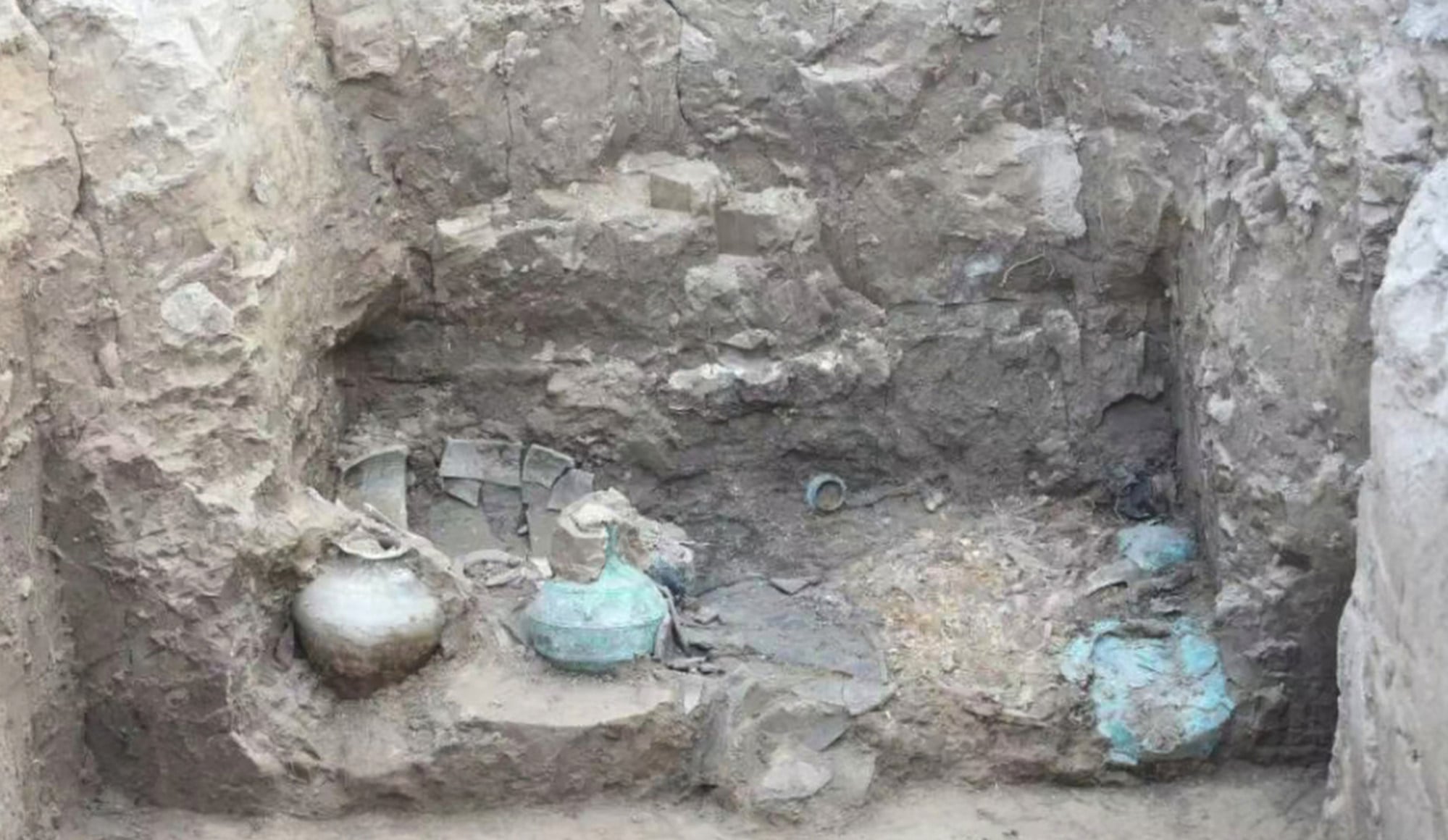
Recently, a well-preserved bronze wine vessel was discovered at the Shanjiabao cemetery, located 2km (1.2 miles) from the Warring States Qin Great Wall. The ancient Warring States-era jar remained perfectly sealed and still glistened, according to a study published in the June issue of the Journal of Archaeological Science.
“This study provides a clear understanding of the cereals utilisation and brewing techniques of the Qin people, contributing to the reconstruction of ancient Chinese brewing technology and also refining the development process,” wrote Chen Ruru, a Northwest University PhD candidate and first author of the study.
Along the 170km stretch of the Qin Great Wall, there are numerous forts, castles and barrier outposts of various sizes. At the time of the Warring States period, border soldiers and their families lived within fortified passes, castles and defensive outposts.
The Ningxia Institute of Archaeology began excavating the Shanjiabao Cemetery in March 2024.
A total of 183 tombs from the Warring States period were excavated, 179 of which belonged to the Qin culture. It is inferred that this may have been a public cemetery for garrison troops and residents stationed at fortifications along the Great Wall.
In Tomb No 39, archaeologists extracted 3,740 millilitres of ancient liquid residue from a bronze garlic-head-shaped pot, a hallmark of Qin culture. Analysis confirmed that the liquid was wine.
“This bronze pot used a double-layer sealing technique with a textile inner lining and an outer coating of organic clay, which allowed the ancient wine from over 2,000 years ago to remain largely intact,” said Wang Xiaoyang, head of the Shanjiabao cemetery archaeological project at the Ningxia Institute of Cultural Relics and Archaeology, in an interview with the Chinese Social Sciences Today on July 30.
“It is currently the most well-preserved and information-rich wine relic from the period of the Qin state that has been publicly reported in China.”
To accurately decipher the ancient wine recipe and craftsmanship, they jointly sent the samples to Northwest University for further analysis.
China is one of the earliest regions in the world to consume alcoholic beverages. An increasing number of ancient alcoholic beverage residues have been discovered in China, sparking widespread interest in the origins of brewing and the evolution of brewing techniques.
However, the raw materials used for brewing differ between southern and northern China. In the south, rice is typically used for brewing, while in the north, grains such as millet and foxtail millet are commonly used.
A total of 24 types of compounds, including organic acids and their derivatives, amino acids and their derivatives, and carbohydrates, were detected in the liquid unearthed from the archaeological site.
The distribution pattern of organic acids was consistent with that of artificially aged yellow wine, confirming that the liquid was a grain-based alcoholic beverage rather than a fruit wine such as grape wine.
In the liquid inside the garlic-head-shaped pot, researchers confirmed through starch residue analysis that over 92 per cent of the starch originated from broomcorn millet (Panicum miliaceum) – a water-efficient grain that has been consumed in northern China for over 10,000 years – while the remaining starch came from wheat and barley.
This discovery fills an archaeological gap in the study of winemaking in the Ningxia region during the Warring States period of the Qin state.
It also suggests that over 2,300 years ago, there was a Qin person at the Great Wall border pass – maybe a soldier – who loved a drink, and when he was buried, his family filled his most cherished bronze wine vessel with fine wine to accompany him for eternity. -- SOUTH CHINA MORNING POST


