




The rare failure of China’s Long March-7A rocket on Monday – which resulted in the loss of a communications satellite – has prompted questions over whether it was an isolated operational setback or a systemic problem.
While space experts caution against immediately linking the incident to China’s rapidly increasing launch cadence, the ongoing investigation will determine if the event was caused by a localised technical anomaly or deeper systemic vulnerabilities within the Long March rocket family.
With attention turning to coming missions – particularly for the lunar-bound Chang’e-7, which shares engine technology with the failed booster – China’s ability to balance its ambitious launch schedule with the rigorous scrutiny required to secure its track record will be under the spotlight.
Around 8pm on Monday, the 60-metre (197-foot) Long March-7A blasted off from the Wenchang Space Launch Site on the southern island of Hainan, piercing the night sky as it carried the ChinaSat-4B satellite towards high-Earth orbit.
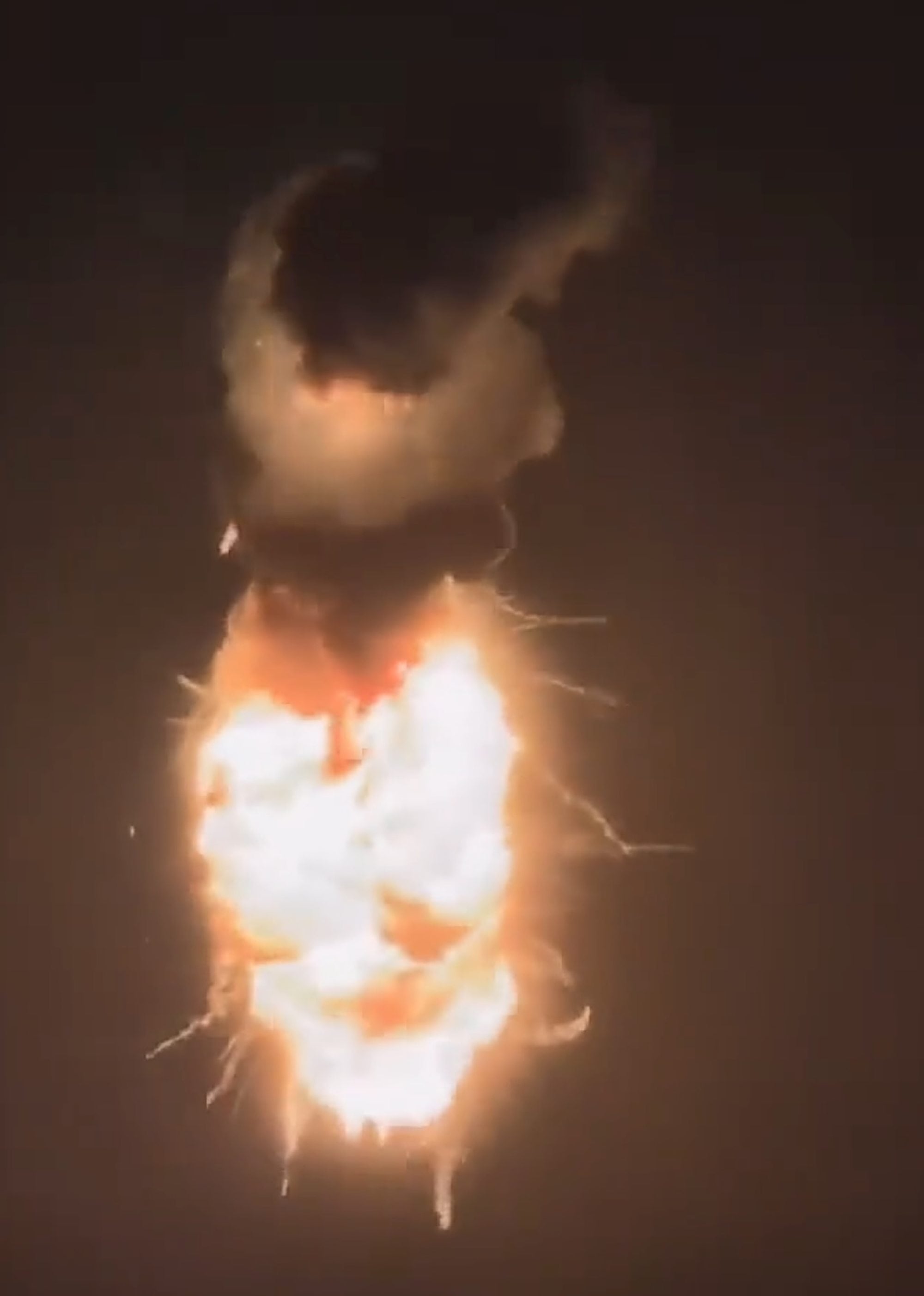
But less than 90 seconds into the flight, the rocket erupted into a fireball engulfed in thick black smoke, according to videos posted on social media by spectators near the launch site.
Space observers suggested a major anomaly might have triggered the rocket’s flight termination system, destroying the vehicle. Both the rocket and satellite were lost over the South China Sea.
State news agency Xinhua confirmed the failure and said the cause was being investigated.
Reacting to the incident on social media, American space flight company SpaceX founder Elon Musk said: “Rockets are insanely hard. There is a reason for the idiomatic expression. I hope they have a speedy recovery.”
Images circulating online, apparently taken from long-wave infrared tracking footage of the launch, appeared to show the rocket snapping near its upper section moments before it was destroyed.
The apparent snap happened around Max-Q, the point in a launch when a rocket comes under the greatest aerodynamic pressure as it accelerates through the atmosphere, according to space observers.
Some speculated that the rocket experienced a structural failure, likely triggered by a sudden surge in wind force at high altitudes shortly after launch, leading it to bend and break.
One military blogger wrote on social media: “A single setback does not mean a retreat. The key is whether the cause can be found and eliminated. For China’s space programme, what deserves real vigilance may not be any one failure, but rather how to maintain uncompromised quality control across every flight within an intensive launch schedule.”
This launch marks the fourth launch failure in China this year, following the state-owned Long March-3B and private company Galactic Energy’s Ceres-2 launches in January, as well as Beijing-based start-up Space Pioneer’s Tianlong-3 attempt in April.
China has conducted 56 launches this year, before Monday’s failure, which would have been the 18th launch of a Long March-7A vehicle.
Astrophysicist Richard de Grijs, the immediate former executive director of the International Space Science Institute-Beijing, said while the incident was a significant failure, it was not evidence of a systemic problem in China’s space programme.
“Rocket failures do occur, even in mature programmes, and the more frequently you launch, the more often you will eventually encounter one,” said de Grijs, who is a professor at the school of mathematical and physical sciences at Macquarie University in Australia.
He cautioned against connecting the incident with China’s rapidly increasing launch cadence, noting that while a high operational tempo put pressure on manufacturing, quality control and operations, one failure did not prove there was a systemic link.
“What matters now is whether investigators identify an isolated component failure or something with implications across a wider family of launch vehicles.”
The ChinaSat-4B satellite was expected to provide radio, television and other communications services to users around the world. Low-numbered ChinaSat satellites are also believed to be used for military communications.
No official details have been released about the satellite, but it is reportedly one of the most expensive of its kind China has built, with a price tag exceeding 1 billion yuan (US$148.20 million).
Its sister satellite ChinaSat-4A, launched in 2024 and now operating about 36,000km above Earth, had an estimated launch mass of about 5 tonnes at launch, according to space-flight tracker Jonathan McDowell.
The Long March-7A is one of China’s new-generation rockets and has become a workhorse for sending large satellites to high orbits. It burns mainly kerosene and liquid oxygen.
The rocket failed on its maiden flight in March 2020 but successfully returned to flight a year later. It has since completed a string of successful missions, most recently sending the Tianlian-3 (01) satellite towards geostationary orbit on July 29.
Those consecutive successful flights carried a wide range of communications, remote-sensing and data-relay satellites, mostly to high orbits, giving the Long March-7A a well-established track record for high-orbit missions.
Monday’s launch had been expected to set a speed record of a different kind. Chinese media reported before lift-off that the roughly 12-day gap since the previous Long March-7A mission would be the shortest turnaround yet for the rocket – and for any of China’s new-generation Long March launchers.
The loss of ChinaSat-4B means the communications capacity it was intended to provide will now be delayed. Geostationary communications satellites can play important roles in both civilian and military communications, and the broader impact will depend in part on how quickly China can launch a replacement.
The failure could have knock-on effects for coming launches. LandSpace’s Zhuque-3, which had been due to launch from Jiuquan early on Tuesday, has been postponed ahead of what would be the company’s second attempt to achieve China’s first orbital-class rocket recovery.
It is not clear if the incident will affect Chang’e-7, China’s robotic mission to the lunar south pole, which is scheduled to lift off from Wenchang on August 24 aboard a Long March-5.
The Long March-5’s boosters use engines from the same YF-100 family as the Long March-7A, meaning an engine-related problem could potentially have implications for its schedule. If the failure proves to be structural and specific to the Long March-7A, however, the impact may be more limited.
De Grijs said that given they shared some technologies, “because Monday’s accident occurred early in flight, before we know its cause I would not say categorically that Chang’e-7 is unaffected”.
He said that because Chang’e-7 was a critical scientific and strategic lunar mission, Chinese authorities remained highly motivated not to take unnecessary risks. Delaying the launch by several days or weeks was considered far less damaging than launching before the underlying cause of this failure was properly understood.
“If the investigation quickly identifies an issue specific to the Long March-7A, I would expect the broader programme, including Chang’e-7, to proceed largely as planned,” he said.
“If it points to a shared engine, component or quality-control issue, the consequences could be considerably wider.”
Meanwhile, de Grijs said the Zhuque-3, whose launch planned for Tuesday was postponed, was a commercial rocket that was developed independently and used distinct technology, meaning that a Long March-7A failure was unlikely to have a direct technical impact on it.
“At this stage I would interpret that primarily as sensible caution rather than evidence of a shared problem,” he said. -- SOUTH CHINA MORNING POST


