




Argentina has renewed its currency swap with China for five years, preserving a US$19 billion lifeline that Washington spent more than a year pressing it to give up.
The Argentine central bank and the People’s Bank of China (PBOC) signed the extension of the 130 billion yuan line on Wednesday, a day before the existing deal was due to expire. The new term runs to 2031, two years longer than any previous renewal since the two countries first signed it in 2009.
The decision ends months of speculation over whether President Javier Milei, who campaigned on a vow never to do business with communists and is now widely seen as US President Donald Trump’s closest ally in the region, would let the swap lapse.
The longer term would provide “greater predictability over the continuity of this tool”, the Argentine central bank said.
A currency swap is a standing credit line between two central banks. Argentina can draw yuan from the PBOC, handing over pesos in exchange, and must return the money later with interest.
The full 130 billion yuan counts towards Argentina’s foreign reserves, but none of it can be spent until a tranche is activated, at which point the sum becomes a debt.
Chronically short of dollars, Argentina has come to rely on the line heavily. It accounts for about 40 per cent of the country’s gross reserves, down from nearly 60 per cent in 2023.
Yuan drawn from it have paid for Chinese imports, propped up the peso during currency runs and covered payments to the International Monetary Fund.
What Argentina pays for the money has never been disclosed by either central bank. A study by researchers including Harvard economist Carmen Reinhart put the rate at 400 basis points over China’s Shibor benchmark, twice what Turkey and Mongolia pay on comparable lines.
From dams to bailouts
Argentina was the first Latin American country to strike a currency swap with Beijing. Martin Redrado, then governor of the central bank, agreed a 70 billion yuan line with his Chinese counterpart Zhou Xiaochuan in July 2009, as the global financial crisis spread. It expired three years later without a single yuan being drawn.
The money only began to flow in 2014, when disbursements were tied to two hydroelectric dams in Patagonia awarded to China Gezhouba Group. Mauricio Macri’s government expanded the line to its present size in 2018.
Under Alberto Fernandez the line stopped funding infrastructure and became an emergency fund. His economy minister, Sergio Massa, activated a US$5 billion tranche in 2023 that Argentina could spend as it chose, using it to pay the IMF and defend the peso in the run-up to that year’s election.
Milei inherited the debt on that tranche weeks after telling voters that “we do not make pacts with communists, not with Cuba, not with Venezuela, not with North Korea, not with Nicaragua, not with China”.
Within days of taking office he wrote to Chinese President Xi Jinping seeking help to unlock the swap, and his government twice persuaded Beijing to postpone repayment, in 2024 and again in 2025.
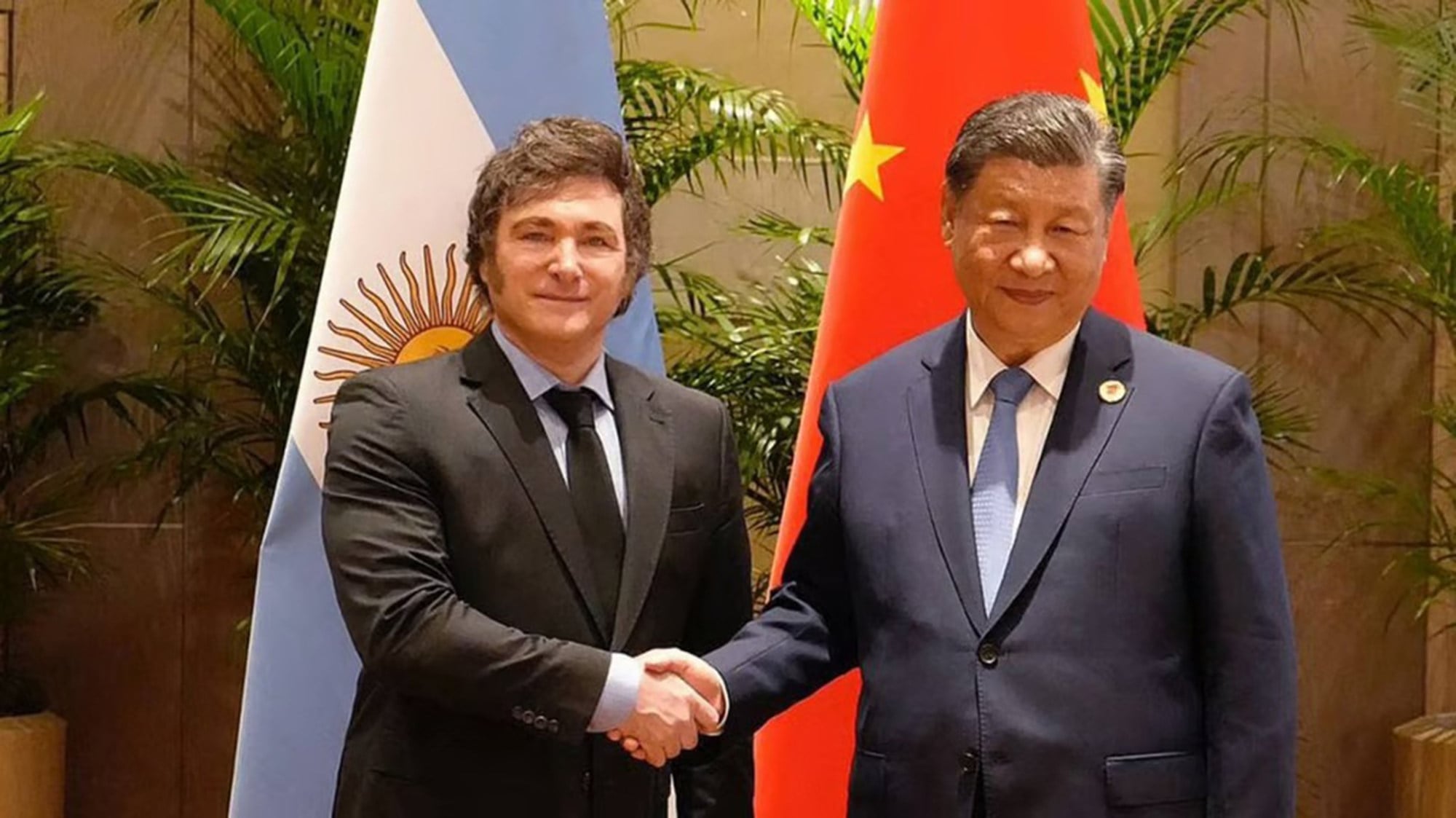
By September 2024 he was calling China “a very interesting trading partner” that “demands nothing”, and two months later he shook hands with Xi at the G20 summit in Rio de Janeiro.
Washington’s pushback
Mauricio Claver-Carone, then Trump’s special envoy for Latin America, called Chinese swap lines “extortionate” in April 2025 and said Washington’s priority was to ensure that Argentina’s new IMF programme did not “reinforce China’s position”.
“As long as it has the swap, Argentina is not free,” he said the following month.
Scott Bessent, the US Treasury secretary, struck a softer note on a visit to Buenos Aires that same month, saying Argentina should eventually earn enough hard currency to pay the line off.
The Chinese embassy in Buenos Aires answered within a day, condemning his “malicious defamations and slander” and telling Washington to stop “obstructing or deliberately sabotaging the assistance provided by other countries”.
In October 2025, the US Treasury signed its own US$20 billion swap with the Argentine central bank and used US$2.5 billion of it to buy pesos, steadying the currency before midterm elections. Argentina repaid that sum in December.
A trade agreement signed the following month committed it to reducing its energy dependence on “non-market actors”, a phrase understood to refer to China.
Argentina had by then returned almost everything it drew from the Chinese line, cutting the outstanding balance from close to US$5 billion to about US$679 million by mid-January.
When the central bank disclosed the figures in its annual accounts in May, speculation grew that Milei intended to let the swap die.
Santiago Bausili, the central bank governor, dismissed the idea, insisting there was “no plan to eliminate” the line and describing the relationship with the PBOC as “stable and quasi-permanent”.
He said Argentina wanted to roll the deal over on the same terms, which would have carried it only to 2029.
Bausili met his Chinese counterpart, Pan Gongsheng, in Shanghai the following month, on the sidelines of a central bankers’ symposium.
The US$5 billion tranche remains activated under the renewed deal and can be used, Bausili has said, “without additional authorisations”.
The swap is one of three tools the government is using to build up about US$22 billion in firepower at the central bank before the 2027 presidential election, alongside dollar futures contracts and repurchase agreements with international banks.
Gross reserves reached US$49.6 billion this week, their highest since September 2019. -- SOUTH CHINA MORNING POST


