




US President Donald Trump signed two executive orders on Thursday seeking to narrow birthright citizenship and intensify a crackdown on “birth tourism”, making a new attempt to restrict automatic citizenship after his original policy was rejected by the Supreme Court.
Trump announced the measures unexpectedly during a White House event, describing the Supreme Court’s June 30 ruling as “very unfortunate” and arguing that wealthy foreigners had built businesses around securing US citizenship for their children.
“They’re buying their way in, and we’re not going to let it happen,” Trump said.
The measures are likely to renew a politically and legally contentious debate that has increasingly focused on China, with Trump and Republican lawmakers repeatedly alleging that wealthy Chinese nationals and commercial operators have exploited US citizenship laws.
The first order directs federal agencies not to recognise the US citizenship of certain US-born children when neither parent is an American citizen.
It applies when either parent is classified as an “alien enemy”, a category the order defines to include members of designated foreign terrorist organisations and individuals designated as global terrorists.
It also covers children whose parents include foreign government employees, a category encompassing ambassadors, foreign embassy or consular staff, people employed by foreign governments in an official capacity and some employees of international organisations.
The order additionally seeks to deny citizenship when either parent paid to arrange for a mother to be present in the United States or one of its territories to give birth, including through a commercial surrogacy arrangement.
It also covers children born in US territories or territorial waters where citizenship is not already conferred by federal law.
The order describes these categories as “non-exhaustive”, leaving open the possibility that the administration could attempt to identify others. It directs relevant federal agencies to issue implementation guidance within 30 days.
The second order directs the State Department and the Department of Homeland Security to take action against “birth tourism”, which it defines as entering the US on a non-immigrant visa for the purpose of giving birth – or helping another foreign national do so.
Measures authorised by the order may include denying or revoking visas, permanently barring people from entering the country, removing those found to have engaged in the practice, and taking action against individuals or organisations facilitating it in the US or overseas.
The order allows the secretaries of state and homeland security to grant exemptions on humanitarian or national-interest grounds.
The measures test the scope of the 14th Amendment, which provides that all people born or naturalised in the United States and subject to its jurisdiction are US citizens.
“The practice of birth tourism is, as of the signing of this order, hereby banned,” said Stephen Miller, White House deputy chief of staff for policy and widely considered the chief architect of Trump’s hardline immigration agenda.
Miller said people would no longer be allowed to obtain US visas for what he described as the fraudulent purpose of giving birth in the country.
US rules already allow consular officials to deny tourist visas when they believe a person’s primary purpose for travelling is to give birth in the United States so that the child will acquire citizenship.
The new orders go further by applying to entry on any non-immigrant visa, authorising permanent exclusion and removal, and targeting people and organisations accused of facilitating such travel.
Giving birth while visiting the country is not itself a crime. Previous prosecutions involving alleged birth-tourism schemes have generally relied on charges including visa fraud, conspiracy and money laundering.
Together, the orders appear to expand the crackdown by attempting to deny citizenship in certain cases and expanding enforcement against companies and individuals accused of arranging such travel.
Trump’s original executive order, signed on his first day back in office in January 2025, directed federal agencies to deny citizenship documents to children born in the US when their mothers were undocumented or temporarily present and their fathers were neither citizens nor permanent residents.
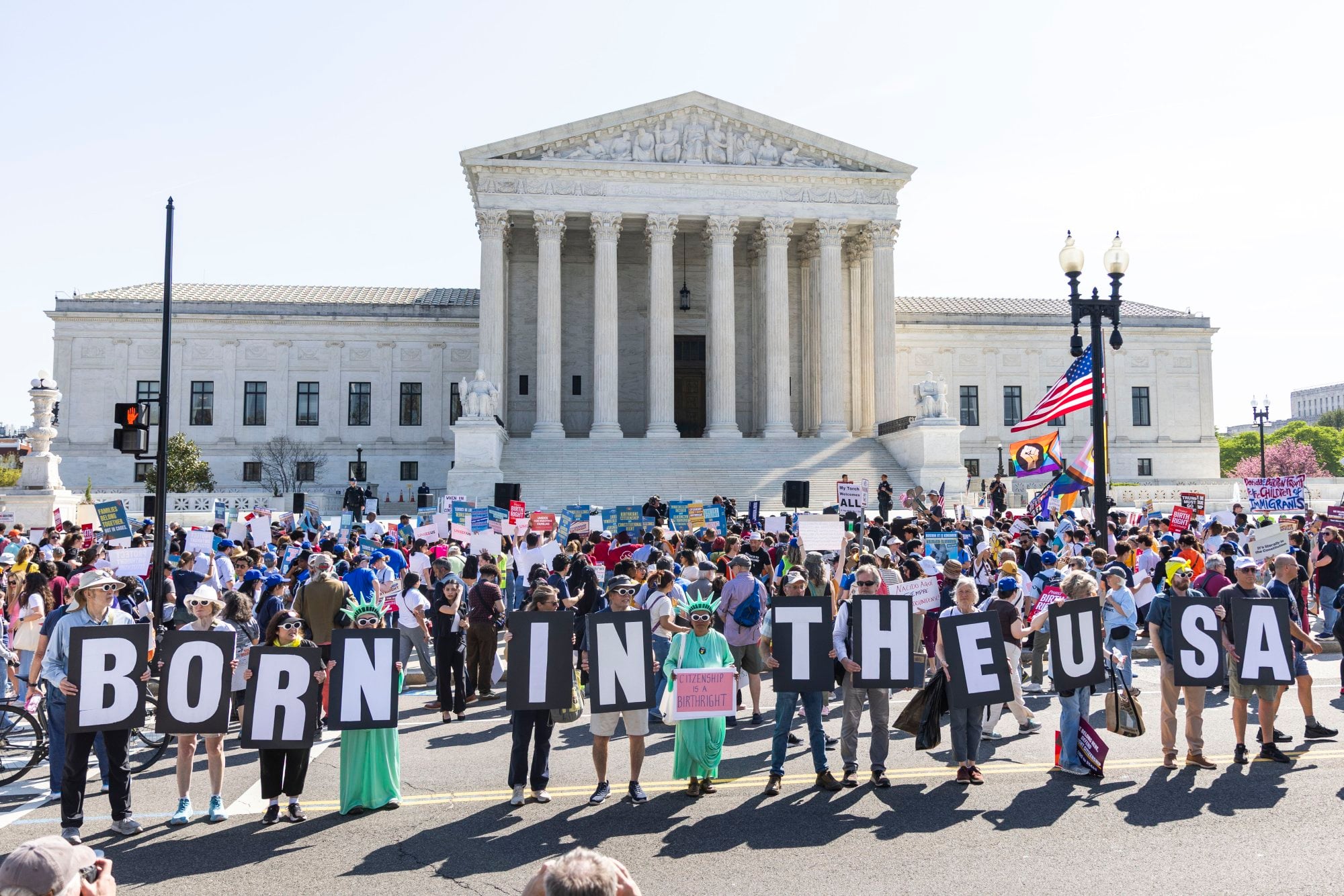
On June 30, the Supreme Court rejected that policy in a 6-3 ruling, holding that children born in the US to parents who were unlawfully or temporarily present were citizens at birth under the 14th Amendment.
Trump said on Thursday that the administration was now “ending it in a different way”.
White House staff secretary Will Scharf said the administration was confident the narrower measures would withstand judicial scrutiny.
“There’s absolutely nothing in here that runs afoul of any of the Supreme Court’s opinions on the subject,” Scharf said, adding that the White House would release a detailed fact sheet.
Trump claimed that “hundreds of thousands” of people had taken advantage of birth tourism, but did not provide evidence supporting the figure.
Estimates vary widely, in part because the federal government does not maintain a data set measuring how many women enter the country primarily to give birth.
Trump has repeatedly singled out China in his arguments against birthright citizenship, although he did not name the country during Thursday’s announcement.
After the Supreme Court ruling, he sarcastically congratulated Chinese President Xi Jinping and China for what he called their “massive Birthright Citizenship WIN”.
In March, Trump argued that the constitutional guarantee was “not about rich people from China, and the rest of the World, who want their children ... to ridiculously become citizens of the United States of America”.
Republican-led congressional committees have also scrutinised companies accused of helping foreign clients give birth in the US.
The House Oversight Committee said earlier this year that expectant mothers travelling for that purpose came predominantly from China and Russia, raising what it described as national security and election integrity concerns.
The Justice Department has meanwhile instructed federal prosecutors to prioritise investigations into alleged birth-tourism schemes.
Cases cited by the department include those involving Chinese operators who charged clients tens of thousands of dollars to travel to the US and give birth.
Available statistics, however, suggest births to non-US residents from China represent a small fraction of total US births.
The National Centre for Health Statistics recorded 113 births to non-US residents from China in 2023, out of around 3.7 million births nationwide. The data do not indicate why the women travelled to the US or whether they misrepresented their intentions. -- SOUTH CHINA MORNING POST



