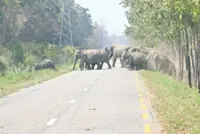
KATHMANDU: When Dhurbe, the notorious elephant, emerged from the forest in Jagatpur last month, few villagers could have predicted who would cross his path next.
The adult male tusker charged into a settlement bordering Chitwan National Park and killed Ashika Bote and her young son, adding two more names to a grim record that stretches back more than a decade. According to wildlife officials, Dhurbe has been responsible for 25 human deaths since 2010, and is one of Nepal’s deadliest wild animals. For Ashika’s family, the loss reopened an old wound: Dhurbe had already claimed the lives of two relatives in Madi in 2012.
Their deaths have renewed attention to a growing crisis across Nepal’s forest fringes. As wildlife populations recover and human settlements continue to expand along the edges of protected areas, encounters between people and wild animals are becoming more frequent — and often deadly.
The Department of National Parks and Wildlife Conservation recorded more than 9,900 cases of wildlife attacks on people in its 2024-25 annual report. Nineteen people were killed, 53 suffered serious injuries, and another 50 sustained minor injuries. Chitwan National Park, Nepal’s flagship conservation area, has recorded more than 120 human deaths from wildlife attacks over the past decade.
In Bardiya district, wildlife killed 11 people between mid-July last year and June this year, nearly doubling the previous year’s death toll. Leopards accounted for eight of those deaths, while tigers killed two people and an elephant killed another. Fifteen others were injured during the same period, after which a joint team from the Division Forest Office, Bardiya National Park, and the National Trust for Nature Conservation captured six leopards identified as posing repeated threats to nearby communities. Even so, residents in municipalities including Gulariya, Rajapur, Madhuwan, and Bardiya continue to report leopard incursions into settlements.
Across Nepal, wild animals have killed 146 people over the past five years. Another 399 people suffered serious injuries and 251 sustained minor injuries. Elephants, rhinos, tigers, leopards, bears, wild dogs, and crocodiles have also destroyed homes, livestock sheds, standing crops, and caused heavy financial losses to households that depend on farming for their livelihoods. During the same period, the government spent nearly Rs586 million compensating victims of wildlife-related incidents.
For decades, Nepal’s primary response has been to compensate victims after attacks occur. Families could apply for government relief for deaths, injuries, damaged houses, livestock losses, and destroyed crops, but the process depended on official verification and government disbursement.
Last month, Nepal introduced a different approach.
Beginning July 17, non-life insurance companies licensed by the Nepal Insurance Authority began offering the country’s first Wildlife Risk Insurance Policy. Developed in response to requests from provincial and local governments, conservation authorities and communities living in wildlife-prone areas, the scheme is intended to complement the existing government relief system rather than replace it.
For an annual premium of Rs1,500, households can purchase protection against death, injury, and property losses caused by attacks by 18 species of wild animals, including elephants, tigers, rhinoceroses, leopards, bears, and crocodiles. Coverage includes up to Rs1 million for accidental death or permanent disability, Rs500,000 for temporary disability, Rs100,000 for treatment of serious injuries, and Rs20,000 for minor injuries. The policy also insures houses, livestock, and agricultural crops, while providing Rs50,000 within seven days to help families cover funeral expenses after a fatal attack.
The policy marks Nepal’s first attempt to manage wildlife risk through insurance. Officials hope it will provide households with faster financial support after attacks while easing pressure on government compensation programmes. Whether it succeeds will depend not only on how widely communities adopt it, but also on whether it can reduce the economic insecurity that often follows living alongside wildlife.
Binod Kumar Pokharel, deputy director at the Nepal Insurance Authority, said the scheme was designed as a pilot and could be refined as insurers begin issuing policies and processing claims.
“This wildlife policy has been formulated on the request of provincial and local governments, especially Koshi Province, Mechi Municipality, and the Department of National Parks,” Pokharel said.
Because Nepal had no previous wildlife insurance programme to use as a model, the insurance authority looked to existing insurance products when determining the Rs1,500 premium, he said. The coverage limits were also designed to ensure victims would receive at least as much support as they currently receive through government relief programmes.
“NIA has taken this product as a pilot product for this year and will revise it accordingly in the following year,” he said. “The major expectation is that this policy will reduce the financial and administrative burden of the government in the days to come.”
The insurance policy will operate alongside, rather than replace, the government’s existing Wildlife Damage Relief Distribution Guidelines.
Under the current relief system, families of people killed by wildlife can receive up to Rs1 million from the government. Serious injuries are compensated up to Rs200,000, permanent disability up to Rs500,000, and minor injuries up to Rs20,000. Relief is also available for livestock, damaged houses, grain stores, and seasonal crops, although the payment ceilings are generally lower than the insurance coverage now being offered.
Relief payments, however, depend on official verification and government disbursement. Victims or their families must report incidents, obtain recommendations from local authorities, and submit supporting medical or veterinary records before claims are approved. While the revised 2080 (Bikram Sambat) Nepali year guidelines simplified the process by allowing applications to be filed at nearby forest offices, payments still depend on administrative procedures and the availability of government funds.
The insurance scheme is intended to provide an additional layer of financial protection. Whether the policy will reduce conflict between people and wildlife, however, remains an open question.
Conservation scientists say the policy could ease some of the financial hardship that fuels resentment towards wildlife, but stress that compensation alone cannot prevent attacks or address the factors driving conflict.
Prakash Kumar Paudel, a conservation scientist who researches human-wildlife conflict, said the policy should be understood as one component of a much broader strategy for coexistence.
“Coexistence means both reducing people's exposure to wildlife and improving their resilience when conflict occurs,” Paudel said. “Human-wildlife conflict involves social, economic, and ecological dynamics that are all interconnected. Insurance is one instrument that can reduce economic vulnerability by compensating for losses caused by wildlife.”
He said insurance could help soften negative attitudes towards wildlife by reducing the financial shock experienced by affected households, particularly those that lose crops or livestock.
Paudel said the policy’s comprehensive coverage and provision for faster payments were encouraging, but cautioned that its success would depend on implementation.
“If this policy is implemented alongside education, awareness programmes and other support systems, it can help reduce the negative perceptions that often arise after wildlife attacks,” he said. “But it does not directly address the underlying causes of conflict.”
Babu Ram Lamichhane, a conservation biologist who has studied human-wildlife conflict in Nepal, said growing losses have eroded support for wildlife conservation in many buffer-zone communities.
“There is a growing concern from local communities regarding losses caused by wildlife,” Lamichhane said. “Many people are increasingly becoming negative towards wildlife because of these losses. From a conservation perspective, this policy is an excellent initiative because it can reduce that financial burden and support coexistence.”
Still, Lamichhane said it remains to be seen whether the programme will prove financially sustainable if claims become frequent in areas with high rates of human casualties.
“If the policy is widely accepted and adopted, it has the potential to address one of the biggest frustrations communities face, which is compensation for wildlife damage,” he said. “But we will only know how effective it is once we see how both communities and insurance companies respond in practice.”
Both scientists emphasised that insurance should complement, not replace, efforts to prevent conflict in the first place.
“Insurance should never be treated as a complete solution to human-wildlife conflict,” Paudel said. “We also need stronger conflict-mitigation measures such as barriers, changes in cropping patterns, habitat improvement inside forests and protected areas, conservation awareness and behaviour change.”
Lamichhane agreed, saying preventive measures should remain the priority.
“Reducing losses through prevention should always come first,” he said. “Physical barriers, early warning systems, cultivation of crops that wildlife are less likely to eat, and awareness programmes all remain essential. Insurance and government relief are important because they help reduce resentment and the risk of retaliation against wildlife, but they cannot replace prevention.”
The policy may also have implications beyond conservation.
Rakesh Gyawali, a sustainable finance professional, believes the policy expands the role insurance can play in Nepal’s approach to climate and environmental risks.
Discussions about sustainable finance often centre on green investment, climate funds, and environmental, social, and governance standards, he said. Risk management receives much less attention, even though it influences whether households and businesses are willing to invest.
“By providing financial protection against wildlife-related losses, it has the potential to reduce uncertainty for people and businesses operating in wildlife-prone areas,” Gyawali said. “Insurance complements financing by helping strengthen resilience alongside investment and economic activity.”
He said many households and small businesses in buffer-zone communities hesitate to invest in agriculture, agroforestry, ecotourism and other nature-based enterprises because a single wildlife attack can wipe out years of savings. Insurance cannot eliminate those risks, Gyawali said, but it can help families recover more quickly, protect productive assets, and continue their livelihoods after losses.
As Nepal grapples with growing human-wildlife conflict, the policy represents a shift in thinking — from simply compensating losses after tragedy to building the financial resilience of communities living alongside wildlife.- The Kathmandu Post/ANN