




Germans have emerged as some of Europe’s most hawkish voters on China, more likely to consider Beijing as a rival or an adversary than in any other major EU country, a new survey has shown.
Published amid a bout of soul-searching in Berlin over whether to back a tougher approach towards China on trade, the findings suggest that the country’s citizens might not be opposed to such a shift.
A combined 49 per cent of German people polled considered China to be primarily a rival or an adversary, way ahead of the second of the 13 countries polled, which was 43 per cent in France – a long-time supporter of a more interventionist EU trade policy.
Just 38 per cent of Germans see China in positive terms, either as a partner or ally. By contrast, 65 per cent of Spaniards and 62 per cent of Bulgarians view Beijing in such glowing terms.
Germany is by far China’s biggest trade and investment partner in Europe. For decades, a symbiosis between the two economies helped deliver mutual industrial success. But the European power is enduring a broad-based manufacturing slowdown, with economists suggesting that China’s industrial rise is a major contributing factor.
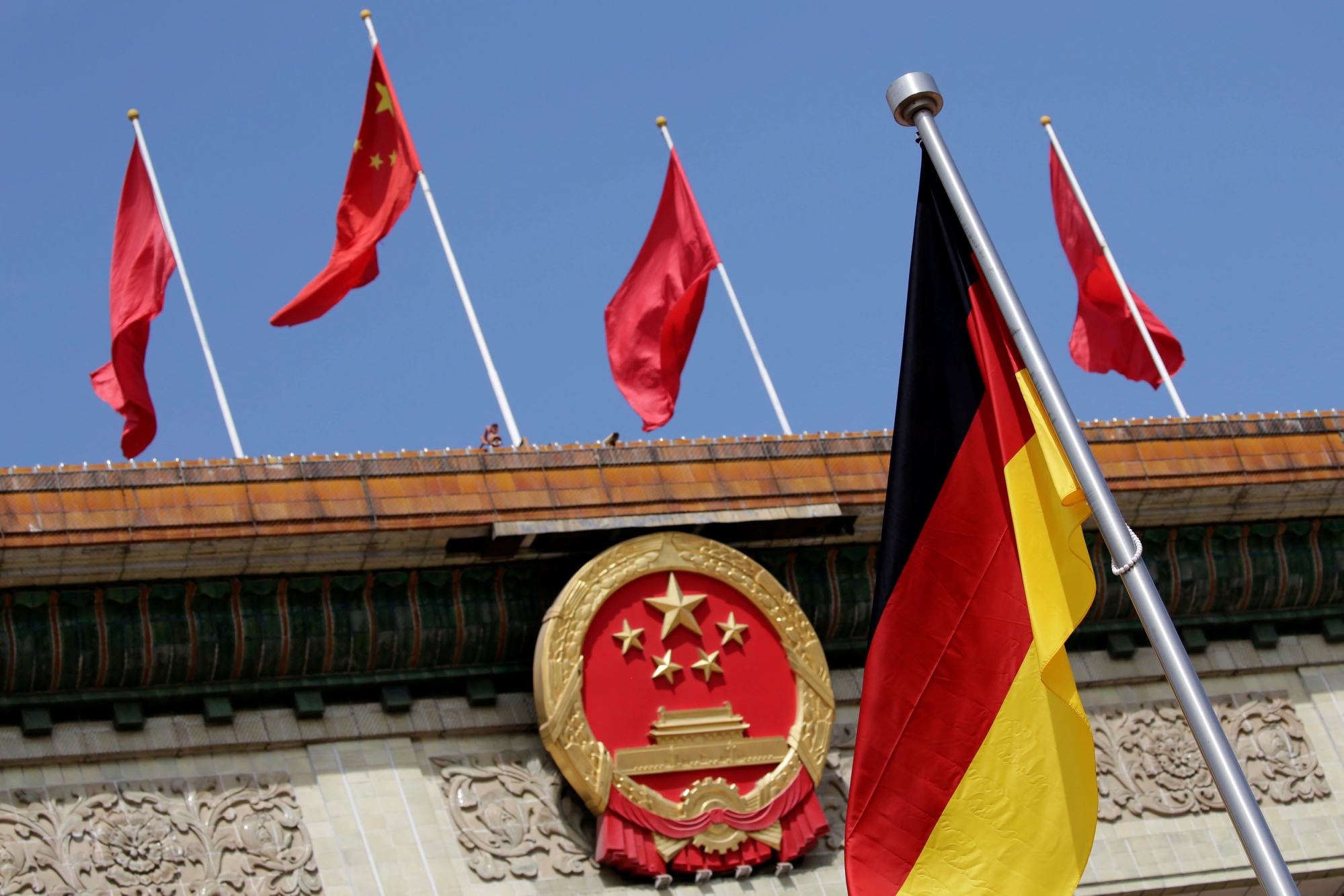
“The China shock has hit Germany particularly hard: its manufacturing sector lost around 420,000 jobs between 2019 and 2025 and it continues to shed 10,000 jobs each month,” read the report by the European Council on Foreign Relations, a think tank.
“The car industry is paying the highest costs, being squeezed out of a market increasingly dominated by Chinese manufacturers at home and abroad.”
Berlin has thus far been reluctant to back new measures. In 2024, it was a notable holdout as the bloc’s 27 member states voted on whether to slap anti-subsidy duties on Chinese-made electric vehicles.
German Chancellor Friedrich Merz has hinted in recent weeks that something may have shifted, although his approach has been inconsistent. Within a three-month period from March, he called variously for a free-trade agreement with the world’s second-largest economy, then a Plaza Accord-style agreement to deal with what he described as an “undervalued” Chinese yuan.
It is understood that his coalition government is divided on how to move on China policy, with Economy Minister Katherina Reiche – of Merz’s own Christian Democratic Union – the most reluctant cabinet member when it comes to taking action against what is described as a “China shock 2.0”.
“One thing Berlin should not worry about is voters’ disapproval should it pursue a more hawkish China policy,” read the report, pointing out that “no fewer than 60 per cent of Christian Democrat and Social Democrat supporters regard the country as an adversary or rival”.
The main political divide in Germany is that parties considered to be extreme – the far-right Alternative for Germany (AfD) and the Left group – are noticeably more inclined to see China as a necessary partner.
The AfD, which has taken a lead in many nationwide political polls and is tipped to win in some provisional elections this year, feels most positively towards China. Some 45 per cent say China is a necessary partner, 5 per cent an ally, while 31 per cent see it as a rival and 8 per cent as an adversary.
The most assertive major party is – perhaps surprisingly – the centre-left Social Democrats, in which a combined 60 per cent see it as either a rival or adversary. On a European level, social democrats have tended to pursue a softer approach towards Beijing.
The survey is the latest signal that something may be changing in Sino-German relations. On a call with investors last month, the CEO of Volkswagen urged the European Commission to put tariffs on Chinese-made plug-in hybrid EVs and praised the very EV duties that he had so vociferously opposed in 2024.
“It was the first time that the head of one of Germany’s big three carmakers had called publicly for trade defence measures against China,” wrote Noah Barkin, an expert in German China policy at Rhodium Group, in his newsletter this week.
“This is new territory and the reason is simple: the threat from Chinese competitors has become so big that the default approach of the past decades – lobbying Berlin and Brussels to do absolutely nothing – is no longer viable.”
Trade talks between the EU and China are set to continue through August and September, while their respective ministers will meet in October, with the EU to assess whether progress has been made in rebalancing the relationship. In October, heads of state including Merz are set to meet in Brussels to decide whether to take concrete measures to stem the flood of Chinese imports. -- SOUTH CHINA MORNING POST


