Having marked its 99th anniversary on August 1, the People’s Liberation Army is now just a year away from its centenary goals, with its evolution highlighting the past, present and future of China’s military strategy. In the fourth part of a series, Amber Wang looks at the PLA’s pursuit of emerging technologies.
In an influential book published nearly three decades ago, a PLA military strategist argued that China should not try to match the US weapon for weapon but instead develop asymmetric advantages against its stronger rival.
Qiao Liang drew lessons from America’s victory in the Gulf War in the book, Unrestricted Warfare. He noted that warfare was entering an informationised era and that China was clearly lagging behind the United States.
Qiao – who co-authored the book with Wang Xiangsui – also said finance, cyberspace and psychological operations would be important in future wars.
“We don’t necessarily need to have what the US has,” Qiao wrote, back in 1999. “We need to have what it doesn’t.”
In the years since then, the book has drawn significant attention in Western military circles and has been studied at the US Military Academy in West Point, New York as part of broader discussions on Chinese strategic thinking.
It also continues to resonate among military strategists in China, as the People’s Liberation Army pursues emerging and “disruptive” technologies as part of its modernisation efforts – from artificial intelligence and quantum tech to hypersonic weapons and directed-energy systems.
Decades later, Qiao said the theory in his book still held.
He told the SCMP that militaries around the world were “increasingly moving towards building weapons for the wars they expect to fight, rather than fighting wars with the weapons they possess”.

The PLA leadership has said it aims to build a “world-class military” by the end of 2049. It is expected to disclose some of its modernisation goals in August next year when the military marks its centenary.
According to analysts, China is not just trying to close the gap with America on military capabilities but also to compete on shaping the next era of warfare through disruptive technologies – and to use them to boost deterrence.
After decades of learning from the US, China is now seen by some to be blazing its own path and even taking the lead in areas such as sixth-generation fighter jets, hypersonic and laser weapons.
Future battlefield
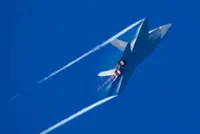
When a mysterious tailless aircraft was spotted in skies over the southwestern city of Chengdu in 2024, it turned heads – all over the world.
Shaped like a ginkgo leaf, it did not look like previous generations of Chinese stealth fighter jets. And it prompted speculation that China might have gained an upper hand in developing a next-generation fighter.
The timing of its appearance was also highly symbolic, with the flight taking place on December 26 – the birthday of Mao Zedong, founding father of communist China.
In Mao’s time, China had limited home-grown defence capabilities and relied heavily on Soviet technology.
The fighter jet over Chengdu, along with another tailless prototype revealed two years earlier, represented more than a new design – it signalled China’s entry into the global race for sixth-generation air power.
America’s programme, known as Next Generation Air Dominance, or NGAD, is developing the Boeing F-47 stealth fighter. Other countries, including Russia, Japan, Italy and Britain, are also developing next-generation combat aircraft.
It has been a long and difficult path for China to reach this point. It took nearly three decades to move on from the first domestically designed fighter jet from the 1960s, the J-8, to the next-generation J-10 in the 1990s.
“For many years, we simply struggled to make breakthroughs,” military analyst Fu Qianshao said.
China eventually entered the fifth-generation fighter jet era with the J-20 and J-35, but they entered service later than their US counterparts.
But the emergence of a sixth-generation aircraft could be a turning point.
“This is a landmark event,” according to Fu.
“In the past, it was always the US and Russia leading the trend while others followed in a race to catch up. But now, a total reversal has taken place.”
It is not just about catching up – it also offers insight into the PLA’s vision for future warfare. According to analysts, that vision is built around “intelligentisation” – or the integration of emerging technologies with mechanisation and informationisation.
“Future aircraft will not be judged only by their speed, manoeuvrability or situational awareness. They will combine the roles of fighter and commander, with human pilots directing multiple unmanned aerial platforms as part of integrated joint operations,” Fu said.
“Similarly, tanks are evolving beyond traditional armoured platforms. Through informationisation and intelligentisation, they are becoming integrated combat systems capable of operating with unmanned platforms,” he said.
“Each tank could become a node for sensing, data exchange and intelligent decision-making.”
President Xi Jinping has pushed for faster development of “new combat capabilities”, while an overhaul of the PLA saw the creation of the Strategic Support Force in 2015 to oversee space, cyber and electronic warfare. It was split into three arms in 2024 – aerospace, cyberspace and information support.
China’s military technology has made progress at a rapid pace – from the advanced electromagnetic catapults on the Fujian aircraft carrier to its unmanned aerial and underwater systems, and AI-powered drone swarms.
Fu said the future would be more about integrated operations, with less direct human involvement.
“We are heading towards an integrated, cross-domain warfighting system – combining aerial drones, surface vessels and underwater uncrewed platforms – with humans taking a back seat in command and control.”
This is all underpinned by a broader technological foundation of advanced materials, advanced manufacturing, AI and high-performance computing.
“The foundation lies in technology: power plants, radar, avionics, flight control and materials,” Fu said, pointing to the development of fighter jets as an example. “Metamaterials represent the development of a complete, systemic technology.”
These advances are supported by the PLA, research institutes, universities and civilian tech companies through China’s military-civil fusion strategy.
As the US and its allies also integrate emerging technologies into their military systems, China’s strengths lie in policy mobilisation, manufacturing scale and engineering, according to Sun Chenghao, a senior fellow at Tsinghua University’s Centre for International Security and Strategy.
“China may be better positioned in scaling technologies and integrating industrial capabilities, while the United States may retain advantages in frontier innovation and the ability to coordinate global technology ecosystems,” he said, adding that China still had work to do in areas like advanced semiconductors.
Disruptive tech
In military terms, disruptive technologies refer to capabilities that go beyond improving existing weapons and have the potential to alter how wars are fought – by changing operational concepts, creating new vulnerabilities, or providing an advantage if they are successfully integrated.
Chinese military mouthpiece PLA Daily has frequently identified emerging technologies with disruptive potential such as AI, quantum, hypersonic weapons, directed-energy systems and biotech.
Malcolm Davis, a senior analyst at the Australian Strategic Policy Institute, said these areas – and how they came together – were “significant” for future warfare, as were autonomous systems, robotics and nanotechnology.
“As to who wins this race, it’s really uncertain. Clearly it’s a race between China and the United States,” he said, adding that China was making steady progress and was probably ahead in areas like hypersonics while facing fewer constraints in ethically challenging fields such as biotech.
China’s priority on advanced systems like electronic warfare, unmanned systems and precision-guided munitions was seen in its military parade last year, according to the Centre for Strategic and International Studies.
“Such weaponry enhances China’s ability to impair US forces from conducting complex military operations in much of the Asia-Pacific,” the Washington-based think tank said in an article in October.
In January, China’s military said it was using quantum technology to gather high-value intelligence from public cyberspace. More than 10 quantum cyber warfare tools are “under development” – many of them being “tested in frontline missions”, according to official newspaper Science and Technology Daily.
The PLA Information Support Force is also reportedly working with the National University of Defence Technology’s supercomputing lab to advance a “quantum + supercomputing” project.
China has invested heavily in quantum communication and computing. In 2016, it launched Micius – the world’s first quantum communication satellite – and has since developed a large-scale space-ground quantum communication network.
Davis said quantum was a key military technology in terms of computing power, potentially with links to AI, cryptography and communications.
“It allows large problems to be solved rapidly, very secure communications and unbreakable cryptography of those communications,” he said.
But Wu Riqiang, a missile expert and professor with Tsinghua University, said while the technology could eventually be disruptive on the battlefield, its practical military impact was still uncertain.
Hypersonic weapons are meanwhile being developed as part of the PLA’s “assassin’s mace” capabilities to exploit US military vulnerabilities.
Travelling at speeds exceeding Mach 5, hypersonic weapons are difficult to intercept because of their speed and ability to manoeuvre during flight. China is widely regarded as the leading developer of these weapons.
A PLA strategist, who requested anonymity, said hypersonic weapons were designed for potential conflict with the US, but also for deterrence.
“With these capabilities, the US will have to think twice before making a move,” he said.
Of all the emerging technologies, artificial intelligence is seen as one of the most immediate drivers of military transformation.
AI is already starting to influence military operations through faster decision-making, autonomous systems, battlefield data processing and intelligence analysis, as seen in recent US strikes on Iran where AI-enabled systems helped target and support battlefield decision-making.
China’s military has reportedly tested AI-enabled drone swarm warfare, claiming that a single soldier could control a swarm of more than 200 drones.
And in 2024, AI firm DeepSeek launched large language models that drew global attention and highlighted China’s progress on artificial intelligence.
Meanwhile, China has been closely watching the Russia-Ukraine war and the conflicts in the Middle East, where drones – and counter-drone capabilities – have played a key role.
Fu said China’s directed-energy weapons designed to counter drone swarms could give it an advantage in the future.
“Countering drone swarms with directed-energy weapons such as laser weapons is the future of air defence,” he said. “Our toolkit is expanding fast, and China is making rapid progress in this area.”
Several high-energy laser weapons and high-power microwave systems were showcased during China’s military parade in Beijing last year as part of the PLA’s emerging anti-drone capabilities.
Chinese researchers are also focused on biotechnology, including concepts involving biological-computer interfaces and human-machine integration – though military applications remain at an early stage.
A Pentagon report on China’s military last year said there was a push to develop biotech including through major military-civil fusion projects in fields such as biology and brain science.
“We do not know which specific applications will eventually become viable, or what capabilities they will ultimately deliver, but clearly both countries are pouring great resources into them,” Wu said.
Analysts noted that the impact of emerging technologies should not be overstated and that they would also bring new risks.
“I believe the importance of disruptive technologies is real, but claims that possessing a particular technology alone can fundamentally determine the outcome of a war are often exaggerated,” said Sun from Tsinghua.
“Emerging technologies are unlikely to replace traditional military capabilities. Instead, they will be integrated with existing assets such as missiles, ships, aircraft, manpower and industrial capacity.”
Davis also pointed to the risks. “Losing control of technologies is a key one, and one that – at least in liberal democracies – is acting as a constraint in areas such as AI and autonomous systems,” he said. -- SOUTH CHINA MORNING POST