
PHNOM PENH: The Kingdom’s rapidly expanding durian exports to China have created a new challenge for farmers, traders and exporters: protecting the reputation of the “Made in Cambodia” label by preventing unregistered, substandard or prohibited produce from entering the supply chain.
Khim Finan, spokesperson for the Ministry of Agriculture, Forestry and Fisheries, explained that Cambodia secured an important commercial opportunity when it gained phytosanitary access to the Chinese market, but warned that dishonest practices could quickly damage the industry’s credibility and jeopardise future exports.
“I have appealed to community members and traders to demonstrate honesty. Please do not commit fraud, and do not purchase durians from unregistered farms and put them up for sale,” he told The Post.
“If we do that and are caught, we will damage our own reputation in the market. Do not sell durians containing prohibited substances,” he added.
His warning comes as Cambodian durian exports to China continue to surge, supported by growing demand, new transport routes and the registration of more orchards and packing facilities.
According to the agriculture ministry, the Kingdom exported 5,738 tonnes of fresh durian to China between April and July 24.
Exports rose from 31.15 tonnes in April to 440.24 in May, before increasing sharply to 2,436.72 in June and 2,830.13 during the first 24 days of July.
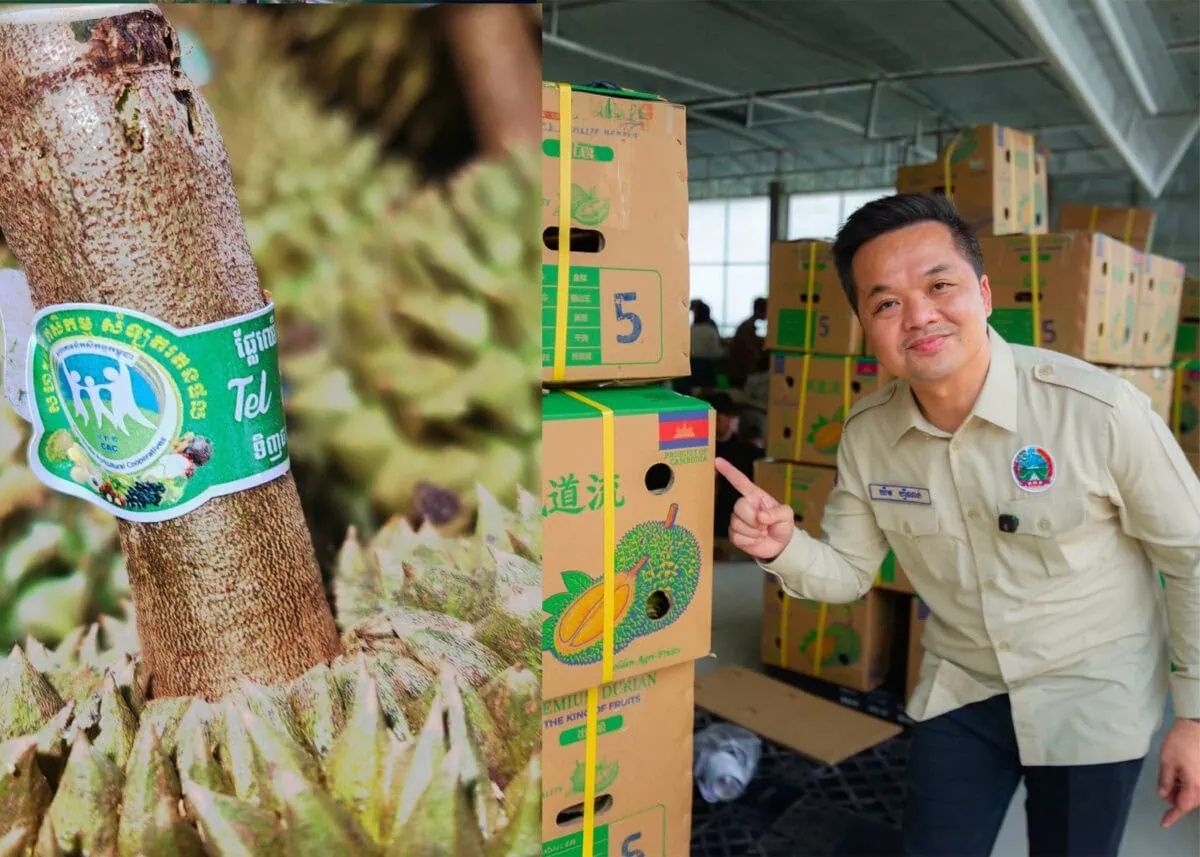
China’s General Administration of Customs has approved 170 Cambodian durian orchards and 38 packing facilities for export, expanding the number of producers permitted to access the Chinese market.
Finan said the growth of Cambodian exports had also begun changing regional purchasing patterns, with some companies that previously sourced fruit from Thailand now turning to Cambodian growers.
“Some companies, as far as we know, previously bought durian from Thailand for export to China. Now they have shifted to Cambodia,” he noted.
He said Cambodian durian had become attractive to buyers because of its quality, competitive price and improved access to transport routes.
“We have transport channels, our quality is good, our price is good, and buyers want our products,” he explained.
“But if we are given this opportunity and then send them rejected or poor-quality products, we will lose the opportunity, as has happened to some countries whose products were banned,” he warned.
Cambodia began negotiations to export fresh durian with China in April 2024. The two sides signed a phytosanitary protocol in April 2025, clearing the way.
China initially approved 112 orchards and 30 packing facilities in July 2025, following and assessments by Cambodian and Chinese authorities.
Cambodia’s first commercial shipment of 17.28 tonnes of fresh durian was sent by sea from Preah Sihanouk province in July 2025, followed by an air shipment of 2.49 tonnes to Henan province the following month.
Cambodia exported a total of 148.6 tonnes of fresh durian to China in 2025.
The trade expanded further this year, after Laos agreed to allow Cambodian agricultural products to transit through Laos to China.
Cambodia’s first 15.77-tonne shipment through Laos was exported on May 22. By July 24, a total of 414.16 tonnes had been transported to China through the neighbouring country.
Finan noted that Chinese authorities had to protect their consumers and enforce import standards, meaning Cambodia could not expect continued access if exporters failed to comply with agreed requirements.
“We should not forget that our Chinese friends also face difficulties. They cannot continue allowing us to export if we fail to comply with their conditions,” he said.
The spokesperson added that the harvest season has not ended, as production seasons varied across different regions.
“Data on Cambodian durian has not ended yet because harvesting depends on each production area. In places like O’Som in Ratanakiri province, there is still a continuous harvest. I recently visited the area as part of the Cambodian durian programme,” he said.
Finan explained that Cambodia’s staggered harvesting seasons mean consumers can still find locally grown fruit even after production has tapered off in some well-known durian-growing regions.
However, he acknowledged that protecting the authenticity of Cambodian produce remains a growing concern.
“I remain concerned that product misrepresentation could still occur because it is difficult to verify the origin of every fruit with complete certainty,” he said.
Failure to enforce those standards could harm farmers and businesses that have invested in compliance, while weakening consumer trust in Cambodian agricultural products.
As Cambodia seeks to expand its presence in one of the world’s largest fruit markets, the next stage of the durian industry’s development will depend not only on increasing production and exports, but also on ensuring that fruit sold under the Cambodian name meets the standards promised to buyers.
For growers and traders, protecting that reputation is no longer simply a matter of national branding. It has become a condition for maintaining market access. - The Phnom Penh Post/ANN