




Anthony Fauci repeatedly invoked his constitutional right against self-incrimination at a contentious US Senate hearing on Wednesday, refusing to answer questions about American funding for coronavirus research in China and allegations that he misled Congress about the origins of Covid-19.
The extraordinary appearance reopened one of Washington’s most politically divisive disputes: whether the pandemic began through natural transmission from animals or a laboratory-related incident in Wuhan, and whether US officials adequately scrutinised research conducted there with American funding.
Fauci, who led the National Institute of Allergy and Infectious Diseases and became a prominent face of the US government’s Covid-19 response during the pandemic, was subpoenaed to appear on Wednesday before the Senate Homeland Security and Governmental Affairs Committee on the virus’s origins.
Committee chair Rand Paul, a Republican from Kentucky, has repeatedly accused Fauci of covering up evidence supporting the lab-leak theory tied to the Wuhan Institute of Virology in China.
In his opening statement, Fauci accused Paul of having an “obsession” with seeing him charged, and argued that answering the committee’s questions could expose him to politically motivated prosecution.
“The sole reason [Paul] is calling me before this committee is to get me to say something, anything that could vindicate his repeated public pledges that I end up ‘behind bars,’” Fauci said.
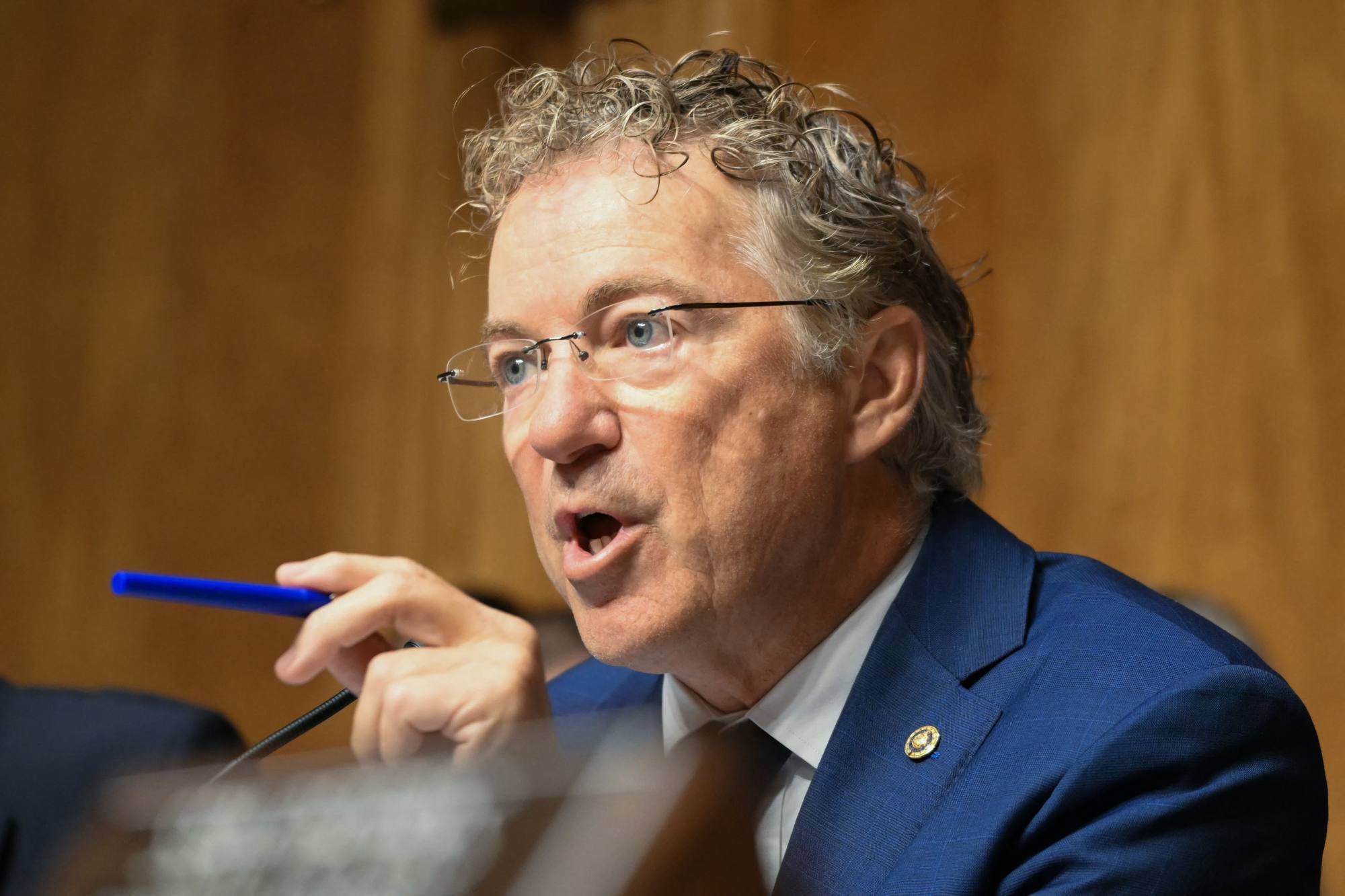
After Fauci’s brief statement, Paul launched into a series of questions.
“Can you explain to the committee why you chose to fund this dangerous research in China?” Paul asked.
Fauci, 85, invoked the Fifth Amendment in response to every question posed by senators.
“On the advice of counsel, I respectfully decline to answer based upon my rights under the Fifth Amendment of the Constitution,” he said.
Fauci’s lawyer, who was trying to make a statement during the hearing, was escorted from the hearing room on Paul’s orders.
The funding cited by Paul was awarded by the National Institutes of Health to EcoHealth Alliance, a US-based non-profit organisation that used part of the money to support research on bat coronaviruses at the Wuhan institute.
Paul and other Republicans have characterised the work as dangerous “gain-of-function” research, a term generally applied to experiments that enhance certain characteristics of a pathogen.
Fauci and the NIH have disputed that description and have denied that the research funded by the agency created the virus responsible for the pandemic.
Paul warned Fauci that there could be repercussions for refusing to answer, arguing that the committee was conducting a legitimate congressional investigation.
Former US president Joe Biden granted Fauci a broad pre-emptive pardon shortly before leaving office in January 2025.
The pardon covered potential federal offences committed between January 1, 2014, and January 20, 2025, arising from Fauci’s government service.
It did not cover any potential offence committed after that date, including alleged false statements made during subsequent testimony. Fauci has not been charged with a crime related to the pandemic.
Partisan divide on Fauci
The hearing exposed a sharp partisan divide. Republicans pressed Fauci over the Wuhan research and his previous statements to Congress, while Democrats accused Paul of using the committee to pursue a personal and politically motivated campaign against the former health official.
Senator Bernie Moreno, an Ohio Republican, grew visibly frustrated as Fauci repeatedly invoked the Fifth Amendment, accusing him of being responsible for wrongdoing.
“I hope that one way or the other, somewhere, sometime, you answer for your crimes,” Moreno said.
Democratic senators came to Fauci’s defence, criticising the hearing as politically motivated and accusing Republicans of using the session to pursue partisan attacks.
“This hearing appears to be a culmination of months of biased and selected efforts by the majority, under the guise of a committee investigation, to basically legitimise a predetermined conclusion that was reached years ago,” said Gary Peters, the ranking member of the committee and a Democrat from Michigan.
The origin of Covid-19 has long been a political flashpoint. Under the Trump administration, the Federal Bureau of Investigation assessed that the coronavirus most likely emerged from a lab incident in Wuhan.
In January 2025, the CIA issued a new assessment supporting the lab-leak hypothesis but with “low confidence”.
Fauci has supported the theory that the virus jumped from an animal to its first human host before spreading person to person. Most scientists in the virology community share this view, according to a survey published in February 2024 by the Global Catastrophic Risk Institute.
At the end of the nearly three-hour hearing, Paul said he would pursue further action in Congress to hold Fauci accountable, and questioned whether any presidential pardon could provide him with complete immunity.
“Today will be the capstone to Anthony Fauci’s 40 years of abuse of power at the [National Institutes of Health],” Paul said.
The Chinese embassy in Washington said in a statement on Wednesday that tracing the origins of Covid-19 is a scientific matter that should be determined by scientists, and that a science-based approach should be upheld.
The embassy cited the conclusions of the World Health Organization-China joint study, which found it was “extremely unlikely” that the pandemic resulted from a laboratory leak following field visits by experts.
“The relevant allegations are sheer smearing and slander,” the embassy’s spokesperson said. “On Covid-19 origins-tracing, we firmly oppose all forms of political manipulation.” -- SOUTH CHINA MORNING POST


