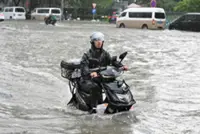
Every year, summer rains cause flooding in China. They also bring high-stakes work for officials.
Once an evacuation order goes out, local governments have long checked on families by calling them on the phone.
Xie Yunshi, an official in the suburbs of the Chinese capital, told Beijing Daily that when waters rose in the past, his department would organise a dozen people to call every single family, sometimes at midnight.
But this year, Xie spent the price of a latte to solve this problem.
He bought 1 billion tokens for a domestic artificial intelligence platform, which cost about 30 yuan (US$4.40), and used it to create a smartphone app.
Grass-roots officials and volunteers can use the app to record whether people are out of danger, eliminating the need for endless phone calls.

A video published by the Beijing government showed Xie, the deputy director of the Miyun District Commission of Planning and Natural Resources, demonstrating that his app displays which locations are at risk from flooding and landslides. The app also offers live weather updates and forecasts.
Users could navigate to any hazard site with a single tap, he said in the video.
Xie told Beijing Daily that he had been interested in computing for decades, even winning first prize at a computing competition in college, but the advent of AI had made building a project far easier.
In Miyun, which is home to a major reservoir, flooding has been a deadly problem. Last year, more than 30 people were killed when a nursing home in the district was inundated.
This month, swathes of China have been battered by typhoons Maysak and Bavi, killing dozens and damaging crops and infrastructure. In southern China’s Guangxi Zhuang autonomous region, there were surreal scenes as hundreds of snakes escaped from local farms.
As extreme weather is expected to become more common due to climate change, local authorities are under greater pressure to cope with more damaging disasters.
Even though there were floods each year, she had never remembered it being this serious, Jin, a woman from Qinzhou, Guangxi, told the South China Morning Post.
Last Monday, after a day of rain, water on the streets reached people’s knees, Jin said. When she looked out her window, everything was muddy yellow. Her house lost power the next day as the rain continued. She spent the whole day panicking, looking around the house for anything that she could use as a makeshift life raft.
After the Liulan reservoir in Guangxi collapsed, the Southern Weekend newspaper reported that staff did not expect such heavy rain and they did not receive immediate orders to discharge water.
“We need to increase our ability to predict floods,” hydrologist Xie Qi told the paper.
“Most medium- and small-sized reservoirs around the country still base their predictions on experience and water level monitoring by staff, which can be too late when there is extreme rain.”
Ma Jun, founder of the Institute of Public and Environmental Affairs, a Beijing-based environmental research organisation, told the SCMP that more focus needed to be placed on the precision of predictions and flooding alerts. He also called for the creation of an integrated system for better communication between different regions and government bureaus.
“For example, if a flood came downstream, but villages downstream belonged to a different district, they may not be informed in time and it could lead to severe results,” he said. -- SOUTH CHINA MORNING POST