BANGKOK: Thailand and China have agreed to establish a high-level “2+2” dialogue involving their foreign and defence ministers, as the two countries move to deepen security cooperation and intensify joint action against transnational scam networks.
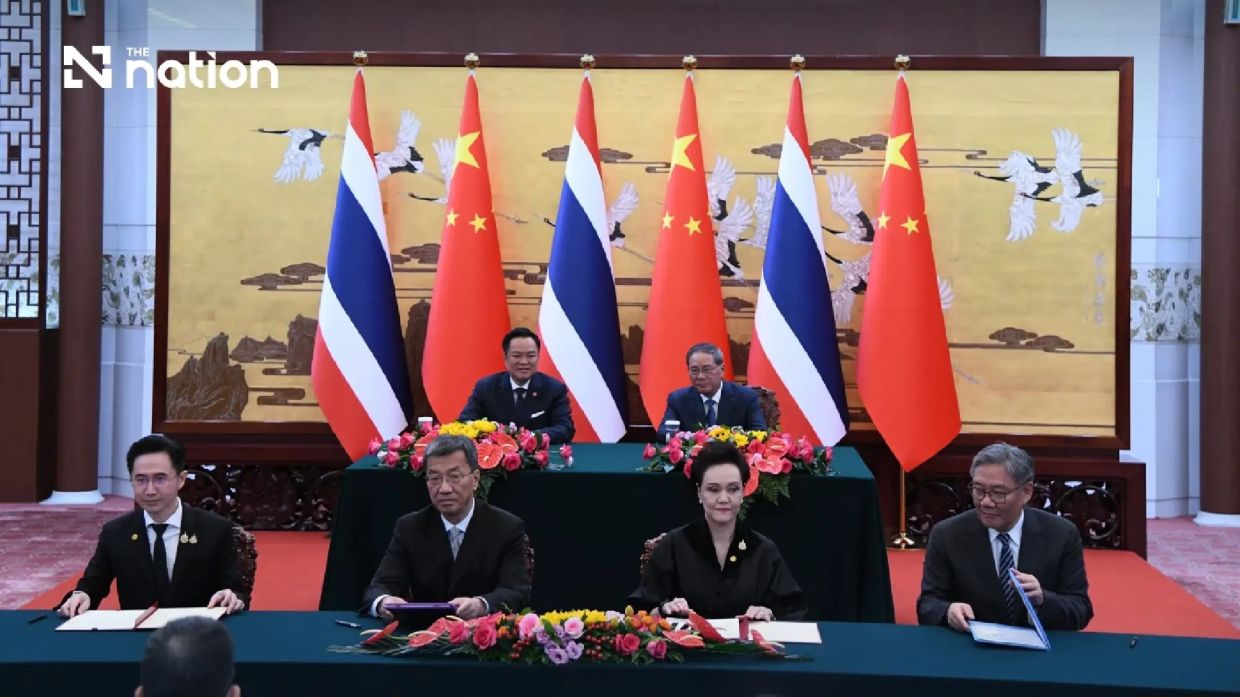
The agreement was highlighted during full-delegation talks between Prime Minister and Interior Minister Anutin Charnvirakul and Chinese Premier Li Qiang at the Great Hall of the People in Beijing on Monday (July 20).
The meeting took place in the East Hall on the final day of Anutin’s official visit to China, which began on July 16 and included engagements in Shanghai, Chengdu and Beijing.
Government spokeswoman Rachada Dhnadirek said the talks were held in a warm atmosphere, with both leaders reaffirming their commitment to strengthening the Thailand–China comprehensive strategic cooperative partnership.
The two sides agreed to advance cooperation in trade, investment, infrastructure, emerging technologies, security and the suppression of transnational crime, while contributing to regional peace, stability and prosperity.
Thailand, China agree on 2+2 security dialogue and stronger anti-scam cooperation
New channel for strategic security talks
The proposed 2+2 mechanism will bring together the two countries’ foreign and defence ministers for high-level strategic discussions on regional security and emerging threats.
Thailand said it was prepared to host the first meeting under the mechanism. Both countries also agreed to expand cooperation in the defence industry, technology transfer and personnel development.
The Thai government had previously highlighted the 2+2 plan following Anutin’s meeting with Chinese President Xi Jinping in Shanghai on July 17, indicating that the mechanism had received support at the highest political level.
During the meeting with Xi, the two sides also backed closer intelligence exchanges and stronger cooperation against online crime and other emerging security threats.
Anutin thanked Li for China’s warm reception and expressed his condolences over losses caused by severe weather in several parts of the country. He voiced confidence in China’s ability to overcome the situation.
Li said Thailand and China had long maintained close and mutually supportive relations founded on trust and respect.
Although the two countries marked the 50th anniversary of diplomatic relations last year, Li noted that links between their peoples stretched back more than 1,000 years and said bilateral relations were now at their closest.
Joint drive against scam networks
Anutin said Thailand attached great importance to dismantling online scam networks, combating financial fraud and suppressing illegal businesses.
He expressed concern about criminal activity along Thailand’s borders with Myanmar, Laos and Cambodia and proposed closer exchanges of intelligence, investigative information and financial transaction data.
The prime minister also called for greater sharing of information about the organisers and beneficial owners of criminal networks, saying this would improve the effectiveness of prevention, investigation and enforcement measures.
According to the Thai government, Thailand has assisted in the return of 7,894 Chinese nationals who fell victim to fraudulent recruitment schemes that took them to neighbouring countries.
Anutin said Thailand hoped China would encourage neighbouring countries to impose stringent measures against all online scam centres operating within their territories.
The security push was supported by a memorandum of understanding between Thailand’s Anti-Money Laundering Office and China’s Ministry of Public Security.
The agreement covers the exchange of financial transaction information to prevent and combat money laundering, terrorist financing and transnational crime.
Trade, investment and greater connectivity
On economic cooperation, Anutin proposed accelerating bilateral work in three priority areas: trade and investment, infrastructure connectivity and industries of the future.
Thailand hopes China will increase imports of competitive Thai products, particularly fresh fruit and high-quality processed food, to provide Chinese consumers with more choices and contribute to the food security of both countries.
Anutin said Thailand welcomed high-quality Chinese investment that strengthened domestic supply chains, increased the use of Thai materials and local businesses, and supported the transfer of knowledge and technology.
He added that foreign investors should operate in accordance with Thai laws and standards to ensure that investment created sustainable benefits for both sides.
On infrastructure, Anutin reaffirmed Thailand’s commitment to completing the first phase of the Thailand–China high-speed railway by 2030 and advancing the second phase on the basis of mutual benefit.
Thailand is also discussing the development of a second Thai–Lao Friendship Bridge with Laos and hopes China will support the project.
Anutin additionally proposed advancing the Chiang Khong–Na Teuy–Mohan railway route as another important transport network linking Thailand, Laos and China.
Thailand, China agree on 2+2 security dialogue and stronger anti-scam cooperation
AI, space and future industries
The two sides agreed on the importance of expanding cooperation in science, technology and innovation, particularly the digital economy and industries expected to drive future growth.
Anutin identified artificial intelligence, health technology, space technology, nuclear energy and quantum technology as potential areas for deeper collaboration.
Such cooperation could create new economic opportunities, improve technological capabilities and strengthen the competitiveness of both countries, he said.
Several of the agreements signed after the talks reflected this focus, including cooperation on nuclear fusion, the application of China’s BeiDou Navigation Satellite System, AI education and the establishment of a joint Thailand–China laboratory for deep-space exploration.
China had described Anutin’s trip as his first official visit to the country since taking office and said it hoped the visit would produce new results in comprehensive strategic cooperation and contribute to regional development and stability.
Anutin seeks support for Thai–Cambodian dialogue
The Thailand–Cambodia border situation was also discussed, with Anutin thanking China for supporting efforts to resolve the dispute through bilateral negotiations.
He said Thailand wanted to open a new chapter in its relationship with Cambodia by using bilateral mechanisms founded on sincerity and good faith.
Anutin stressed that the border issue should not undermine constructive cooperation under the Mekong–Lancang Cooperation framework.
However, he acknowledged that the situation remained fragile and said rebuilding trust between Thailand and Cambodia was essential.
The prime minister expressed hope that China would play a constructive role in encouraging all parties to return to bilateral dialogue. The Thai government had also raised the issue during Anutin’s earlier meeting with Xi, saying China supported the use of bilateral mechanisms to preserve regional peace and stability.
High-level visits and APEC cooperation
Anutin described last year’s state visit to China by Their Majesties the King and Queen as an important milestone in bilateral relations.
He said Thailand looked forward to an official visit by Xi and renewed an invitation for Li to visit Thailand. Such a trip would be the first visit to the kingdom by a Chinese premier in seven years.
Thailand also supports China’s hosting of APEC in 2026, with Anutin confirming that he would attend the APEC Economic Leaders’ Meeting in Shenzhen in November.
Shenzhen is scheduled to host the APEC Economic Leaders’ Week in November 2026.
Fifteen agreements signed
Following the talks, Anutin and Li witnessed the signing of 15 agreements and memoranda of understanding between Thai and Chinese government agencies.
The agreements covered the exchange of financial information against money laundering and transnational crime; public health; sanitary requirements for Thai aquatic exports; rural water management, hydropower and irrigation; nuclear fusion; and the application of the BeiDou satellite navigation system.
Other agreements addressed higher education, a joint deep-space exploration laboratory, collaborative scientific research, industrial and supply-chain cooperation, intellectual property enforcement and AI education.
Three additional memoranda covered media cooperation between Thailand’s Public Relations Department and Xinhua News Agency, People’s Daily and China Media Group.
Li later hosted a luncheon in honour of Anutin and his wife. - The Nation/ANN