A decade after Beijing rejected a ruling on its South China Sea claims by an arbitral tribunal in The Hague formed under the United Nations Convention on the Law of the Sea, rival nations continue to manoeuvre for control. In the second of our series on the anniversary, Alyssa Chen explores how deepening maritime cooperation between the Philippines and Vietnam could affect China’s regional strategy.
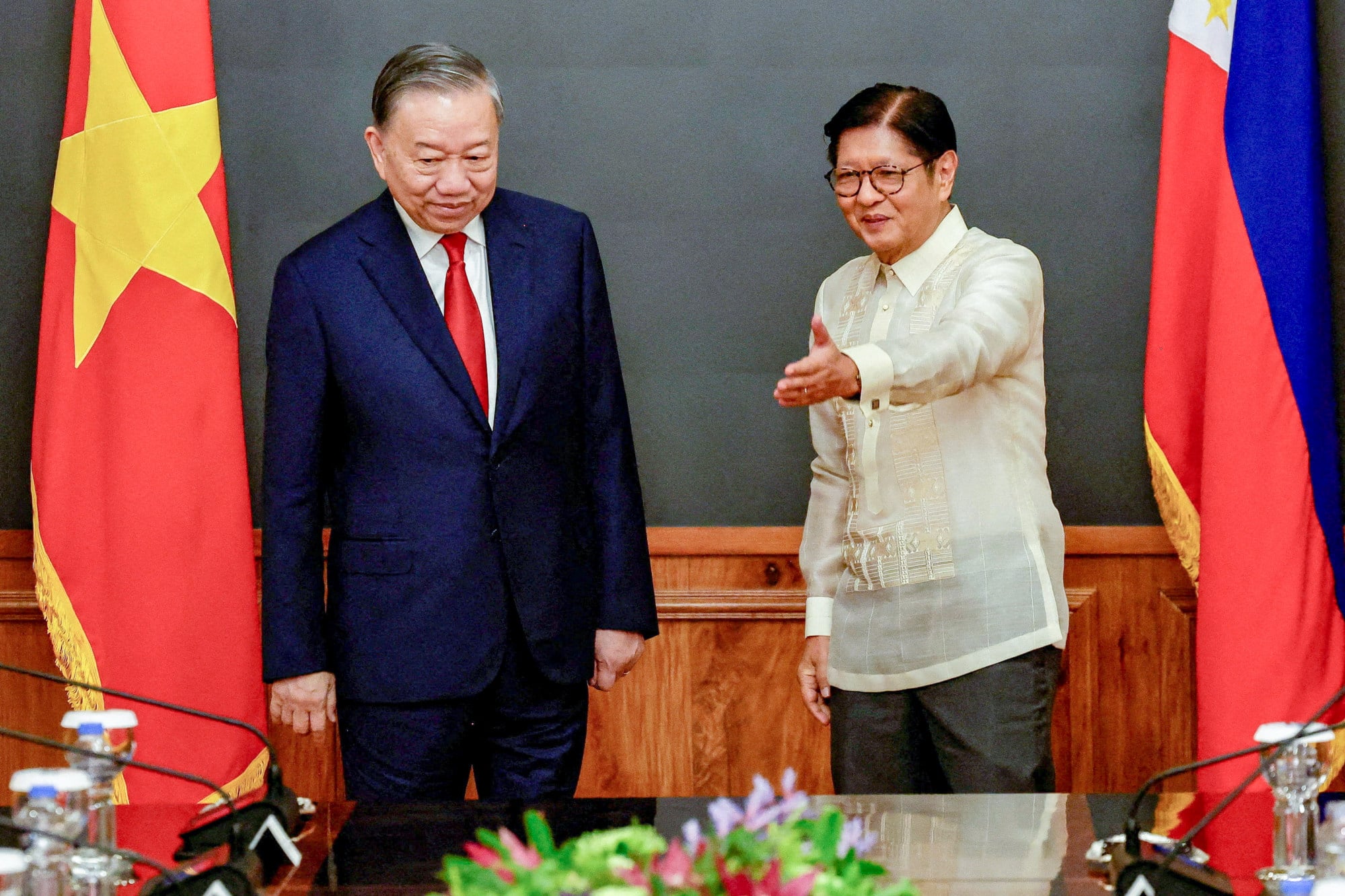
With Vietnamese President To Lam by his side in Manila late last month, Philippine President Ferdinand Marcos Jnr sent a clear message of intent.
“Maintaining peace, stability and the freedom of navigation and overflight in the South China Sea remains non-negotiable,” Marcos said.
The two countries “remain resolute in their commitment to the peaceful resolution of disputes”, he said, adding that this approach would be grounded in international law.
The commitment emerged during Lam’s state visit to the Philippines, a trip that the two countries used to elevate their strategic partnership to an “enhanced” level.
As part of that upgrade, Manila and Hanoi also agreed to implement a hotline and improve coordination between their coastguards to prevent accidental clashes in disputed waters.
The move came at a symbolically important time – just weeks before the 10th anniversary of the arbitral tribunal ruling that dismissed China’s expansive claims to most South China Sea features.
Manila had lodged the case with the tribunal but Beijing did not take part in the arbitration.
A decade later and China continues to reject the ruling but now, with last month’s state visit, two of its rival claimants in the South China Sea – the Philippines and Vietnam – are forging stronger ties.
For China, the alignment is concerning as it undermines Beijing’s South China Sea playbook of engaging each of its smaller challengers one by one. But analysts said the two nations’ divergent strategies meant the partnership’s symbolic value was bigger than its operational punch, at least for now.
The partnership could chip away at Beijing’s negotiating advantages, observers say, but Hanoi and Manila have fundamentally different approaches to managing long-standing maritime disputes.
“Beijing has generally preferred a bilateral approach to negotiations in the South China Sea, as this allows it to engage claimants individually and tailor arrangements to specific disputes,” said Ian Seow Cheng Wei, senior analyst at the China programme at Singapore’s S. Rajaratnam School of International Studies.
“As Vietnam and the Philippines deepen cooperation and expand information sharing, it may become more difficult for China to engage each country in isolation.”
While Beijing maintains a regular maritime dialogue mechanism with Manila, the countries’ vessels have still repeatedly clashed in the region.
In contrast, Vietnam has managed to contain its territorial disputes with China to diplomacy, with Beijing and Hanoi holding their first ministerial meeting of the “3+3” strategic dialogue on diplomacy, defence and public security in March.
While pursuing what observers describe as “struggling while cooperating” with China, Vietnam maintains “four noes”: no military alliances, no siding with one country against another, no foreign military bases and no use or threat of force.
However, Vietnam has also quietly expanded its construction efforts in the South China Sea, reclaiming an area of 11.2 sq km (4.32 square miles) in the Spratly Islands, according to the Washington-based Asia Maritime Transparency Initiative.
Seow said Hanoi viewed Beijing through a dual lens: an object of struggle in maritime disputes and an important partner in areas such as economic development and regime security,
Meanwhile, the Philippines under Marcos pursues “assertive transparency” – publicising Chinese grey-zone tactics to block Philippine access to the waterway to escalate reputational costs.
These differences are likely to shape the types of cooperation that are politically acceptable to both sides, according to Seow.
The countries’ coastguard cooperation would likely focus on “practical confidence-building measures and non-traditional security issues” rather than deeper interoperability or joint enforcement activities, Seow added.
He said the cooperation was still nascent – joint exercises involving the pair’s coastguards only began in 2024 – and developing interoperability, common procedures and institutional familiarity took time.
Joshua Espena, an international relations lecturer at Polytechnic University of the Philippines, said the practical challenges to the maritime partnership included disparate command structures, bureaucratic lines of command accountability and logistical priorities.
“Their political will, based on trust and patience, can serve as a formula to incrementally overcome differences,” Espena said.
“This is why continuous engagements at the strategic level, as well as education and training at the operational and tactical levels, are keys to making this happen.”
He added that such arrangements required time to develop, and both countries needed to first “stress test” these mechanisms.
There was still a long way to go before the countries’ coastguards could directly challenge China’s activities in the South China Sea, said Hanh Nguyen, a research fellow at the Yokosuka Council on Asia Pacific Studies.
Nevertheless, the symbolic value of their deepening cooperation should not be dismissed.
While Manila has been the most confrontational in its dispute with China, Hanoi has been quietly but steadily expanding its presence in the region.
According to Espena, Vietnam and the Philippines are the only countries within the Association of Southeast Asian Nations (Asean) to show “more visible resistance to Chinese harassment” at sea.
“The unilateral diplomatic preferences are already a given, but the strategic convergence is not,” he said, noting that this strategic pivot was being driven by both domestic capacity-building needs and “constant uncertainty posed by major power competition”.
Whether this model will spread to other South China Sea claimants remains uncertain.
Nguyen said overlapping maritime claims had prevented members of Asean from forming a consensus against China’s expanding maritime power.
But the hotline and maritime incident management mechanisms were positive steps towards reducing misunderstandings and defusing tensions, she added.
Luo Liang, deputy director of the Centre for Area Studies at National Institute for South China Sea Studies, said that building a broader coalition would be an uphill battle.
“Even as Vietnam and the Philippines scrambled to face a common challenge from China, they remain tangled in their own disputes,” Luo said.
For example, in May last year, Vietnam protested against separate incidents in which the flags of China and the Philippines were raised on Sandy Cay, a group of small sandbanks in the Spratly Islands that are claimed by all three countries.
The two countries also have overlapping extended continental shelf claims – the portion of the seabed and subsoil that extends beyond a country’s 200-nautical-mile exclusive economic zone.
Luo added that it could be hard to persuade countries which were prioritising economic ties with China to join any maritime bloc.
Bao Yinan, an associate research fellow at the Huayang Centre for Maritime Cooperation and Ocean Governance in southern China’s Hainan province, said the upgraded partnership between Manila and Hanoi was not a true military alliance as it lacked any mutual defence obligations or unified military command structure.
“Manila’s real geopolitical muscle still depends on external powers such as the United States and Japan.”
That partnership was on display in April and May when the US and the Philippines held their annual Balikatan joint military exercises, which included a record number of countries including Japan, Australia, New Zealand and Canada.
The Philippines is also negotiating with Tokyo about acquiring five Abukuma-class destroyer escorts when they are decommissioned from Japanese service. Japan’s Type 88 surface-to-ship cruise missile was used in this year’s Balikatan exercises for the first time. In addition, Australia provided surveillance drones to the Philippines in April.
“The best strategy for Beijing right now is to wait and see how the partnership plays out,” Bao said, as some details of the Hanoi-Manila deal were not yet public.
But on the water, the situation remained heavily stacked in China’s favour, Bao added, as its coastguard boasted a fleet that was “substantially larger and better equipped” than the combined forces of Vietnam and the Philippines.
Luo cautioned against reading the new maritime cooperation agreements as an immediate game-changer.
“The real turning point will be when Vietnam and the Philippines begin launching joint naval patrols in disputed waters, sharing sensitive intelligence or actively banding together to block Chinese law enforcement on the front lines.” -- SOUTH CHINA MORNING POST