



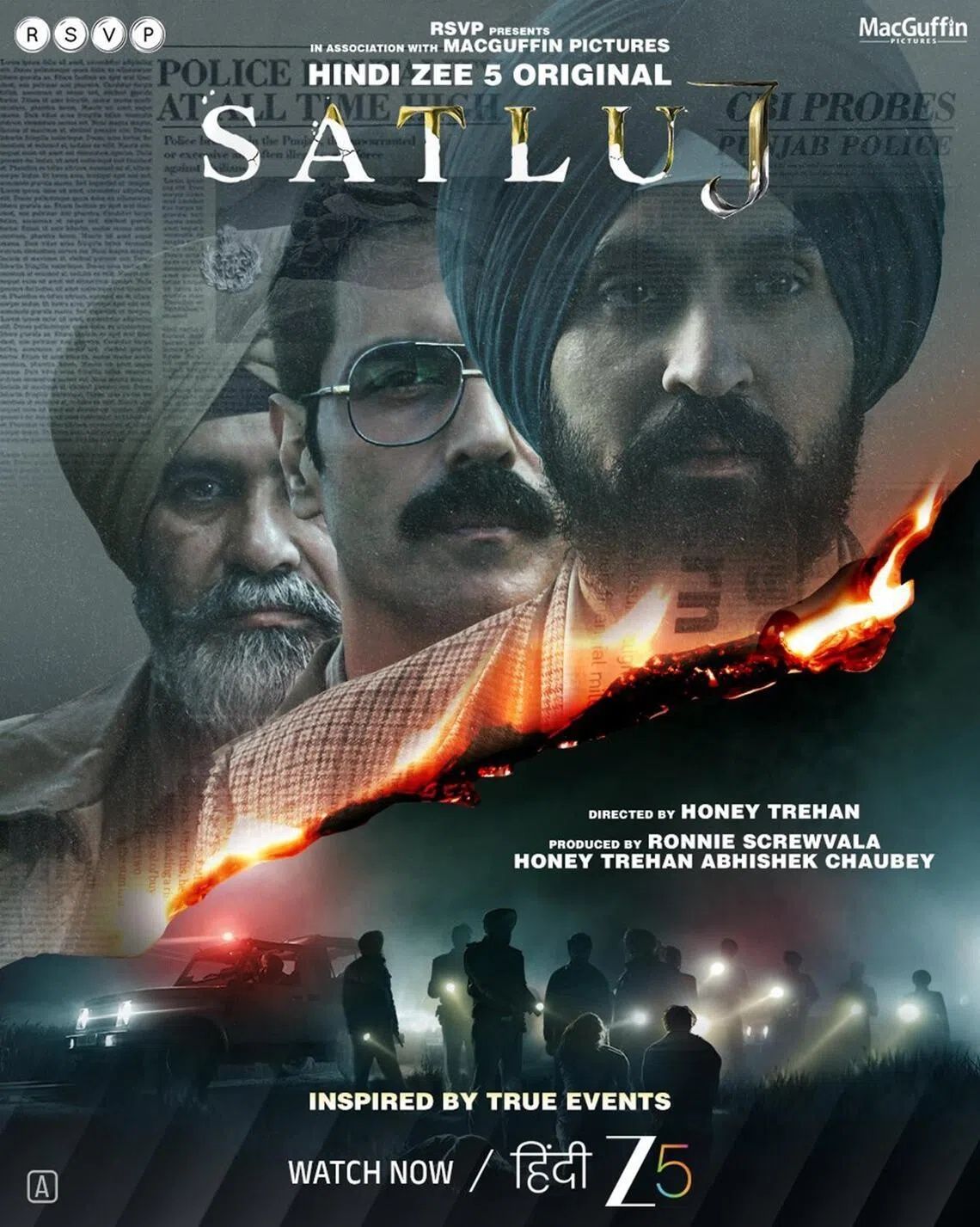
NEW DELHI (The Straits Times/ANN): The release was low-key, almost furtive even. There were no noticeable publicity campaigns or promotional tours featuring the film’s stars. That’s how Satluj, a movie caught in the government censorship net since 2022, made its quiet debut on Zee5, an Indian streaming platform, on July 3.
Films in India do not need clearance from the Central Board of Film Certification (CBFC) to show online – unlike in theatres – and the movie, originally named Ghallughara, a Punjabi term that refers to historical massacres of Sikhs, began wooing audiences quickly.
The screening did not last long though. Just 48 hours after its release, the film, which deals with Punjab’s bloody insurgency from the 1980s and 1990s, was pulled down mysteriously on July 5. Some viewers were reportedly even left hanging midway through the nearly-three-hour-long film.
There was no explanation, just a cryptic statement from Zee that read: “In light of the current developments, Satluj will be unavailable in India until further notice.” It emerged later that the government had ordered the takedown using the country’s Information Technology Act that enables the authorities to block online content.
In this case, the content revives one of India’s darkest chapters – the violent armed separatist campaign in Punjab for an independent Sikh homeland, or Khalistan, that lasted more than a decade.
Thousands of militants and security personnel were killed during this period, one that saw even more innocent civilians being killed by both warring sides. It is this turbulent phase that forms the backdrop for Satluj, the film directed by Honey Trehan and starring Indian-born American singer and actor Diljit Dosanjh.
The film depicts the life of human rights activist Jaswant Singh Khalra, who campaigned bravely in the late 1980s and the first half of the 1990s to expose thousands of extrajudicial killings by the police in Punjab. These efforts led to his kidnapping, torture and eventual murder by some members of the police force in 1995.
Khalra’s body was thrown into a canal and was never recovered; many say Punjab has yet to find closure as well.
In 2005, six Punjab police officials were convicted for his abduction and murder, including two who were sentenced to life imprisonment. One of them, Jaspal Singh, went missing in 2023 after being released on bail.
Old wounds
The film’s ban has not just reopened old wounds, prompting introspection on how India should deal with an uncomfortable chapter in its history, but also raised questions about how far film censorship can go without throttling free speech.
A government panel that reviewed Satluj since its sudden takedown has now reportedly recommended that the movie remain blocked from public access, noting the film’s “one-sidedness aligns with the structure of pro-Khalistan propaganda” and flagging “the risk of (its) hostile exploitation”.
Following this recommendation, the film was even removed from Zee’s international streaming platform on July 11, the latest blow for Satluj in its long battle with government censors.
Back in September 2023, the film was scheduled to premiere at the Toronto International Film Festival but was pulled out by the filmmakers given the censorship quandary it was stuck in.
Rumours alleging political pressure had circulated back then. That year, ties between India and Canada had hit an all-time low with an escalating row over the murder of Hardeep Singh Nijjar, a Sikh separatist leader in British Columbia. Canada had claimed there were “credible allegations” about the potential involvement of Indian government agents in his murder, sparking rage as well as concern among the Sikh diaspora.
However, in July 2026, Lisa Moreland, a senior Canadian police official, said the authorities had found no evidence linking Indian officials to the killing of Nijjar under Operation Hard Ball, a recent cross-border crackdown on organised crime launched by United States and Canada. Dozens of people linked to three prominent gangs have been criminally charged with multiple crimes, including Nijjar’s shooting.
India’s censors not only forced the production team to change the film’s name from Ghallughara to the less controversial Punjab ‘95 – a reference to the year Khalra disappeared – but also reportedly demanded more than 120 cuts, including scenes depicting police violence. Trehan, the director, opposed these cuts saying they would fundamentally alter the film.
While he did not respond to questions from The Straits Times, Trehan told Mint, an Indian newspaper, in 2025 that he was “not interested in making a government film”. “The film with 120 cuts is directed by the government and edited by CBFC,” the director added.
The film, eventually renamed Satluj to reportedly bypass dogged censorship, was released online on July 3 without any cuts.
‘An inconvenient truth’
Ms Namrata Joshi, a senior film critic, told ST that Satluj revives “an inconvenient truth” for the Indian government and noted it has become one of the rare Indian films in recent history to have been kept away from the public “for so long and with such sternness”.
“Somehow it has ended up becoming the biggest punching bag for our censors,” she said.
This intense government security comes despite the fact that it speaks of atrocities committed during a period when the opposition Congress was mostly in power both in the state of Punjab and in the centre in New Delhi.
Analysts say the Bharatiya Janata Party-led government’s perseverance to ensure the film does not reach public audiences reflects its growing concerns about a potential resurgence of the separatist Khalistani movement in Punjab.
Mr Satinder Bains, a senior journalist who was based in Amritsar in the 1990s and now lives in Toronto, noted there has been growing outrage in Punjab in recent years with more and more Sikhs ascribing to the view that justice still eludes them.
“The government fears that this film could fan this sentiment further,” he told ST. “There are only a handful of people in Punjab who today support the Khalistani cause but if this sentiment spreads wider, it could grow into a separatist movement.”
The Khalistani issue, which has strong support from sections of the Sikh diaspora, has bedeviled India’s bilateral ties with several nations in recent years, including Australia and New Zealand, two countries prime minister Narendra Modi visited from July 8 to 11. In Auckland, Modi was even jeered at by a small group of Khalistan supporters.
Bains is widely credited for bringing to light the precise details of Khalra’s murder in 1996 with a report for The Indian Express newspaper that quoted from a hitherto secret testimony from one of the junior police officers who was part of the team that kidnapped, tortured and later killed Khalra.
He noted that another reason for the government’s unease with the film is that it indirectly draws attention to alleged human rights violations perpetrated by the state in India even today.
“The film has refreshed peoples’ memories,” Bains said. “Many are naturally comparing it with how fake encounter killings (another term for extrajudicial killings) continue even today, which is why the film, in a way, exposes the state. That’s why it doesn’t want the film to be released.”
One of the controversies surrounding Satluj is its claim of over 25,000 people being killed by the police or missing, a number that some say is an overstatement. The film is even accused of ignoring Khalra’s purported sympathies for Sikh separatists and the Khalistani cause, a charge his defenders have denied.
At one point in the film, Khalra, played by Dosanjh in the film, declares he is “not anti-police or anti-government, but (against) those selfish individuals who, for their own promotions, have crossed the limits of humanity”.
The film also comes with a long disclaimer right at the start, including the caveat that is it “not to be construed as (an) accurate representation of historical facts” or seen as a film that glorifies any violence or illegal activity.
Satluj’s critics have also said the film fails to portray atrocities perpetrated by Khalistani terrorists, but film critic Joshi says this is a “specious” argument. “If militants were killing, that doesn’t justify what the state did to the people. This film is about one man’s mission to find justice for the innocents being killed. What all details of the insurgency are you going to put in there?” she noted.
“Will you similarly criticise The Voice of Hind Rajab for not showing Hamas’ killings in Israel on Oct 7, 2023?” added Joshi, referring to the award-winning docudrama that portrays the Red Crescent’s unsuccessful attempts to save Hind Rajab, a five-year-old Palestinian girl, from Israeli attacks in the Gaza Strip.
Public screenings
The ban, ironically, has also boosted Satluj’s profile and reach. Since it was removed from Zee’s streaming platform in India, various Sikh community organisations and local activists have been organising public screenings across Punjab using downloaded copies that have circulated online.
Gurudwaras, or Sikh places of worship, and village community halls have been rebelliously transformed into temporary theatres with audiences comprising the young as well as the old, including elderly survivors from the days of the insurgency.
“When we screen the film, we see our elders and mothers, many of them 60 or 70 years old, crying because they have lost their sons,” Inderjeet Singh Bains, who helps coordinate screenings in Gurdaspur district, told Associated Press. “Our people have endured immense suffering.”
And with state elections expected to be held in Punjab in February 2027, opposition parties too have put their weight behind the film. In a post on X, Sukhbir Singh Badal, a former deputy chief minister of Punjab and leader of the key regional opposition party Shiromani Akali Dal, said he had directed his party workers to screen the film “in every nook and corner of every village, town and city of Punjab”.
Khalra continues to be an inspiring figure for many in the global Sikh community with schools and parks named after him in the United States and Canada. His wife Paramjit Kaur Khalra, now in her early 70s and still based in Punjab, continues to defend human rights.
Bains, the senior journalist, said the government should not have banned the film, adding that the government can become “overly sensitive” about such issues at times. “What happened is part of our history and people should learn from it,” he added. -- The Straits Times/Asia News Network

