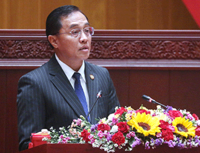
VIENTIANE: The 10th National Assembly opened its first extraordinary session on Monday (July 6)with lawmakers set to adopt a National Agenda on Rural Development and Poverty Reduction, designating it as the government’s top development priority.
The opening session was chaired by the President of the National Assembly, Dr Xaysomphone Phomvihane, while the Secretary General of the Lao People’s Revolutionary Party Central Committee and President of Laos, Thongloun Sisoulith, attended as a guest of honour.
The five-day session, running from July 6-10, brings together senior Party and State leaders, Cabinet members and National Assembly members to discuss economic policies, review progress in the first half of 2026, and consider finance-related legislation.
Xaysomphone said the convening of the Extraordinary Session reflected the Party and government’s determination to turn the resolutions of the 12th Party Congress into practical action and accelerate national development.
He said the Party and State continue to place economic development at the centre of national policy to improve people’s livelihoods and support Laos’ graduation from Least Developed Country status this year.
With the country looking beyond that milestone, he said the government is working towards its long-term goal of becoming a middle- to high-income country by 2055.
“The Party and State have always placed economic growth at the heart of the development drive, considering it essential to continuously raising people’s standard of living so that Laos can graduate from Least Developed Country status in 2026,” he said.
“On this basis, continuing efforts to address economic and financial hardship carried out from 2021-2025, the Party and government have therefore proposed the adoption of the National Agenda on Rural Development and Poverty Reduction, which is the primary objective of this 1st Extraordinary Session,” he added.
National Assembly members will consider four major items during the session.
These include reports on the first six months of progress under the National Socio-Economic Development Plan, the State Budget Plan and the Monetary Plan, approval of the National Agenda on Rural Development and Poverty Reduction, and consideration of the new State Treasury Law and amendments to the State Budget Law.
Dr Xaysomphone urged National Assembly members to carefully examine the proposals before them and to work together to reach consensus on measures that will benefit the nation.
Presenting the government’s six-month report, Prime Minister Sonexay Siphandone said Laos maintained economic growth despite continuing global uncertainty, geopolitical tensions, and natural disasters.
“First, I strongly concur with the remarks of the President of the National Assembly assessing the regional and international situation as continuing to be tense, complex, and protracted, particularly trade conflicts, instability in the Middle East, and fuel shortages,” the Prime Minister said.
“In addition, rapid development in the application of modern technology, especially AI, and ongoing natural disasters that have significantly affected the global economy, have created many challenges for the implementation of the National Socio-Economic Development Plan in the first half of 2026,” he added.
Despite these challenges, the Prime Minister said decisive measures taken by the Party, government and provincial authorities had enabled continued economic growth.
According to the report, Gross Domestic Product grew by 5 per cent in the first six months of 2026, with the economy valued at 199,987 billion kip, equal to 48 per cent of the target for the whole of 2026 as approved by the National Assembly.
State revenue reached 44,956 billion kip, or 54 per cent of the 12-month target figure, marking a 19 per cent increase compared to the same period last year.
The value of foreign trade exceeded US$10.1 billion, generating a trade surplus of US$1.159 billion despite lower exports of solar panels, gold ore, and paper products.
The government also reported progress in tackling major social problems. During the first half of the year, authorities prosecuted 1,786 drug-related offenders, arrested 4,025 suspects, and admitted 7,046 drug users to rehabilitation centres.
Law enforcement agencies dismantled 44 online scam operations and detained 4,482 suspects from 25 countries.
To address fuel shortages and rising prices, the government reduced fuel consumption tax, increased foreign currency allocations for fuel imports, and continued to promote the use of electric vehicles.
Despite positive economic results, the Prime Minister acknowledged that inflation remains a major concern, with the price of goods rising by an average of 8 per cent in the first half of the year, above the National Assembly’s target of 5 per cent, while the kip depreciated by 3.09 per cent.
For the remainder of the year, the government aims to increase the economic growth rate to 5.5 per cent, raise average annual per capita income to US$2,238, expand agricultural production, boost electricity generation and mineral exports, attract 4.46 million international visitors, and roll out measures to stabilise prices and the value of the kip.
The Prime Minister also proposed that the National Assembly approve 2,500 new civil service positions for 2026 to strengthen public administration across key sectors. - Vientiane Times/ANN