JAKARTA: President Prabowo Subianto has credited the military and police for helping advance Indonesia’s food self-sufficiency drive. But critics say relying on the forces instead of farmers may undermine food sufficiency goals as well as civilian autonomy.
Speaking during farmers and fishers week in Gorontalo last week, Prabowo touted the military and police's contribution to agriculture, which he said was unique to Indonesia.
“Only in Indonesia do the police take care of agriculture. Only maybe in Indonesia are soldiers often seen working in rice fields. Only in Indonesia does the Navy plant soybeans. Only in Indonesia does the Air Force grow sugarcane,” said Prabowo, who is also a retired military general and former defence minister.
He called the deployment a strategy to strengthen national food security.
“This is why Indonesia will rise to become a great nation,” he went on to say. But as concerns grew over militarisation of civilian affairs into 20 months of Prabowo’s administration, the remarks did not sit right with the Agrarian Reform Consortium (KPA), an organisation advocating for formers' rights.
“It’s an anomaly when an agrarian nation like Indonesia takes pride in soldiers farming or opening new rice fields. Those should be led by empowered farmers, fishers and other food producers,” KPA secretary-general Dewi Kartika told The Jakarta Post on Saturday (June 27).
Agricultural development that relies on the military and police would only “make food self-sufficiency impossible to achieve”, she said, adding that it was ineffective and had instead fuelled problems including more agrarian conflicts.
In 2025, the first full year of Prabowo’s administration, the KPA recorded 24 of 341 agrarian conflicts allegedly caused by military involvement in government’s development projects, particularly in food production. The figure was up threefold from 2024.
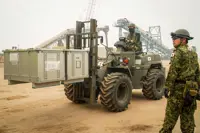
Last year, Prabowo ordered the Army to help convert unused land into rice fields. The Defence Ministry has also been establishing hundreds of territorial development battalions, tasked with food security programmes and infrastructure projects.
The National Police has likewise established a food security task force, which last year launched a corn production programme to increase supply for livestock feed.
Under Indonesian laws, the TNI's primary role is national defence and the police are mandated to maintain public order and enforce the law. Military observer Jaleswari Pramodhawardani from LAB 45 research institute said a mature democracy would not send soldiers and police officers to crop fields because it would have trained capable civilian agricultural workers and agronomists to do the job.
“Whether Indonesia has failed to build those civilian institutions or has chosen not to rely on them, that is the real meaning behind the President’s statement,” she said on Saturday, warning that normalising the role of security forces in agriculture would “narrow space for civilian autonomy”.
Rukminto of the Institute for Security and Strategic Studies (ISESS) said the police taking part in agricultural programmes was an expansion beyond its mandate.
“It can be seen as a shift away from the police reform agenda, from civilian policing toward becoming an instrument of development,” he said, warning that it risks diverting their focus from law enforcement and public order.
TNI spokesperson Brig Gen Muhammad Nas stressed that the military is in a supporting role in agriculture, saying the job falls under its mandate to conduct noncombat operations.
“The TNI does not take over the role of farmers or any institutions. Instead, it provides support to ensure government programmes are implemented effectively, while farmers remain the main actors in achieving food self-sufficiency,” he said on Saturday.
National Police spokesperson Brig Gen Trunoyudo Wisnu Andiko similarly said the police's role in agriculture was an “embodiment of its role as a state institution” by serving as the bridge between farmers, the government and business partners.
He added it was also part of the police's task to maintain public security and order: “When people's basic food needs are met and farmers' welfare improves, the potential for social conflict and crime will naturally decline.”
Agriculture Ministry spokesperson Arief Cahyono was not immediately available for comment. - The Jakarta Post/ANN