Taiwan’s recent launch of Himars rockets westwards towards the Taiwan Strait highlights how the island’s defensive strategy is shifting to the use of mobile strike weapons to disrupt a mainland Chinese attack before it reaches shore.
The exercise on June 10 was the first time the High Mobility Artillery Rocket System had been launched in the direction of mainland China. Beijing has yet to respond to the launches.
Analysts said the significance of the drill lay in what it revealed about how Taiwan plans to employ one of its most important new weapons in a cross-strait conflict.
Beijing sees Taiwan as part of China and has never renounced the use of force to reunite it with the mainland.
Most countries, including its main international partner the United States, do not recognise Taiwan as an independent state, but Washington is opposed to any attempt to take the island by force and is committed to supplying it with weapons.
During the drill, the launchers were deployed on both sides of the Dajia River estuary near Taichung on the island’s west coast.
The simulated exercise involved enemy forces advancing into northern Taiwan, with the launchers deployed in central Taiwan to provide rapid reinforcement and carry out precision strikes.
Military officials said later that four of the 36 rockets used in the exercise failed to launch.
The Taiwanese military said the drill demonstrated the launcher’s ability to move into position, fire rockets and quickly relocate before enemy forces could respond.
This “shoot-and-scoot” tactic has become a defining feature of how the Himars system is used.
The exercise reflected Taiwan’s broader shift towards an asymmetric defence strategy centred on mobility, survivability and precision firepower rather than attempting to match the People’s Liberation Army weapon for weapon, analysts said.
Lu De-yun, a former press secretary at Taiwan’s defence ministry, said a truck-mounted Himars launcher could stop, fix on a target and fire a full pod of six missiles in under three minutes before departing the launch site in less than 60 seconds.
“These characteristics provide significant tactical advantages that have been fully demonstrated on the battlefield in Ukraine,” Lu said.
Taiwan’s western coastline, which lies opposite the mainland, is widely seen as the most likely location for a future PLA amphibious landing operation.
Military planners have identified beaches and port facilities in central and northern Taiwan, particularly around Taichung, as potential objectives because they are best suited for landing heavy equipment and expanding a beachhead.
The exercise also featured locally developed Thunderbolt-2000 multiple-launch rocket systems, drones and conventional artillery – a sign, analysts said, that Himars would be used alongside these weapons to create a layered system targeting a seaborne attack.
“The military wants to build a denial capability integrating long, medium and short-range firepower,” said Lin Ying-yu, a strategic studies professor at Tamkang University in New Taipei City.
“Whether Himars is used as an early trump card or reserved as a final strategic asset, it provides the ability to strike rapidly once the PLA begins concentrating forces or preparing an attack.”
The system also extends Taiwan’s ability to carry out strikes beyond the immediate battlefield, according to analysts.
Deployed from central Taiwan, Himars units could support operations across much of the island without moving across distances that could expose them to enemy surveillance and attack.
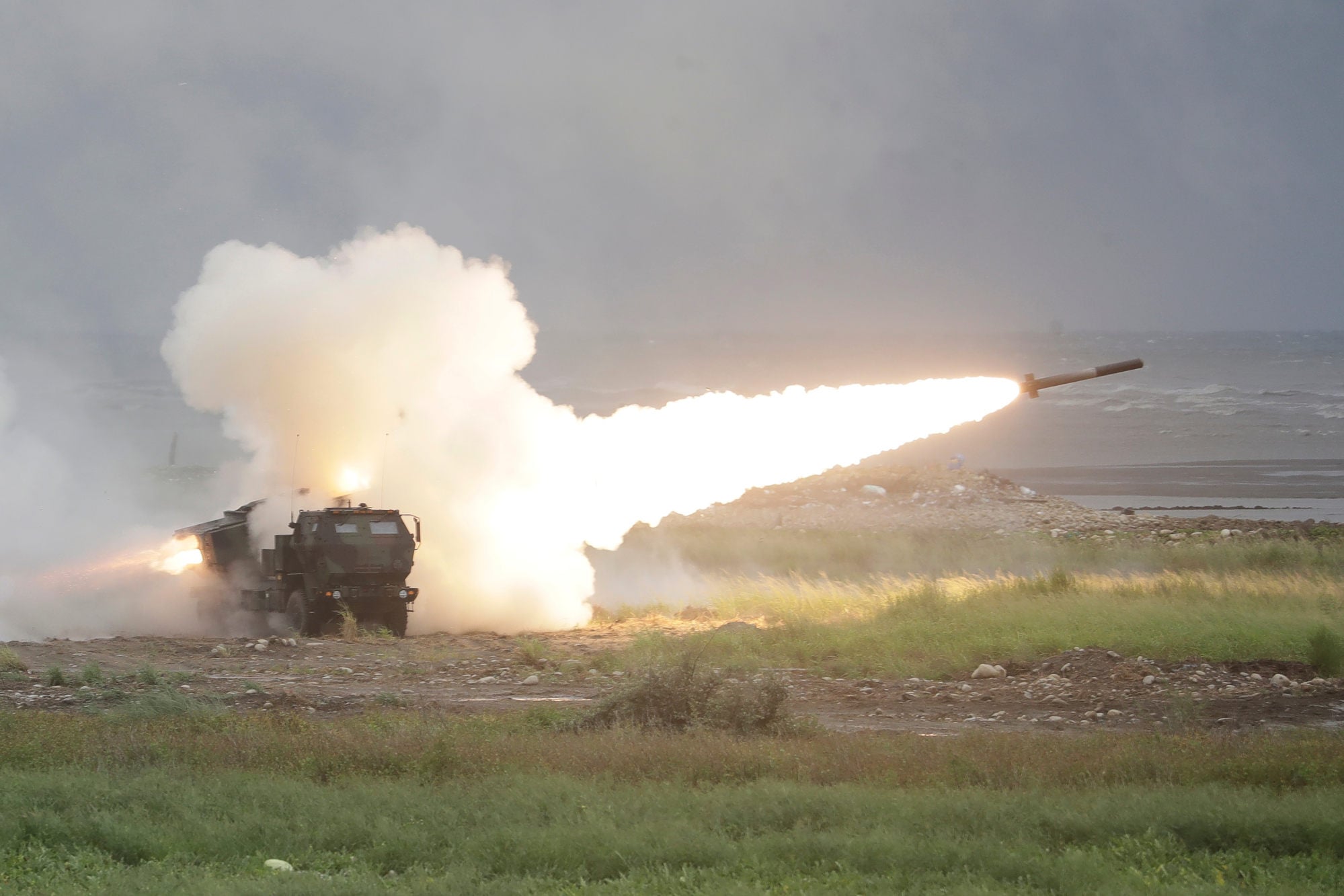
The launchers can fire either Guided Multiple Launch Rocket System (GMLRS) missiles, which have a range of over 70km (around 45 miles), or the Army Tactical Missile System (ATACMS), which can strike targets up to 300km away.
“The system could target forces crossing the Taiwan Strait, amphibious units attempting to establish beachheads and follow-on reinforcements,” Lu said.
Armed with ATACMS missiles, it could also strike ports, airfields, logistics hubs and missile units on the mainland, he added.
The system, which Taiwan has previously launched away from the mainland, appears to have drawn Beijing’s attention.
In December, state broadcaster CCTV aired footage of a PLA exercise carried out around Taiwan that included a simulated long-range attack on Himars launchers.
Mainland coastguards have also released imagery depicting one of their vessels intercepting a Himars shipment bound for Taiwan.
Su Tzu-yun, a senior analyst at the government-funded Institute for National Defence and Security Research in Taipei, said this unusual focus suggested how significant Beijing thought Himars was.
“Himars is a precision weapon suited for deep counterstrikes,” Su said. “It can be deployed against a PLA amphibious landing operation to strike lines of communication behind the front lines, potentially causing the operation to fail.”
Su said Beijing was probably concerned about Washington’s approval in December of a US$11.1 billion arms package that included 82 additional Himars launchers and 420 ATACMS missiles.
The deal would expand Taiwan’s Himars fleet to 111 launchers and increase its ATACMS inventory more than fivefold. Taiwan currently operates 11 systems, with another 18 scheduled for delivery later this year.
But analysts warned that Himars was not a game-changer on its own.
Yang Tai-yuan, chairman of the Secure Taiwan Associate Corporation think tank, said its effectiveness depended heavily on concealment.
“If the PLA has indeed obtained information about Himars deployment sites in Taiwan, it could indicate that one or more operating locations had been compromised,” Yang said.
“Taiwan should also strengthen camouflage measures to reduce the risk of detection by Chinese satellites.”
Su said the Ukraine war had highlighted potential vulnerabilities. While Himars had proved highly effective against Russian forces, satellite-navigation interference and electronic warfare could degrade missile accuracy. -- SOUTH CHINA MORNING POST