From free marketeers to long-term interventionists, EU countries of all stripes are converging on the need for urgent action to prevent a Chinese-driven European deindustrialisation ahead of a key summit in Brussels, multiple sources said on Wednesday.
A broad coalition of members now support the development of a tough new trade strategy that could involve multiple new instruments and a more rapid-fire, strategic use of existing weapons.
One of the tools could be modelled on US President Donald Trump’s Section 301 tariff measures, which have been used against both the EU and China. The idea was first floated by French President Emmanuel Macron, and while there are still concerns over its compatibility with global trading rules, others have expressed interest.
“There are different strands: a diversification instrument and a more protective instrument. There’s work to be done to see how both can be combined – this is why the commission needs guidance from leaders to find a compromise,” said a senior diplomat from a supportive member state, who, like many, spoke on condition of anonymity because policy is still evolving.
“Macron called for a ‘Section 301’ as a metaphor for an overcapacity instrument – this will be part of our discussion to see what it will be,” they said, adding that while “China is a problem”, it would be preferable if the tool was “country neutral”.
“There’s a link between overcapacity and subsidies – especially if we can’t do a proper investigation in third countries on what kind of subsidies they are using, we have to defend ourselves against that,” the diplomat continued.
The debate, which some Europeans see as existential, comes as China doubles down on exports as housing, employment and other fundamental economic planks founder.
The European Union’s trade deficit in goods with China grew by about 15 per cent in value between 2024 and 2025.
The hardening of European resolve comes ahead of a debate about China policy on Thursday evening, over dinner at a European Council summit of the bloc’s 27 national leaders in Brussels.
This in itself occurs amid a fevered debate about how to deal with what is widely described as the “China Shock 2.0”.
Studies have shown that hundreds of thousands of manufacturing jobs have already been lost to Beijing’s hyper-competitive industrial juggernaut, with further industrial hollowing-out predicted by many economists if Europe does not intervene.
The commission is set to present a blueprint for this intervention on Thursday, which will include ramping up emergency safeguard tariffs and quotas across sectors experiencing extreme import surges, including chemicals and machinery, along with new trade tools.
“Even we see there’s a new situation. We share the European Commission’s analysis that we’re in a new place now, it is much different than before,” said one diplomat from a country not ordinarily predisposed to protectionism.
“We are really supportive of the commission analysing the problem and coming up with new solutions.”
Merz leaning towards tougher China policy
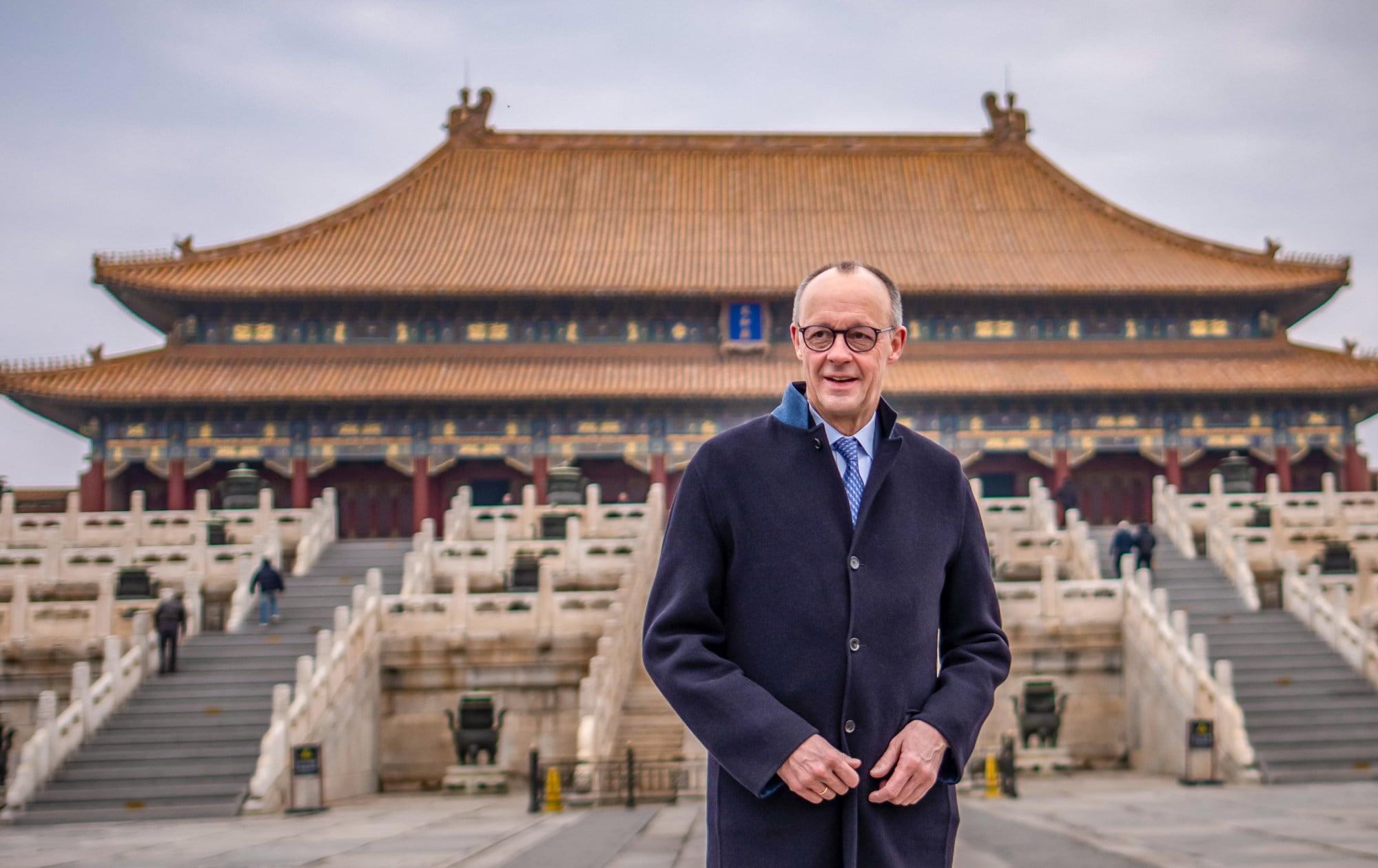
German Chancellor Friedrich Merz is said to have come around to the idea of changing Berlin’s long-term resistance to a tougher China policy, having been convinced by research into China’s role in his country’s economic malaise.
At the G7 leaders’ summit in France on Wednesday, Merz said the Chinese currency was “undervalued by 20 to 30 per cent”.
“European leaders are finally converging on a hard truth: China Shock 2.0 is eroding Europe’s industrial base,” said Sander Tordoir, chief economist at the Centre for European Reform and co-author of a study said to have compelled Merz to shift his views.
“The priority now is not to spend another 18 months designing new instruments, but to use the trade defence arsenal the EU already has – and to use them vigorously.
“Every month Europe waits, China strengthens its grip on critical industrial chokepoints and deepens Europe’s dependence.”
After the commission’s pitch, member states will offer their views on how the bloc should move forward.
It is expected that a bold new plan will be backed, after which Brussels will propose the measures in the coming months. Safeguard investigations in critical sectors could be launched in the coming weeks.
A third diplomat said that China’s latest five-year plan was an “attack” on Europe, given that it doubled down on support for sectors already feeling the pain from Chinese competition.
While Thursday’s debate will certainly be about Beijing, there is no mention of China in the official agenda, nor will there be written conclusions naming it.
Official sources said this is to ensure there is an off-ramp for the sides, even as they head closer to the cliff of a trade war.
Nonetheless, diplomats insisted that the reluctance to name China should not be taken as a sign that the EU was afraid to defend itself.
“I wouldn’t confuse the fact that you don’t see something spelled out as inaction ... the best thing is to revisit this issue in a few months to see if you still feel or not that there has been inaction,” said one source involved in the planning.
Another added that “fear is never a good counsellor”, and that Europe should move with confidence, since China was also reliant on some areas of European technology.
“We have to work through our strength ... we’re dependent on the Chinese, but they are dependent on tech from Europe. We are not only a target – we can also operate through strength.”
Momentum grows for more robust China strategy
During a European Parliament debate on Wednesday, the biggest political group threw its weight behind a more robust China strategy.
“The trade deficit comes to one billion euros a day; this is simply unacceptable. China is flooding EU markets, and this has to stop,” said Manfred Weber, leader of the centre-right European People’s Party.
Weber also called for Europe to work with the United States on a joint approach to China after the two sides appeared to align on Ukraine at the G7 event.
“It gives us a chance to restart a kind of ‘economic Nato’ thinking ... together with the Americans, we should think about how to answer the economic model of China,” Weber said.
New research published in Germany on Wednesday, meanwhile, suggested that Europeans are also supportive of a shift in stance.
A Bertelsmann Stiftung survey found that 77 per cent in the EU feel their countries need to reduce dependency on China “even if it hurts your economy in the short term”, including 80 per cent in Germany. -- SOUTH CHINA MORNING POST