




Hong Kong graduate Ivan Cheung has filed more than 200 job applications since March, and he is hoping that out of the dozen or so companies that have asked him to interview or take a written test, one will eventually hire him.
But the data science and analytics graduate from Polytechnic University is in a slightly better position than some of his peers, as he works part-time, giving him a small financial cushion as he tries to find a permanent role.
Cheung said that those around him who had managed to find a job considered themselves lucky, as the previously predictable transition from university to career had become rife with uncertainty with the advent of AI.
“Artificial intelligence literacy is perhaps the most important skill to have to be able to secure a job now,” he said, adding that it was important to learn how to give AI specific and directed prompts to generate information that could help address business pain points rather than general answers.
Cheung is among tens of thousands of fresh graduates facing the gloomiest employment market since 2021 in Hong Kong.
The South China Morning Post earlier reported that job vacancies in 2025 numbered 30,798, the fewest in the past five years and down by 55 per cent over the 68,728 recorded in 2024, according to the Joint Institution Job Information System, an online job information system run by the city’s eight public universities.
The unemployment rate for those aged 20 to 29 stood at 6.8 per cent between February and April, compared with the overall rate of 3.7 per cent.
Sid Sibal, managing director at Hong Kong-based hiring firm Aster Recruiting, said that the job market remained soft. Graduates seeking white-collar roles were especially struggling due to the lack of high-quality jobs, he noted.
Some multinational companies had moved their back-office functions and IT operations to lower-cost locations offshore, while also relocating their regional headquarters from Hong Kong to Shanghai or Singapore to cater to different markets.
“This structural change about geographical headquarters movements ... [led to] some of the key roles to be based elsewhere, which then meant that you don’t need as big a footprint as you used to before, when you catered to the whole of Apac here,” he said.
“That naturally meant that you will reduce your management training programmes. You will reduce your new generation cohort groups.”
The influx of talent from mainland China through government schemes had also made it an employers’ market, he noted.
But it was not all doom and gloom, as Sibal highlighted that the wealth management sector was expanding in Hong Kong as the city was offering more specialist and niche financial services.
Vincent*, an international business graduate of the University of Hong Kong (HKU), started a job in business development at a tech firm on Monday. He said he had spent a year looking for a position, filling out more than 100 applications.
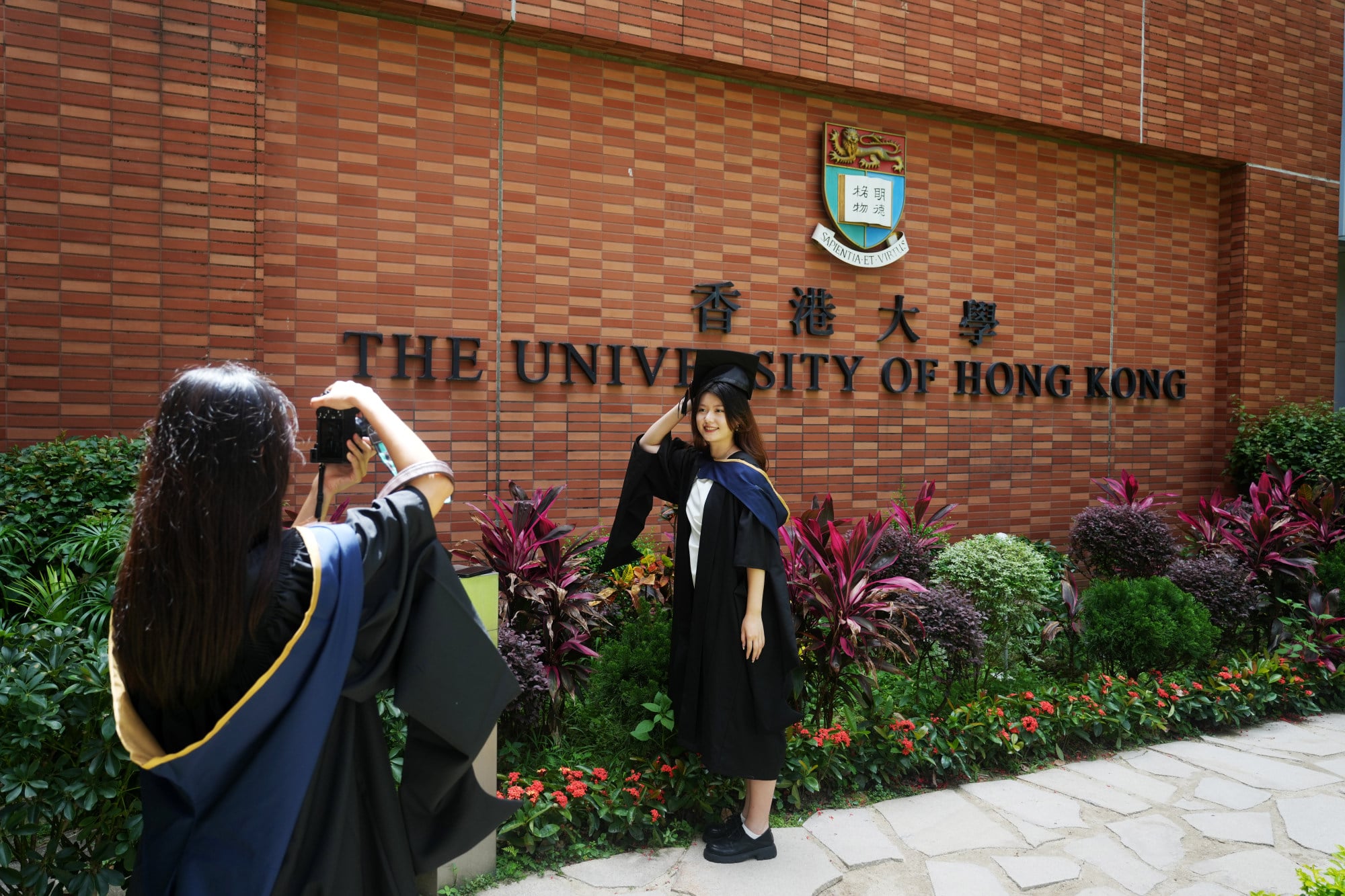
He explained that he had searched for roles in banking, consulting and venture capital, adding that about 20 per cent of the companies he contacted had replied and offered an interview.
“It was very frustrating,” he recalled. “For every single application, you’d have to research the company thoroughly before writing the cover letter. Then they’d ask you to do a virtual interview and aptitude test. You’d spend a lot of time on an application.”
Vincent said there was a consensus among his university friends that job-hunting had been very challenging, and he learned through chats with alumni that this year was particularly competitive as artificial intelligence had taken over many junior roles.
According to a Jobsdb survey of 507 university students graduating this year, 58 per cent were confident of securing their ideal job within 12 months of graduation.
“Only 17 per cent of them were willing to compromise if they can’t find an ideal job in a certain time period, so I think there are probably some mismatches in expectation versus reality,” Bill Lee Chern-hsing, managing director of Jobsdb Hong Kong, said.
He pointed out that AI had permeated all sectors and markets.
“Because of the softer market conditions, employers tend to prefer somebody with a bit more experience and the opportunities still exist, so there’re probably [fewer roles] for graduates versus any other of the previous years,” he said.
In addition to the finance and banking sectors recovering, Lee also observed improvements in the sports and entertainment industries as the government pushes the mega-event economy.
Human resources expert Alexa Chow Yee-ping, managing director of ACTS Consulting, said the monthly salary range of those with an undergraduate degree stood at HK$17,000 to HK$23,000 (US$2,170 to US$2,935) while those with diplomas or associate degrees could earn HK$15,000 to HK$18,000.
“This marked a mild increase of 2 to 3 per cent,” Chow said. “The economic performance was strong in the first quarter with a year-on-year 5.9 per cent growth in GDP, with many projections for the year adjusted to 4.3 to 4.6 per cent. But despite this, vacancies for fresh graduates did not increase.”
Chow said some graduates might opt to become slashers, or workers who juggle different types of employment or earning streams, which would give them an income and additional experience while they hunted for a permanent job.
HKU journalism student Yuna Qin also found it “frustrating” that she had failed to find a position despite having filed up to 300 job applications in her field in the city and mainland China.
The 22-year-old, who is finishing her master’s degree, said she went through a roller-coaster of emotions after rounds of applications, written tests and interviews resulted in rejections.
“There was a period of time when I kept calling my mum and crying to her, saying that job-hunting was just too difficult. I also lost around 3kg to 4kg [6.6lbs to 8.8lbs] during that time,” she said.
But she had just started a three-month internship that could lead to a full-time role, she said.
“So right now, I’m mainly focusing on doing well in this internship,” she said.
*Name changed at interviewee’s request -- SOUTH CHINA MORNING POST


