SINGAPORE: The Singapore Police Force is taking advantage of technology such as artificial intelligence to help forensic specialists and investigators solve cases and to optimise the use of resources.
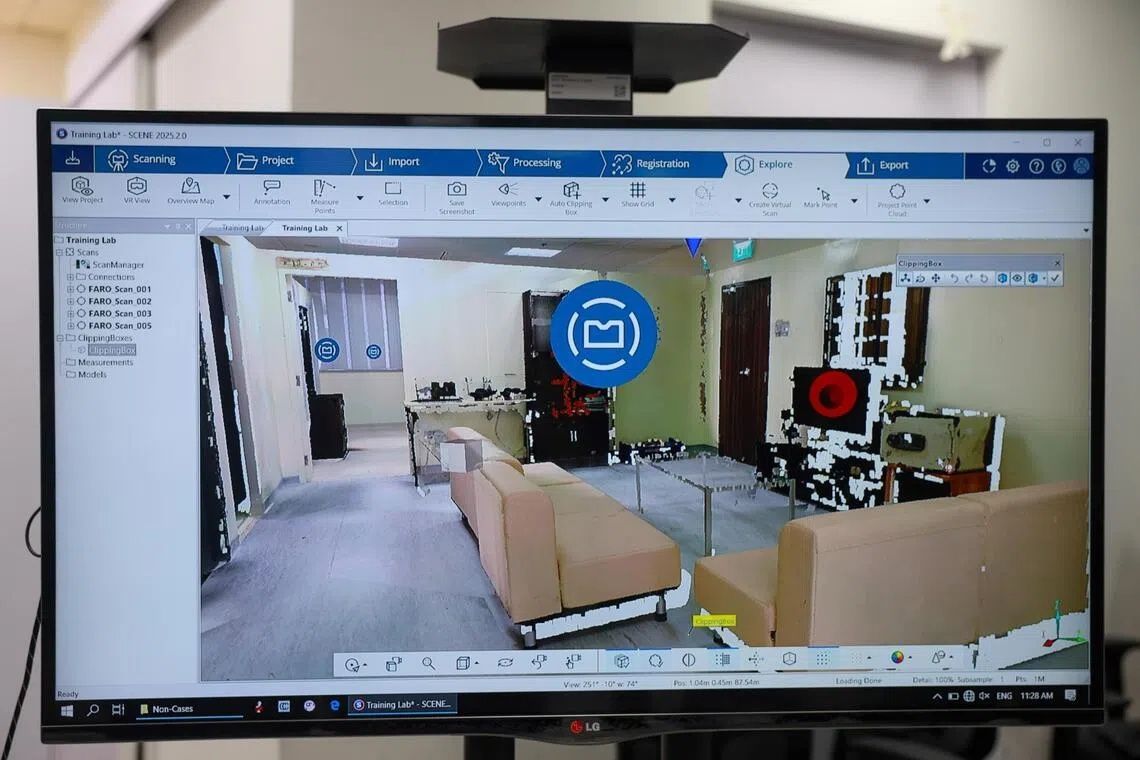
The officers are also using tools like unmanned aerial vehicles (UAVs) and 3D scanners to capture precise spatial information to create replicas of crime scenes.
Deputy Superintendent of Police Tan Boon Kok, the officer in charge of the Criminal Investigation Department’s Special Investigation Section, said with the scanners, investigators need only a quarter of the time they previously took to recreate crime scenes.
“With current 3D scanning technologies, we can produce a digital twin of the scene, which allows us to revisit the scene anytime to take additional measurements,” he said.
Such scanners are also used for road accidents so that traffic can resume quickly while preserving the scene virtually for investigations.
He added: “We also now have UAV capabilities that we can deploy to capture aerial views of a scene, especially for large scenes.”
On June 8, the police gave a media demonstration of how such tools are being used to solve complex cases and train forensic specialists.
With the Mixed Reality Training System, trainees don mixed-reality goggles that immerse them in a world that combines virtual evidence such as weapons with real-world set ups like a crime scene to analyse bloodstain patterns.
The system was developed in collaboration with the Home Team Science and Technology Agency.
Tan said processing a complex crime scene takes significantly longer without the tools.
He was part of the team that was activated on Nov 25, 2016, to investigate a suspicious death. The body of a woman was found in a drain at Tanah Merah Ferry Terminal.
Police spent over seven hours processing the scene, including two hours of painstakingly taking photos and measurements to create a sketch they could refer to.
Tan said that they had to keep returning to the scene over several days to get more information.
They eventually solved the case – the 54-year-old cleaning supervisor had been stabbed and killed the day before in the cleaner’s room in the terminal, before her body was dragged and hidden inside the drain.
By then, the killer, who was the woman’s subordinate, had already escaped to Malaysia. He was arrested almost a month later, extradited to Singapore and eventually sentenced to life imprisonment and 18 strokes of the cane.
Tan said with 3D scanners, they could have processed the ferry terminal scene in a quarter of the time.
He added that AI is useful for processing large amounts of documents and evidence, noting that what took him months previously could now be done in a matter of hours.
“AI is a powerful enabler that can streamline administrative tasks, accelerate data-driven insights and improve information sharing with the investigators and forensic officers involved in the case,” he said.
“However, the core investigative craft – judgment, empathy, on-site perception and strategic decision-making – remains firmly in the hands of human investigators.”
Senior crime scene specialist Wong Jun Yan said investigators and crime scene specialists are first trained in the fundamentals and taught to do things manually before being exposed to the technologies.
He said the new technologies are there to assist, not replace them.
“The fundamentals of such major investigation have remained the same over the years,” he said.
“These include meticulous processing of the scene, proper recognition of relevant exhibits, careful recovery and preservation of evidence, as well as thorough interviews and ground enquiries.
“New technologies do not replace this... but allow us to work better by enabling quicker and more information exchange, and new ways to appreciate the scene more holistically.” - The Straits Times/ANN