JAKARTA: Indonesia’s military justice system still reflects a broader pattern of impunity for handing down mild sentences, especially in cases of violence committed by personnel against civilians, according to rights group the Commission for Missing Persons and Victims of Violence (Kontras).
The group analysed 131 verdicts delivered by military courts against Indonesian Military (TNI) personnel charged with the offences of murder, attempted murder and assault from October 2024 to September 2025.
Within that period, military courts across the country tried 13 defendants for murder, five for attempted murder and 113 for assault.
From the analysis, Kontras found the punishments given to defendants ranged from one month and 20 days to six years in prison for assault cases.
Meanwhile, personnel standing trial for murder received sentences ranging from a year behind bars to life imprisonment.
Only four defendants in attempted murder and one other murder case were sentenced to death by the military courts, according to Kontras’ finding.
The figures between October 2022 and September 2023 analysed by Kontras were no better.
Of 117 military personnel prosecuted within that period, the lightest sentence was one month and 15 days in prison, while the heaviest was a year and three months.
Kontras also found that most crimes committed by TNI personnel against civilians, which were unrelated to their military duties, were still tried in military courts.
Group researcher Muhammad Yahya Ihyaroza argued that such cases should be prosecuted as a general crime in civilian courts rather than in military courts.
“If the state is truly committed to protecting and respecting the human rights of its citizens, one way to demonstrate such commitment is by improving the practice of military justice,” Yahya said during a press briefing on Thursday (June 4).
One recent case of a lenient sentence for military personnel found guilty of a crime took place in Medan, North Sumatra.
First Sgt. Riza Pahlevi was sentenced to 10 months in prison in October 2025 after the military court found him guilty of killing a 15-year-old boy during an operation to disperse a street brawl in the city.
The acid attack against Kontras activist Andrie Yunus also reflects the impunity pattern, Yahya said.
Unidentified men hurled acid at Andrie on March 28, causing severe injuries to most of his body and face.
The National Military Police Headquarters (Puspom TNI) later arrested four personnel of the TNI’s Strategic Intelligence Agency (BAIS) for alleged involvement in the attack.
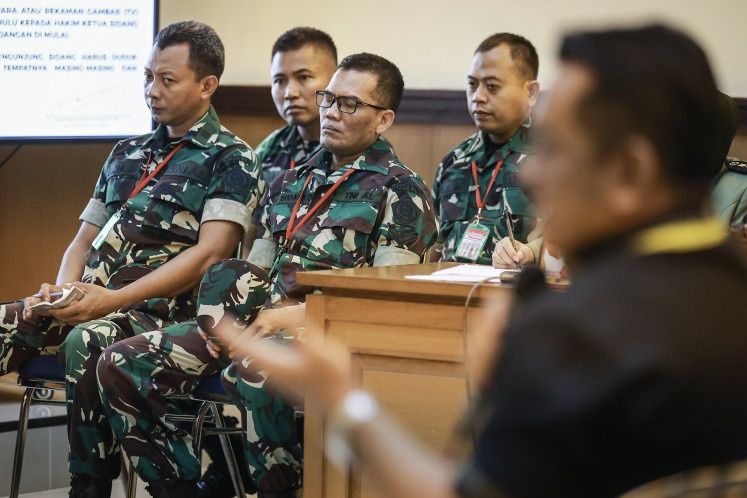
The four suspects are currently standing trial at the Jakarta Military Court.
On Wednesday, military prosecutors sought two and a half year prison sentences for the defendants.
The verdict against the four defendants is expected to be read by the judges on June 10.
Impunity for TNI personnel persists due to the lack of impartiality in the military justice mechanism, said rights group Imparsial researcher Riyadh Putuhena, due to the fact that all parties involved in legal proceedings in the court are members of the armed forces.
“The defendant is a soldier, the lawyers are soldiers, as well as the judges and the prosecutors,” Riyadh said at Thursday’s briefing. “In practice, this resembles a ‘family court’ because it is filled with military personnel.”
Military courts are designed primarily to maintain discipline and provide internal guidance rather than to punish criminal acts, criminal law expert Abdul Fickar Hadjar said separately on Thursday.
Such a framework potentially allows for a high risk of impunity, particularly when punishments are imposed within the military chain of command.
To address such a problem, Fickar said the military should show a “genuine commitment” to comply with the TNI Law, which stipulates that military personnel prosecuted for general crimes must be tried in civilian courts.
“[The law] has clearly distinguished military and ordinary crimes that fall under the jurisdiction of civilian courts,” he said.
TNI spokesperson Brig. Gen. Muhammad Nas said on Friday that sentences in military courts are determined solely by their panels of judges, with proceedings conducted independently based on facts and evidence presented during the trials.
“The TNI is committed to enforcing the law against any soldier found guilty of violating the law, while upholding the principles of professionalism, accountability and due process,” Nas told The Jakarta Post. - The Jakarta Post/ANN