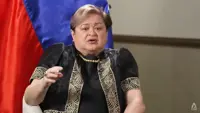
MANILA: The House prosecution panel on Wednesday (July 22) concluded its presentation of Article IV, which accuses Vice President Sara Duterte (pic) of making grave threats against President Ferdinand Marcos Jr, First Lady Liza Araneta-Marcos and former Speaker Martin Romualdez.
The prosecution’s presentation was completed in nine days, despite being given a total of 11 days to present their evidence. Though it should be noted that, technically, it only took six days for the court to tackle Article IV as three days were spent on other matters.
Below are the highlights from these nine days:
Day 1
The trial officially began on July 6, marking the very first time the Senate convened as an impeachment court to try a sitting Vice President.
However, the first day of the trial focused on administrative and procedural matters, with Senator-judge Francis “Chiz” Escudero being elected as the court’s presiding officer, a post traditionally held by the Senate president.
Escudero then made his first ruling the same day of her election, maintaining that at least 16 votes from senator-judges are needed for a conviction, even if three senators are currently unable to participate in the trial.
Duterte, maintaining her consistent absence from previous House hearings, chose to snub the first day of the proceedings—relying only on her team of private lawyers to represent her as the defence panel.
Day 2
Meanwhile, arguably the main highlight of the second day occurred right before the trial itself started when Duterte herself suddenly showed up at the Senate.
However, the vice president appeared at the upper chamber not to join the trial but only to meet with her lawyers, choosing to hold their meeting at the Senate instead of a different location.
Despite being adamant about not joining the trial, the vice president delivered a statement to reporters: “In this bloodbath and bludgeoning, I will be bloodied but unbowed.”
It was during the second day when the prosecution panel formally introduced Article IV of the Articles of Impeachment against Duterte before the court.
House prosecutor Rep. Lorenz Defensor opened the prosecution’s case by calling the threats “especially sinister” because they came from the vice president herself and not an ordinary citizen.
Their accusation was rooted in a statement uttered by Duterte herself during a November 2024 online press conference where she herself revealed the kill plot. This clip was screened before the senator-judges despite defense objections.
The prosecution then called up their first witness, National Bureau of Investigation (NBI) Senior Cyber Investigation Agent John Mark Calilung, who testified on the forensic authentication of the livestreamed videos containing the statements.
The defence attempted to block Calilung’s presentation as a witness, but was overruled by the court.
Private prosecutor Amando Ligutan then argued that Duterte’s statements established that she had a “plan” to have the three officials killed, which was in response to Sen.-judge Risa Hontiveros’s question on how the statements are impeachable given that they do not constitute proof an assassin was actually contracted.
Escudero then gave the defence a chance to also respond to Hontiveros’ question as it “pertains to the final issue of this entire impeachment proceeding.”
Day 3
It was on the third day when NBI senior agent John Mark Calilung concluded his testimony, informing senator-judges that the NBI investigated Duterte’s alleged threats based on its mandate to probe threats against the president and other top officials, even without a formal complaint from the offended parties.
Duterte’s defence team then presented snippets of Duterte’s chief of staff Zuleika Lopez crying over her detention by the House in the same press conference where the vice president revealed her kill plot against Marcos, his wife and Romualdez.
Senator-Judge Risa Hontiveros then pressed the defence on the clip’s relevance, asking if the defense was arguing that Duterte’s alleged threats were warranted because her chief of staff had been oppressed.
The defence, through Atty. Carlo Joaquin Narvasa Jr. then confirmed that the defense’s position is that there had been systematic oppression by the House of Representatives when Duterte made her pronouncements.
Meanwhile, after being given a chance to respond to Hontiveros’ earlier question the day before, the defense, through Atty. Mark Vinluan, maintained that Duterte’s alleged hiring of an individual to assassinate President Ferdinand Marcos Jr., First Lady Lisa Marcos, and former Speaker Martin Romualdez was merely an “unconventional” but “justified” response to genuine threats against her and her family.
It was also on the third day when the impeachment court granted the House prosecution’s request to subpoena Lopez.
Day 4
On the fourth day of the impeachment trial, the prosecution presented its second witness, NBI Regional Director Jeremy Lotoc, who testified that Duterte’s alleged kill plot was “serious” and not protected by freedom of speech.
Lotoc, who previously headed the NBI Cybercrime Division that investigated the case, told the impeachment court that the bureau found sufficient basis to investigate Duterte’s statements, saying she herself admitted having spoken to a supposed assassin before her Nov. 23, 2024 online press conference.
He also testified that the NBI is mandated by law to investigate threats against the country’s high officials, effectively corroborating Calilung—the first witness’s—testimony before the court.
Another highlight was Senator-Judge Bam Aquino questioning the defense on its position that Duterte never hired a hitman, asking whether that meant her statements during the November 2024 briefing were untrue. Defense counsel Mark Vinluan, in response, then simply maintained that the vice president did not contract an assassin.
Meanwhile, the prosecution, in its position, also drew a parallel to the 2020 case of public school teacher Ronnel Mas, who was swiftly arrested for placing a bounty on former President Rodrigo Duterte, to argue that the VP’s threats should be treated similarly.
The defence, on the other hand, announced the same day its intent to present witnesses to prove the existence of the so-called “Operation Romanov,” an alleged plot targeting Duterte and her family.
Day 5
Lotoc’s testimony was then continued on the fifth day of the trial, with the NBI official this time telling the impeachment court that former President Rodrigo Duterte’s case before the International Criminal Court (ICC) was among the factors considered in assessing Vice President Sara Duterte’s alleged capability to carry out her alleged kill plot.
According to Lotoc, investigators factored in the vice president’s relationship to the former president and his pending ICC case when evaluating whether she had the capability to execute the threats she allegedly made during a November 2024 online press briefing.
However, during the defence’s cross-examination led by Vinluan, Lotoc admitted that he had no personal knowledge that Duterte had contracted someone to kill the president or the other targets, but maintained that the evidence the NBI gathered linked her to such a plot.
The defence also continued to point out various typographical errors in the NBI documents presented as evidence, but Lotoc asserted that such errors did not alter the NBI’s findings that Duterte committed grave threats and inciting to sedition.
The term “Oplan Romanov,” was also once again touched upon during the trial’s fifth day, with Lotoc and even Senator-judge Erwin Tulfo—in a manifestation—saying that it was first actually first publicly used by Davao City Mayor Sebastian Duterte during a rally referring not to him and his families, but actually against the Marcos family.
Meanwhile, it was this day when the prosecution revealed its decision to withdraw its presentation of two witnesses, particularly, Zuleika Lopez and House Legislative Security Bureau official Capt. Belinda Bello.
Private prosecutor Lorna Kapunan explained that they withdrew the two witnesses as their testimonies on Duterte’s alleged grave threats would be “unnecessary,” “redundant,” and a “surplusage” after the testimonies of Calilung and Lotoc.
Day 8
With the sixth and seventh day of the trial largely focused on matters unrelated to Article IV—as both days were focused on the oral arguments concerning the prosecution’s request to subpoena Duterte’s financial and tax records—the prosecution’s presentation on the subject article continued on the eighth day.
On the eighth day, NBI Director Melvin Matibag was called to the witness stand by the prosecution panel. But before his testimony began, Escudero admonished and warned Matibag from making statements pertaining to individual senator-judges to avoid affecting the court’s integrity.
In his testimony, Matibag told the court that the NBI aimed to establish a “pattern of violence” against Duterte.
Matibag also testified that the similarity between threats made by Duterte and those later made by her brother, Davao City Mayor Sebastian Duterte, suggests possible collusion against the president’s life.
When Senator-judge Bam Aquino asked about the probability that Duterte had spoken to a hitman, Matibag replied that based on the vice president’s own statements, he was “100 per cent” certain she had spoken to someone.
Another highlight was when the prosecution presented a video of Duterte, when she was Davao City mayor, punching a sheriff as supporting evidence of that pattern.
Furthermore, the prosecution also showed an “affidavit” of former self-proclaimed member of the Davao Death Squad and ex-police officer Arturo Lascañas that Vice President Sara Duterte was among the architects of the “Oplan Tokhang” in his father’s bloody campaign against drugs.
This, however, was objected to by both the defense and Senator-judge Pia Cayetano as the affidavit was not notarized.
Meanwhile, the court granted the defense’s motion for a continuance, giving the defense team more time to examine documents the prosecution presented during Matibag’s testimony.
As a result, the cross-examination of Matibag continued to a ninth day.
Final Day
On the ninth and final day of the trial days so far, Vinluan continued the defense’s cross examination of Matibag.
One highlight was Vinluan asking Matibag whether the NBI is conducting its ongoing investigation to substantiate the impeachment case against the vice president, and the latter responding that there would be no need to as “it has already been established.”
Vinluan also asked if it was possible the NBI misunderstood Duterte, particularly in one of her press conferences where she said she “imagined cutting the President’s head” as she may have only said this in jest—thereby taking her out of context.
But Matibag responded that it is hard for the law enforcement to ignore such pronouncements, likening it to “bomb jokes” made in public vehicles, particularly airplanes.
Matibag said this statement of Duterte is part of their investigation where they established a “pattern of violence.”
The prosecution then forwent their redirect examination, stating that they no longer find it necessary.
Since Matibag was the last witness for Article IV, presiding officer Escudero informed the court and both parties that the prosecution only consumed six days for their presentation.
“So we are still ahead by two days based on the timetable given in the pre-trial order. I hope we can be able to continue along these lines,” said Escudero.
After Article IV, the court is then expected to proceed tackling Article I, which involves the alleged misuse of P612.5 million in confidential funds from the Office of the Vice President, or P500 million, and the Department of Education, or DepEd, amounting to P112.5 million.
With the court now taking nine days, it has 83 days left to decide whether to convict Duterte.
If convicted, Duterte faces possible removal from office and perpetual disqualification from holding any public office. - Philippine Daily Inquirer/ANN