




Since US President Donald Trump launched a tariff war against China during his first term in office, Washington has steadily expanded restrictions on Chinese access to advanced technologies, targeting semiconductors, artificial intelligence (AI), quantum computing, aerospace systems, supercomputers and a broad range of dual-use technologies.
These export controls are aimed at slowing China’s rise in high-end manufacturing and frontier science.
But Beijing’s rapid progress in a number of strategic sectors has forced a dramatic shift: China is no longer merely a target of technology restrictions – it may also need its own system to restrict the outflow of critical technologies in areas where it has achieved global advantages.
A groundbreaking study on the matter, first published on March 19 in the Bulletin of the Chinese Academy of Sciences, was highlighted again in a May 21 press release published by the journal’s social media account.
The study was titled “Selection Framework and Empirical Research of Restricted Export Technology”.
The team proposed what it described as China’s first relatively comprehensive framework for identifying technologies that might warrant future export restrictions, ultimately producing a list of 63 technologies viewed as strategically sensitive or globally competitive.
The technologies span sectors ranging from advanced materials and quantum communications to AI hardware, energy systems, biotechnology and aerospace engineering.
Among the technologies identified were satellite quantum encrypted communications, electromagnetic catapult systems, space robotics, free-space optical communications, quantum device manufacturing and miniaturised AI edge computing systems.
Others included deep ultraviolet LEDs, perovskite solar cells, autonomous positioning technologies for the Beidou-3 inter-satellite network, graphyne materials and “lifelike robots”.
China increasingly sees itself moving from what the authors called a coexistence of “following, running alongside and leading” global technology powers into selected areas of technological leadership.
The study was jointly conducted by researchers from the Chinese Academy of Engineering Innovation Strategy, the Chinese Academy of Science and Technology for Development, the China Academy of Engineering Physics and other institutions deeply involved in national technology strategy and security research.
Its corresponding author, Guobin Fan, is an academician of both the Chinese Academy of Engineering and a senior researcher at the China Academy of Engineering Physics. His work focuses on science and technology strategic consulting.
“The technologies in various fields mainly came from two sources – existing technology lists from reports and patent-based selection methods,” Xianke Peng, deputy secretary general of the Chinese Academy of Engineering Innovation Strategy and the paper’s first author, said on May 28.
At the same time, the authors cautioned against interpreting the study as an imminent policy roll-out.
Peng stressed that the research remained an academic exploration rather than an official export control programme.
“This article is only an academic-level exploration and reflection,” he said, adding that the framework had not been formally adopted as a basis for China’s actual export restriction policies.
At the centre of the research was a fundamental strategic question rarely discussed publicly in China until recent years: which Chinese technologies are now important enough to justify restricting exports, and how should such technologies be identified scientifically?
To answer that, the researchers developed what they called the SMSSEV framework – short for “survey and measurement, screening and supplement, evaluation and grading”.
The model combines patent analytics, expert consultations and strategic assessments to evaluate technologies across three major dimensions: necessity, feasibility and impact.
Under the framework, “necessity” refers to whether a technology has strategic value for China’s industrial system, national technology base or national security; “feasibility” examines technological maturity and whether foreign alternatives exist, while “impact” evaluates how restrictions might affect innovation, industry, employment and trade.
The researchers wrote in the paper that the framework partly referenced long-standing US export control mechanisms, including Washington’s use of advisory committees, public consultation systems and strategic technology reviews.
The paper noted that US restrictions had historically focused not only on military and dual-use technologies, but also on emerging technologies where rival countries were rapidly catching up or threatening future American dominance – including AI, semiconductors, brain-computer interfaces, quantum technologies and hypersonics.
The Chinese team attempted to build a comparable methodology tailored to China’s own development stage and industrial structure.
According to Peng, the broad technology categories used in the study were primarily based on the disciplinary divisions of the Chinese Academy of Engineering to facilitate consultations with academicians and specialists from different sectors.
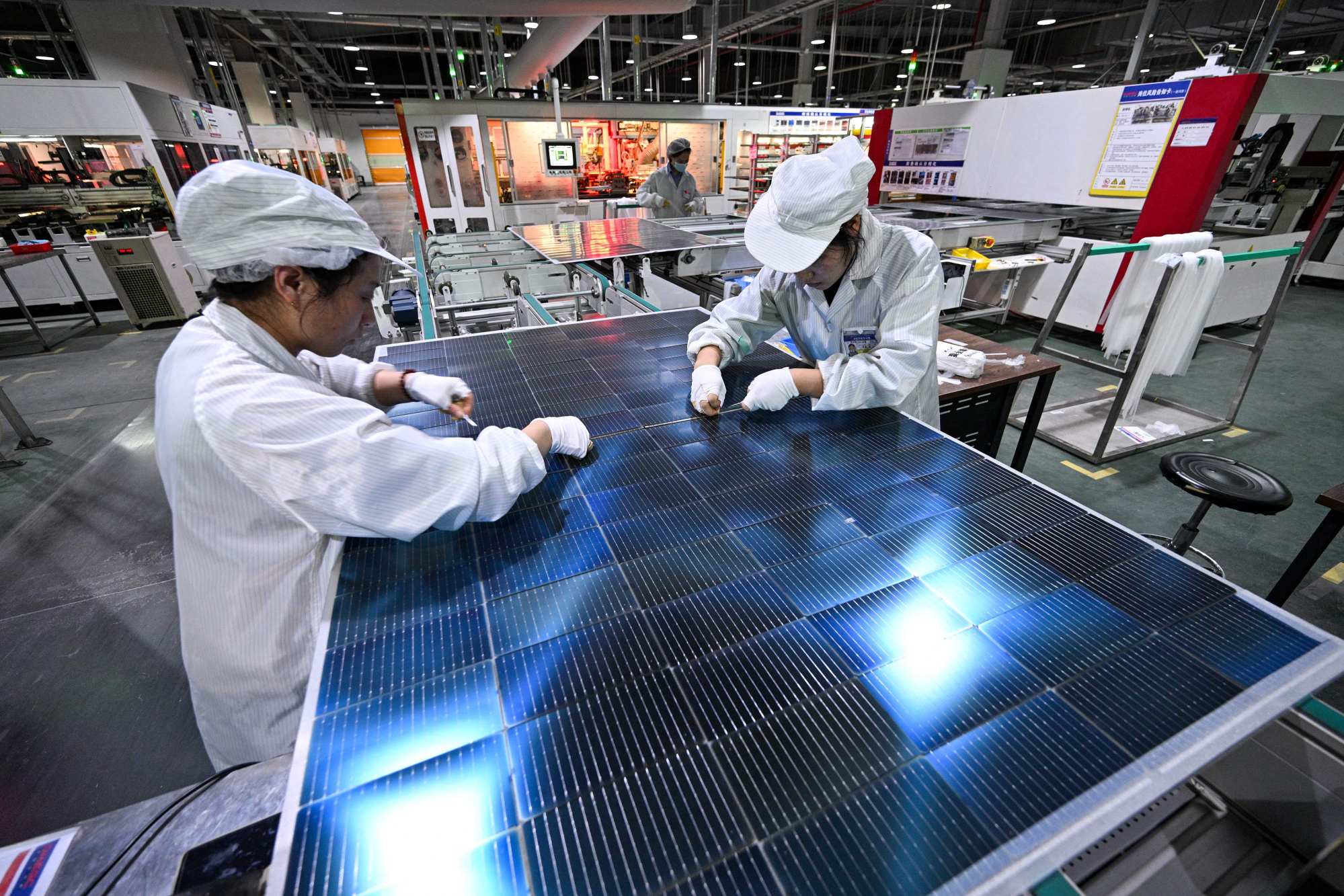
The screening process incorporated existing Chinese and foreign technology lists, International Patent Classification or IPC, technology-gap models, patent co-occurrence network analysis, and multiple rounds of expert reviews involving researchers, industry representatives and government-linked specialists.
The study also relied heavily on patent databases to identify technologies where China may possess comparative advantages. In one example focused on advanced materials, researchers analysed more than 215,000 international patent records and used machine learning clustering models and network analysis to identify key technological nodes.
The final list of 63 technologies, however, was not generated purely by algorithms.
“The final 63 technologies were the result of both patent-based selection and expert assessment,” Peng said.
The implications of the research extend beyond export policy itself.
The study argues that China’s technology trade security system still lags behind those of developed nations such as the United States, Britain, Germany and Japan, all of which have established mature export control frameworks over decades.
Historically, China’s technology policy has focused more heavily on technology acquisition and industrial catch-up.
But as Chinese firms and laboratories move closer to the global frontier in selected sectors, Beijing is beginning to discuss concepts such as “technology sovereignty”, “technology security” and strategic technological protection more openly. -- SOUTH CHINA MORNING POST


