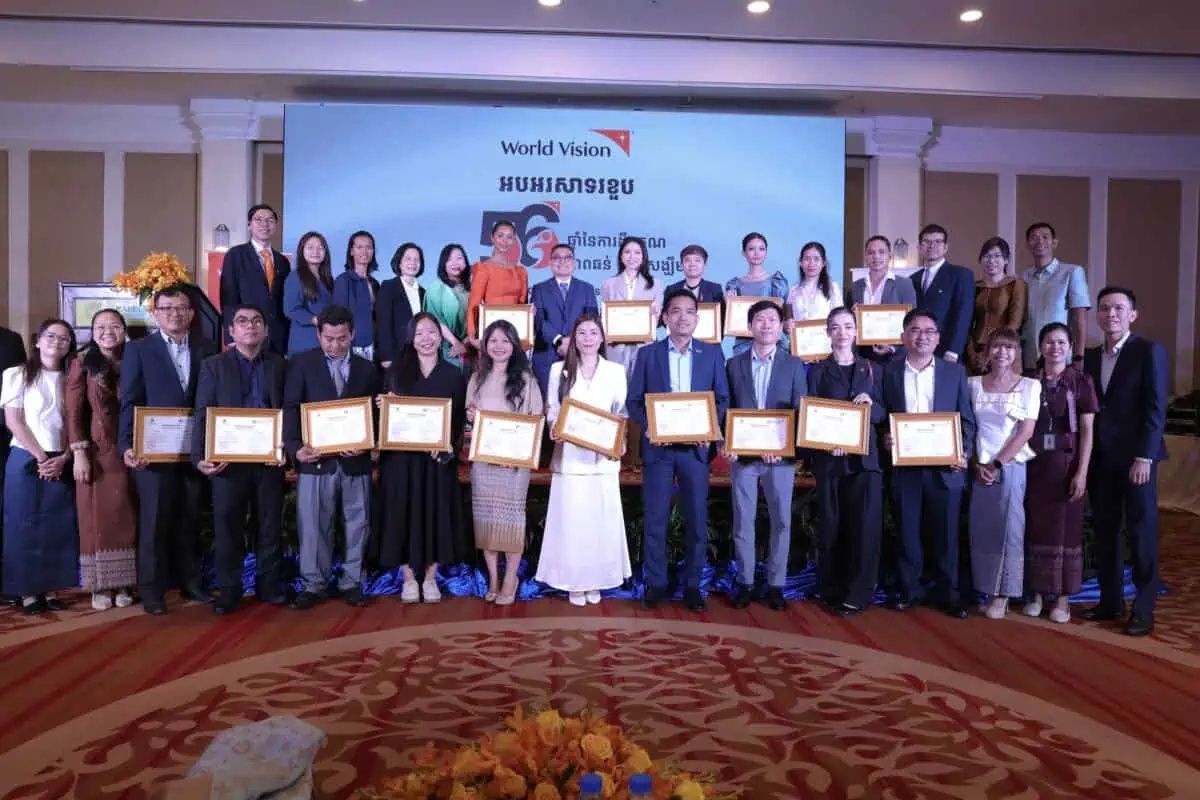
PHNOM PENH (Phnom Penh Post/ANN): Cambodia’s long journey from war, mass displacement and post-conflict recovery to sustained development came into sharp focus on June 1 as government officials, development partners and former beneficiaries marked the 56th anniversary of World Vision International’s work in the Kingdom.
At the centre of the commemoration was a consistent message: children — especially those affected by displacement and vulnerability — remain both the most affected by crises and the clearest indicator of national resilience.
Minister of Education, Youth and Sport Hang Chuon Naron used the occasion to reflect on how decades of conflict reshaped Cambodia’s education system and underscored the importance of sustained investment in human capital.
He recalled that Cambodia’s development trajectory was severely disrupted by conflict in the 1970s, which led to widespread displacement and the breakdown of essential public services, including education.
“Cambodia’s development was disrupted by war, and the country fell into conflict,” he said, describing how the crisis halted long-term national progress.
He stressed that rebuilding the country required more than physical reconstruction, noting that restoring education systems and access to learning — particularly for displaced and vulnerable children — was central to recovery.
The minister highlighted the contribution of development partners such as World Vision in supporting this long-term rebuilding process, particularly in remote and underserved communities.
“Partners such as World Vision have supported the recovery of education, health and community systems,” he said, noting that such efforts complemented government-led reconstruction and decentralised service delivery.
From emergency response to long-term development
World Vision began its work in Cambodia in 1970, just before the country descended into civil war. Its early engagement included emergency assistance and support for essential services, including contributions to the National Paediatric Hospital in Phnom Penh.
Following its return after 1979, the organisation expanded its work from emergency relief into long-term development, focusing on rebuilding essential services alongside government institutions and local communities.
World Vision International president and CEO Andrew Morley said the organisation’s 56-year presence reflects both Cambodia’s resilience and sustained collaboration with national stakeholders.
“As World Vision marks 56 years in Cambodia, we extend our sincere gratitude to the Royal Government of Cambodia, our partners, and communities,” he said. “We are proud to have contributed to improvements in education, health, child protection and livelihoods — always prioritising the most vulnerable children.”
Over the decades, World Vision has implemented integrated programmes across education, health and nutrition, child protection, water, sanitation and hygiene (WASH), livelihoods and climate resilience.
World Vision Cambodia national director Janes Imanuel Ginting said the anniversary marked both reflection and continued commitment.
“This anniversary is not only a reflection of our past and resilience, but also a renewed commitment to every child in Cambodia,” he said. “Together with communities and partners, we have witnessed profound transformation — yet too many children remain vulnerable.”
Displacement as a recurring challenge
Speakers repeatedly highlighted that displacement is not only a historical issue but also a continuing challenge in Cambodia’s development landscape.
In recent years, climate-related disasters, flooding, and localised displacement linked to border tensions have disrupted livelihoods and education access, placing renewed pressure on vulnerable communities.
Education officials noted that temporary learning spaces and emergency response measures have been used to ensure that displaced children can continue their schooling during crises.
The Minister stressed that education continuity in emergencies is essential.
“Ensuring children continue learning, even in emergency situations, is a right that cannot be lost,” he said.
Development partners, including World Vision, have supported these efforts through learning materials, teacher assistance, and community-based education support mechanisms.
From beneficiaries to community leaders
A key feature of the anniversary was testimony from individuals who once benefited from World Vision’s child sponsorship and community programmes and now serve in leadership and professional roles.
A former sponsored child from Samlout district in Battambang province, an area heavily affected by past conflict and landmine contamination, described how early support changed his life trajectory.
“Growing up in a community affected by war and landmines left little hope for the future,” he said. “Joining World Vision’s Child Sponsorship Programme became a turning point that opened up opportunities and gave me a renewed sense of purpose.”
He is now a branch manager at a microfinance institution and said that savings groups and agricultural initiatives introduced years ago continue to benefit communities today.
“These structures are still functioning and continue to support families,” he said, calling them a lasting example of sustainable community development.
Local governance and social change
Local government representatives also described how long-term community programmes have reshaped both service delivery and social norms, particularly in rural areas.
A commune council member from Kampong Leng district recalled that in the early 2000s, many children — especially girls — were forced to leave school due to distance, safety concerns and household pressures.
“Education for girls in remote areas was extremely difficult,” she said.
She said early interventions supporting community education, leadership training, and social accountability helped shift attitudes and increase school retention, particularly among girls.
She herself transitioned from a housewife to a commune chief now serving in her fifth mandate.
“I used to be just a housewife,” she said. “Now I serve as commune chief in my fifth term.”
Youth participation and changing expectations
Young participants described a different dimension of impact, focusing on civic engagement and future economic opportunities.
A 21-year-old engineering student from Phnom Penh said her involvement in youth programmes supported by World Vision helped her better understand community challenges such as waste management, domestic violence, and child dropout in urban fringe areas.
“Youth are not just beneficiaries of development,” she said. “We are partners in creating change.”
She later participated in a youth-led initiative and international discussions on sustainable development, which she said shaped her ambition to build a small enterprise supporting local production and employment.
Wide national footprint
According to figures presented at the event, World Vision currently works across 20 provinces and Phnom Penh, reaching more than 5.4 million people, including 3.1 million children.
Its programmes span the majority of the country’s communes and support hundreds of schools and health centres through integrated interventions covering education, child protection, nutrition, WASH, livelihoods and climate resilience.
Social accountability, gender equality, disability inclusion and community ownership were highlighted as central to its approach.
Looking ahead
As Cambodia advances toward its national development targets and the Sustainable Development Goals, both government and partners signalled a shift toward strengthening systems and long-term sustainability.
The education minister framed this trajectory as part of Cambodia’s broader evolution from post-conflict recovery to resilience and eventual self-reliance.
World Vision leadership echoed that direction, emphasizing continued collaboration with government and communities.
“Our history in Cambodia has been shaped by partnership, perseverance, and the resilience of communities,” said national director Janes Imanuel Ginting. “The work continues, and our focus remains firmly on the future—ensuring that no child is left behind.”
As the ceremony concluded, the message that ran through speeches, testimonies, and data was consistent: Cambodia’s development story remains inseparable from the experiences of its children—especially those shaped by displacement, and those now shaping the country’s next chapter. -- Phnom Penh Post/Asia News Network