More than 4,000 passengers were expected to use the expanded second terminal at Hong Kong International Airport on its first day of operation on Wednesday, a launch the managing authority described as smooth
Some passengers praised Terminal 2 for its efficiency but said that more convenient boarding arrangements were needed.
Hong Kong Airlines became the first – and so far only – carrier to use the upgraded terminal, with 36 flights scheduled to depart throughout the day.
Fourteen more airlines are due to move in by June 10, with six commencing services at the new facility on Thursday.
The Airport Authority estimated that 4,200 passengers would use the terminal on Wednesday, chief executive Vivian Cheung Kar-fay said.
“[Operations] this morning have been very smooth and our passengers are very happy,” she said.
Cheung added that the automated check-in system designed by the authority could complete the entire process in 45 seconds.
“We want to help airlines migrate to [a fully automated] process, which will improve the passenger experience,” she said.
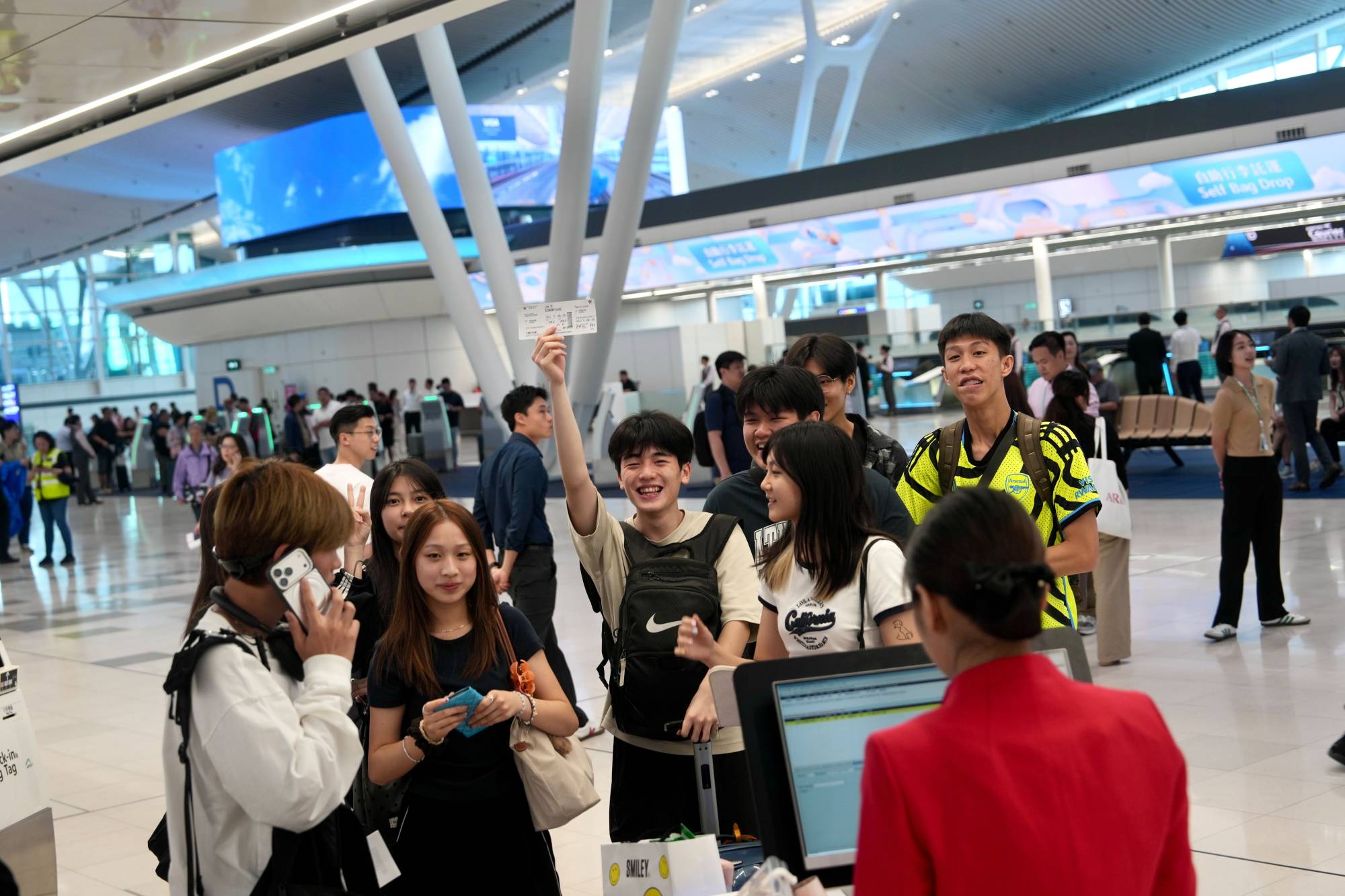
By 6am, hundreds of travellers were already checking in and dropping off their bags, with no long queues observed.
“I was able to complete baggage drop within five minutes of entering the terminal, as I had already checked in online,” said McQueen Chung, a 20-year-old student who was flying with friends to Tokyo at 8.30am.
“The environment is new and the decorations are nice.”
Chung said he allowed extra time as a precaution, arriving 2½ hours before departure.
He said he took a bus serving route NA37 from his home in Tin Shui Wai directly to Terminal 2. But the stop had not yet been added to the bus operator’s route map, and he had to inquire with the driver before boarding.
The first flight, HX236, departed for Shanghai Pudong International Airport at 8.05am, followed by HX614 leaving for Osaka, Japan, at 8.25am.
Office clerks Karen Kwok and Betty Cheng, both 35, also praised the efficiency of the new terminal ahead of their flight to Incheon, South Korea, at 8.45am.
“It is convenient and the staff are friendly,” Kwok said.
While agreeing that the check-in process was smooth, Cheng said she had difficulty with the layout of Terminal 2 after getting off the bus at the old terminal.
“I lingered on the lower floor and did not see any check-in counters. I later realised the departure floor was upstairs,” she said, calling for clearer signage.
Terminal 2, which closed in 2019 for reconfiguration as part of the three-runway project, is expected to handle about 8 million passenger trips in its first year of operation. It is designed to ultimately handle 30 million trips per year.
The terminal has 108 airline check-in counters, 58 smart kiosks for self-check-in and baggage tag printing, and 68 self-bag-drop counters, supporting smartphone-enabled services.
After clearing check-in and immigration procedures, passengers still have to proceed to Terminal 1 to board their flights, as the revamped terminal’s departure concourse and boarding gates will not be completed until the end of next year.
Travellers Kwok and Cheng said it would have been preferable if passengers checking in at Terminal 2 could board their flights there directly.
“I think it is a little troublesome. We do not know how long it will take to reach the boarding gate, and we anticipated there might be chaos on the first day, so we set aside more time,” Kwok said.
She added that they arrived three hours before departure, leaving time for breakfast at the airport.
The pair also chose to eat in the restricted area of Terminal 1 closer to their gate as they were uncertain of how long it would take to travel from the upgraded facility.
Addressing the concerns, Cheung said passengers could reach the boarding area of Terminal 1 via the automated people mover system in a “seamless” process.
The other carriers planning to relocate their check-in counters to Terminal 2 are HK Express, Greater Bay Airlines, AirAsia, Batik Air (Malaysia), Hainan Airlines, Philippines AirAsia, Thai AirAsia, Thai Lion Air, Cambodia Airways, IndiGo, VietJet Air, Bangkok Airways, Jeju Air and Cebu Pacific.
The terminal now offers 25 shopping and dining options. Food and drink choices include TamJai SamGor Mixian, Milk Cafe, McDonald’s, Nap Tea, Cupping Room Coffee Roasters and Sang Roastery.
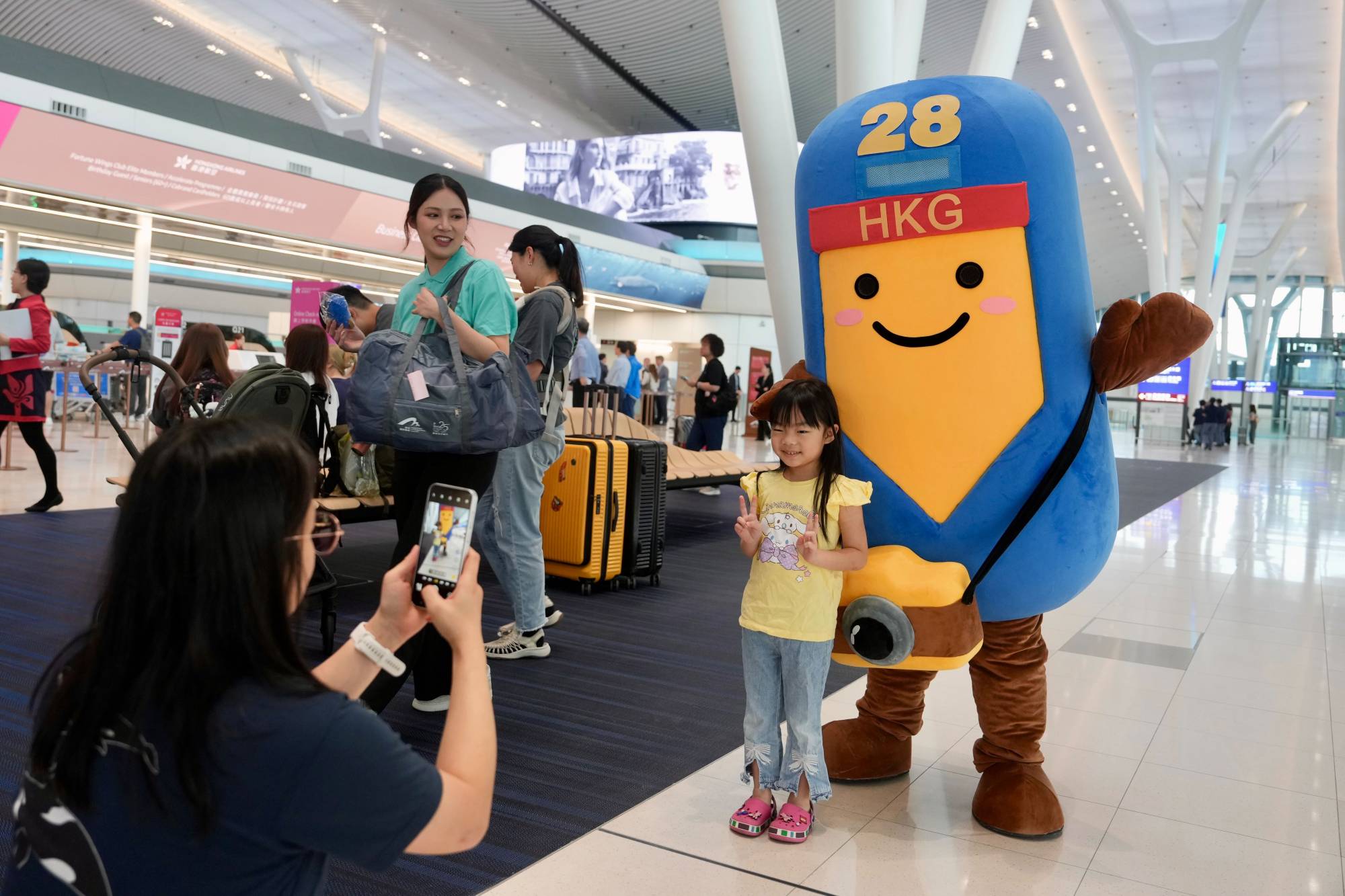
Tang Kwok-chau, a 60-year-old driver, said the new facility offered a better variety of dining options than Terminal 1, and prices were more affordable but still higher than what was available in town.
His family, who were departing for Fukuoka, Japan, spent more than 10 minutes checking in at a staffed counter, which Tang said was slightly slower than at Terminal 1.
“It is the first day after all. The staff might not be very familiar with the equipment,” he said.
Student Adrian Chan, 18, toured the food court and called the choices “average”, adding he would eat on the plane.
Chan said he arrived by Uber and because the ride-hailing app could not pinpoint the facility as a destination, he had to walk for 10 minutes from Terminal 1.
Meanwhile, Airport Authority CEO Cheung said 11 Skies, an office, entertainment and retail complex connected to the new terminal, originally slated to open between 2022 and 2025, should be reconfigured to include fewer retailers.
Indebted New World Development, which was contracted to design, build and operate the complex, is in discussions with the authority to revise the contractual terms.
Cheung said the most opportune opening would be around 2028, in line with the authority’s HK$100 billion (US$12.8 billion) Skytopia megaproject.
“After the pandemic, consumption patterns have changed drastically, and 11 Skies should prepare for that change,” she said, adding that it would feature more entertainment facilities and fewer retailers. -- SOUTH CHINA MORNING POST