




The foreign ministers of the Quadrilateral Security Dialogue, or Quad, nations gathered in New Delhi on Tuesday in a coordinated display of unity aimed at reaffirming the bloc’s relevance amid recent shifts in geopolitical dynamics.
The Quad, comprising the United States, Japan, Australia and India, aims to promote a “free and open” Indo-Pacific and balance China’s expanding influence in the strategically vital region.
With US President Donald Trump fresh from talks with Chinese President Xi Jinping in Beijing, raising questions over Washington’s long-term regional commitment, and with no Quad leaders’ summit held since 2024, the ministers tried to project the message that the four-nation partnership remains active and important.
But the leadership uncertainty was reflected in the joint statement, which said the partners merely “look forward to the convening of the Quad Leaders’ Summit” without specifying when or where it would take place. India was essentially unable to host a leaders’ summit after Trump declined to travel without a US-India trade deal, and Australia is set to take over as chair next.
“The foreign ministers wrapped up their meeting in just over an hour without announcing a summit,” Brahma Chellaney, an Indian international affairs expert, said on social media, observing that “without the political weight of a leaders’ summit, the Quad risks losing its strategic coherence and punch.”
Seeking to dispel doubts about the alliance’s momentum, US Secretary of State Marco Rubio touted strong American backing at a joint press conference.
“We are deeply committed to this partnership. It is a linchpin and a cornerstone of our global strategy,” Rubio said.
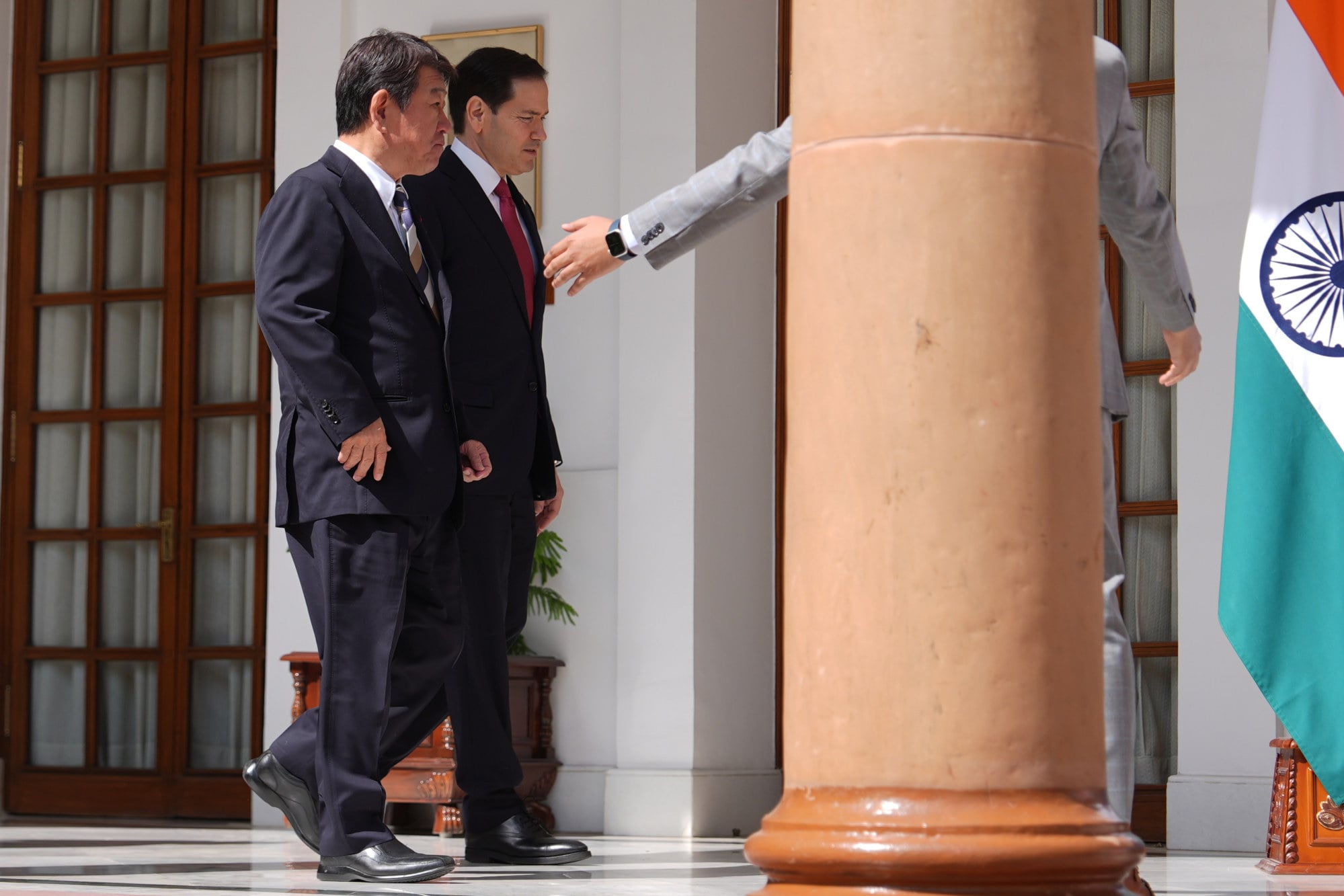
He noted that the alliance represents nearly 2 billion people and about a third of global GDP, adding that the four nations want the Quad to be “a forum of action”, rather than just another platform for discussion.
The most significant policy outcome of the day targeted regional economic vulnerabilities.
In their joint text, the ministers reiterated grave concerns over the use of economic coercion and non-market policies and practices, clearly aimed at China, including “arbitrary export restrictions, price manipulation, and disruptions particularly on critical minerals that impact global supply chains and critical industrial sectors.”
The ministers officially launched the Quad Critical Minerals Initiative Framework, a pact aimed at securing supply chains, mining, processing and recycling to reduce the world’s reliance on Chinese rare earth elements.
China controls over 60 per cent of global rare earth mining and a staggering 85 per cent of the world’s processing and refining capacity.
To bankroll this push, the Quad intends to mobilise up to US$20 billion in government and private sector support. The initiative will back strategic projects with a “Quad nexus” using export credit agencies, development finance institutions and public funding tools such as guarantees, loans and subsidies.
Mirroring this multilateral deal, Indian Foreign Minister Subrahmanyam Jaishankar and Rubio signed a separate bilateral critical minerals framework.
“Vibrant innovation economies such as ours cannot afford to leave the foundational materials of these industries vulnerable to single-source monopolies that could deny us these things,” Rubio said during the signing ceremony.
The framework draws heavily from Japan’s long-standing blueprint for breaking resource monopolies. After China halted rare earth exports to Japan following a 2010 maritime clash, Tokyo launched a US$1 billion diversification drive, backing alternative supply chains and strategic stockpiles.
The effort cut Japan’s dependence on Chinese rare earth imports from over 90 per cent in 2010 to about 60 per cent in 2026. But it still remains vulnerable to Chinese leverage, as does much of the rest of the world.
Relations between Tokyo and Beijing over Taiwan have dramatically worsened following an unprecedented diplomatic and military crisis that erupted in late 2025, when Japan’s China-hawkish prime minister, Sanae Takaichi, explicitly stated that a Chinese military attack on Taiwan would constitute an “existential crisis for Japan”.
Since then, Beijing has placed severe export restrictions on rare earth elements and dual-use technologies bound for Japan, while heavily restricting Chinese tourism and certain imports from Japan.
Meanwhile, Trump has openly suggested using Taiwan as a bargaining chip against Beijing.
The Quad joint statement on Tuesday made no mention of Taiwan but used standard diplomatic language to push back on Beijing’s regional assertiveness, saying it strongly opposes any unilateral or destabilising actions that seek to change the status quo by force or coercion and undermine regional peace and stability.
Beijing considers Taiwan a breakaway province to be brought back under its control, by force if necessary. Most countries, including the US, do not officially recognise Taiwan as an independent state, but Washington is opposed to any attempt to take the self-governed island by force and is committed to supplying it with weapons.
The text on Tuesday also registered “serious concerns regarding dangerous and coercive actions” in the East and South China Seas, explicitly calling out “the unsafe use of water cannons and flares, and ramming or blocking actions.”
Quad ministers also rolled out concrete defence and economic initiatives across the Indo-Pacific corridor.
The debut of the Indo-Pacific Maritime Surveillance Collaboration was announced alongside an expansion of existing maritime domain awareness programmes, aimed at creating a “Common Operating Picture” for regional waters.
Building on the Ports of the Future Partnership, the Quad committed to backing critical port infrastructure projects across key Indo-Pacific shipping corridors. This includes a newly announced pilot port infrastructure project in Fiji.
Against the backdrop of rising energy market volatility driven by US tensions with Iran and surging global oil prices, the Quad also issued a separate joint statement on Indo-Pacific energy security, underscoring energy stability as a strategic priority.
The statement said the four countries are “united by a common vision for a free and open Indo-Pacific, underpinned by robust economic and energy systems”, and warned that disruptions in oil, gas, petrochemicals and related goods “fall heavily on the Indo-Pacific region”.
The framework notably emphasised vulnerabilities in developing and small island states in the Indo-Pacific, and called for coordinated support to strengthen regional energy security. It also announced plans for a Quad Fuel Security Forum to deepen cooperation on energy markets and crisis response.
The meeting took place against what Australian Foreign Minister Penny Wong described as an increasingly challenging regional environment, noting that the Quad must “provide real choices, particularly as strategic circumstances in our region are deteriorating”. -- SOUTH CHINA MORNING POST


