
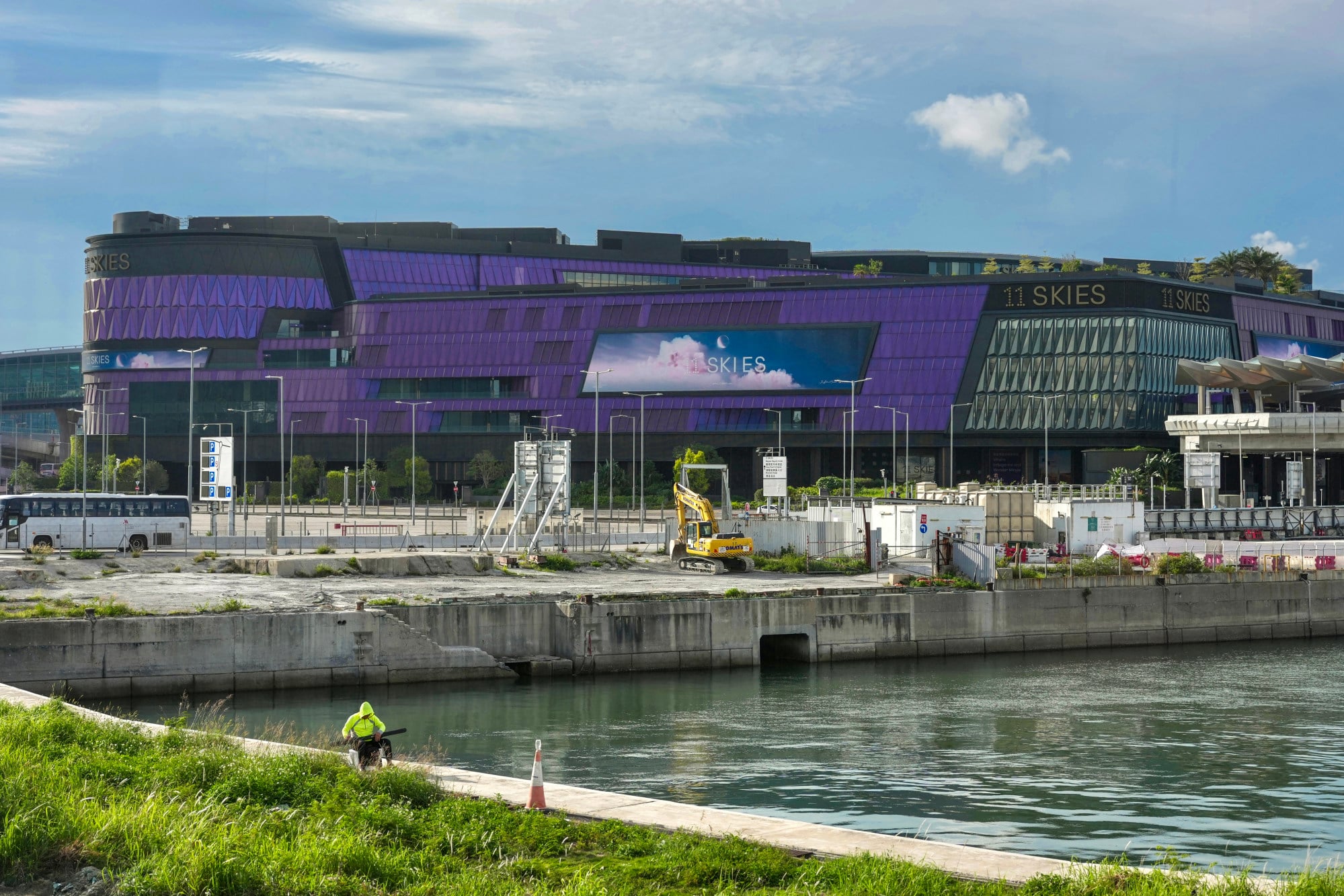
Inside a massive retail and office complex called 11 Skies next to Hong Kong International Airport, all 800 shops sit vacant and only two of 120 food outlets were open earlier this month.
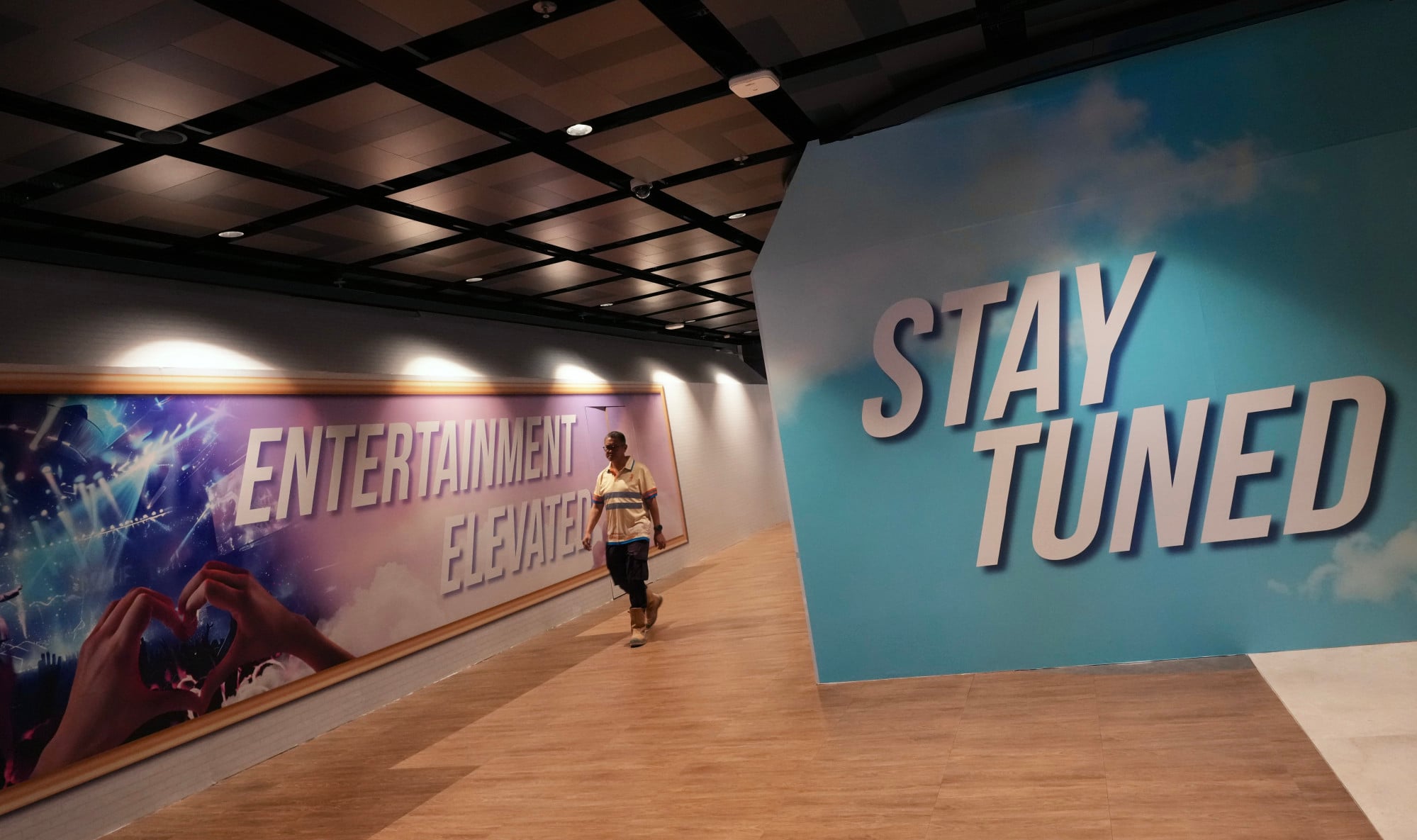
They were supposed to begin operating in the 3.8 million sq ft development – equivalent in size to about 53 football pitches – by last year. A recent South China Morning Post visit to 11 Skies found it largely empty, with areas cordoned off and store spaces boarded up with hoardings featuring adverts for the wider airport megaproject, Skytopia.
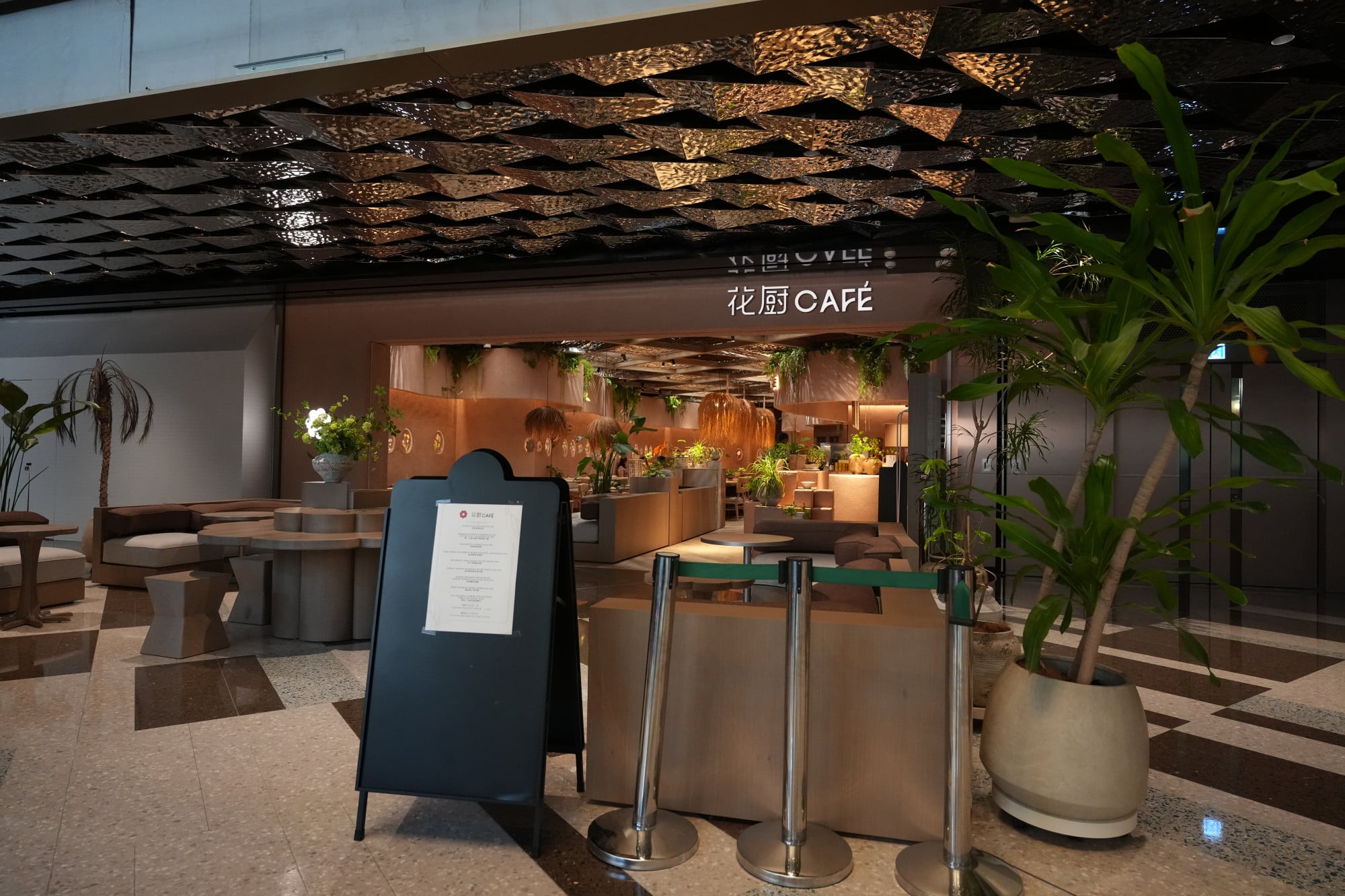
Few lights were turned on, adding to the eerie atmosphere, and the handful of people present were mostly travellers trundling through the empty corridors with luggage on their way to a nearby hotel. At a coffee shop catering mainly to office workers, business was slow.
The Airport Authority, which is now managing the project, is taking the lead in reconfiguring the retail space into dining and entertainment venues and believes the most opportune time for opening will be from 2028 onwards.
Uncertainty surrounding 11 Skies, the ongoing Middle East war and visitors’ changing consumption and travel patterns have created headwinds for the airport’s HK$141.5 billion (US$18 billion) three-runway system project.
Against that backdrop, the authority will reopen the airport’s expanded Terminal 2 on Wednesday as part of efforts to raise its game and strengthen Hong Kong’s position as a global aviation hub. But with competition mounting among regional aviation rivals, will the authority’s strategy pay off and can 11 Skies be put to good use?
Lawmaker Mark Chong Ho-fung said the terminal would give Hong Kong’s standing as an international aviation centre a shot in the arm despite the challenges.
“Terminal 2 is clearly an upgrade of the hardware,” Chong said, adding that the city’s competitiveness in terms of capacity would ultimately rise to 120 million passenger trips a year.
While the corridors of 11 Skies currently resound with echoes, Chong expressed confidence that it would eventually attract footfall with connections to the Hong Kong-Zhuhai-Macau Bridge and a driverless train linking to nearby Tung Chung on Lantau Island in 2028.
“This may help bring mainland shoppers who can drive there, as well as locals not only from Tung Chung but also those in Tuen Mun and Yuen Long,” he said.
‘Broader dimension’
Terminal 2, which closed in November 2019 for reconfiguration as part of the three-runway project, will host 15 low-cost airlines moving in between Wednesday and June 10. Travellers will still need to go to Terminal 1 for boarding until the Terminal 2 concourse is completed for use by the end of next year.
The relaunch follows the commissioning of the third runway in 2024, which was designed to boost passenger and cargo capacity.
At the time, the Transport and Logistics Bureau said the new runway system would add a “broader dimension” to the city’s aviation growth and enable about 120 million passenger trips and 10 million tonnes of cargo throughput annually from 2035.
In 2025, the first full year after the third runway opened, passenger numbers at the airport jumped 15 per cent from 2024 to 61 million. Airport Authority CEO Vivian Cheung Ka-fay earlier said she expected another 15 per cent increase in 2026 to 70 million.
Economist Simon Lee Siu-po said the 2035 target would be difficult to achieve.
“With 61 million passenger trips in 2025, the annual growth required is 7 per cent for the next 10 years, which is higher than the pre-pandemic levels, making it highly unlikely,” he said.
A 2015 study commissioned by the authority forecast the three-runway system would contribute HK$184 billion, or about 5 per cent, to Hong Kong’s GDP by 2030.
Lee noted the authority paid about HK$4 billion in interest annually in the financial years ending March 2024 and 2025, and HK$3 billion in the first six months of the 2025-26 financial year.
He said the previously projected economic benefits were unlikely to occur.
Competition from other airports in the Greater Bay Area is also intensifying. Foshan, one of nine Guangdong cities in the bay area, broke ground on an international airport in March. That will bring the number of major aviation hubs in Guangdong to three, alongside Guangzhou and Shenzhen airports.
Back in 2018, when the city’s tourism was at its peak, the authority tendered the 11 Skies project to capitalise on transit passengers, who accounted for 29 per cent of total traffic at Hong Kong airport.
Designed as an office, retail and entertainment complex for both visitors and locals, 11 Skies was scheduled to open between 2022 and 2025 as the city’s largest shopping centre.
It forms part of the broader HK$100 billion Skytopia scheme, which also includes a 500-berth yacht marina and resort, a 53,000 sq ft luxury arts storage facility and a new 20,000-seat arena at the nearby AsiaWorld-Expo.
The authority said that following changes in consumers’ spending behaviour after the Covid-19 pandemic, 11 Skies would focus more on entertainment and dining and align with the overall Skytopia development.
Beleaguered developer New World Development, which won the contract to design, build and operate 11 Skies for 40 years, said it was in discussions with the authority “to revisit and explore any possibility for changes in the contractual arrangements of the complex”.
Its difficulties have been compounded by debt pressures in recent years. Sources said it had to pay the authority HK$1.8 billion in fixed rent annually regardless of the complex’s profitability.
Lee, the economist, said the fundamentals and environment were now different. “Using 11 Skies to boost retail and catering is just unrealistic now.”
He added that transit passengers with short layovers were unlikely to go through customs to visit a mall, while those with more time could reach Central in 23 minutes via the Airport Express.
“There may also be a mismatch between the positioning of 11 Skies as a luxury mall and potential customers from Terminal 2, which houses budget airlines,” he said. “Passengers might prefer wallet-friendly shopping options.”
A thriving rival
Airports elsewhere were trying to maximise tourism earnings by creating lifestyle and entertainment complexes nearby, experts said.
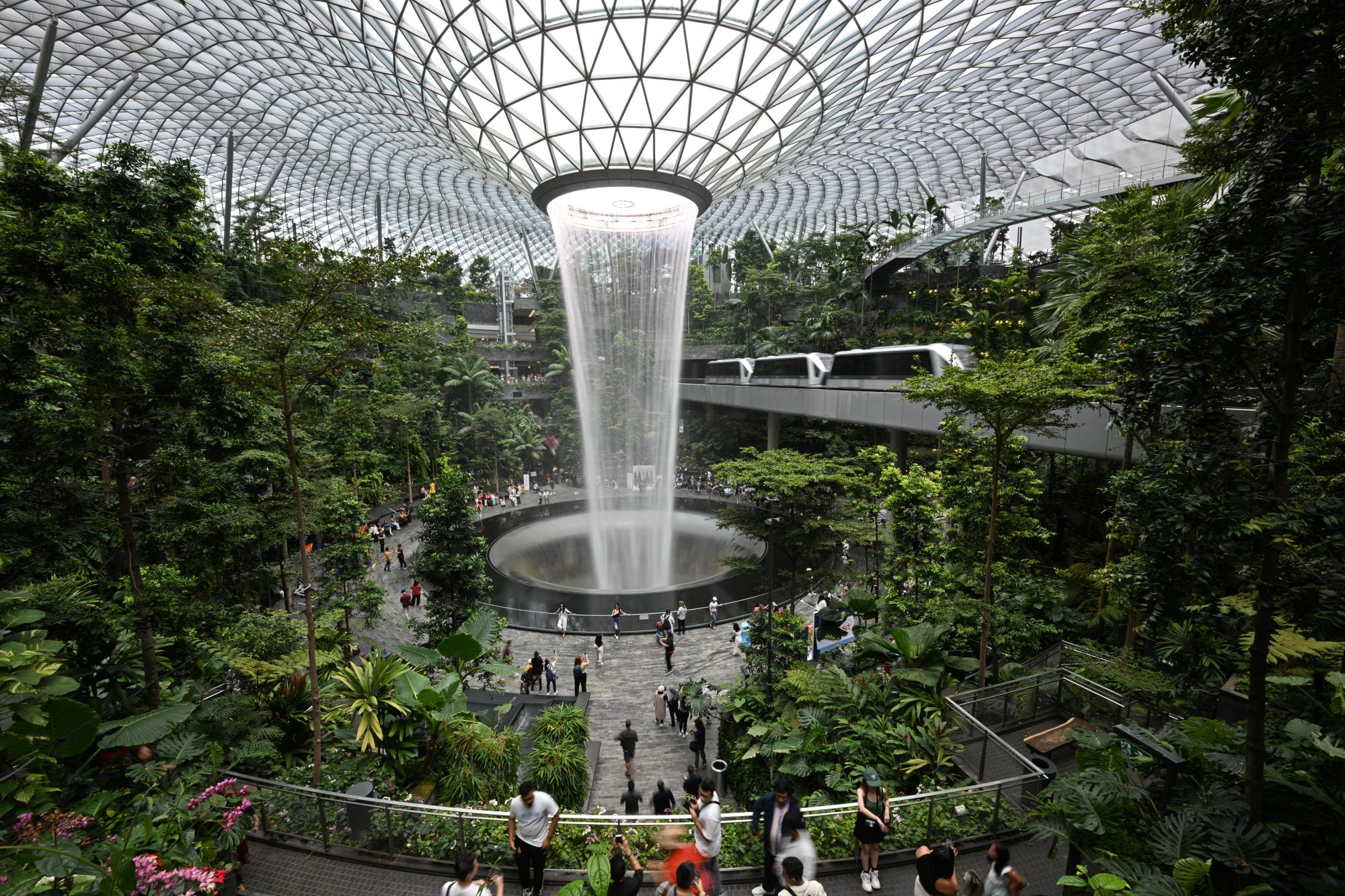
Among the success stories is Singapore’s Changi Airport. It was named the world’s best airport for 2026 by Skytrax, and is recognised as a lifestyle destination rather than just a transit hub. Hong Kong ranked fourth, behind Incheon in South Korea and Tokyo Haneda in Japan.
“What the really successful airports do is that they understand the needs and desires of their customers,” said Max Hirsh, managing director of Zurich-based Airport City Academy, a research centre focused on airport planning and development.
He said Changi Airport was “smart enough” to diversify its customer base to include not just high-net-worth individuals and first-time fliers, but also people who lived nearby such as regional migrant workers and local families.
Beyond its efficient operations and automated immigration services, Changi features the Jewel complex, home to the world’s tallest indoor waterfall and gardens, as well as a free round-the-clock cinema alongside dining and shopping options, turning layovers into part of the experience.
Hirsh said a resilient airport ecosystem had to look beyond passengers to sustain its commercial spaces. It must also tap into the daily workforce and capitalise on the local market.
To attract local residents and short-stay travellers, the strategy had to focus on transit convenience and walkability to offer an exciting taste of the city that encouraged repeat visits across all demographics, he said.
“Airports like Changi, Zurich and Amsterdam are really trying to attract a diversity of different types of customers to the airport city, so that they’re not just completely dependent on one of them,” he added.
At 11 Skies, 70 per cent of the space, or 2.66 million sq ft, is earmarked for retail, with the rest for offices and entertainment.
Vera Yuen Wing-han, a political economy lecturer at the University of Hong Kong, noted that global luxury sales had been falling while mainland shoppers were less interested in designer goods than before.
She said the mall’s original plan to draw footfall by attracting middle-class families with young children was viable, as there was a lack of places catering to their needs in Hong Kong.
“They would be willing to spend upwards of HK$1,000 a day,” she said, adding that while alternatives existed in Hong Kong and on the mainland, it did not hurt to have an extra option.
“Many parents are just looking for a clean, family-friendly place for their children to have fun.”
Yuen said the mall operator would need to work out the positioning of the complex, and that turning it into an attraction itself could draw foot traffic, citing the example of the popular exhibition of sets from the blockbuster film Twilight of the Warriors: Walled In.
“It needs to be something that people will go out of their way to visit, then there will be a higher likelihood of people spending there,” she said.
Blue skies ahead?
Hirsh agreed that airports needed to offer unique or popular attractions, as they competed with city-centre malls. He cited the example of Changi’s Jewel introducing major brands such as Shake Shack.
11 Skies would need to provide exclusive offerings to Hong Kong residents, he said, recalling how AsiaWorld-Expo drew crowds for concerts when local arena venues were scarce in the late 2000s to the early 2010s.
Hirsh suggested operators analyse neighbouring Tung Chung to identify and provide services that were lacking in the community.
Noting the availability of space at 11 Skies, Yuen said the rent would likely be lower than those in the city’s business districts.
Making it a pet-friendly destination could also attract local customers who would be willing to spend, Yuen said, as it was difficult bringing pets across the border.
Law Cheung-kwok, a senior adviser at the Chinese University of Hong Kong’s Aviation Policy and Research Centre, said that despite the headwinds airports were facing, he was confident Terminal 2 could still help the city reinforce its aviation hub position.
He said Hong Kong-based Cathay Pacific Group recorded a 24 per cent year-on-year increase in passengers in March this year and accounted for more than half of the city’s air traffic.
“I estimate Hong Kong airport could reach passenger levels [last seen] in 2019, at about 72 million this year,” Law said, adding that although Cathay had suspended flights to the Middle East, they were only a small fraction of the carrier’s operations.
He noted that Hong Kong still faced difficulties reclaiming transit passengers who switched to hubs like Singapore, Bangkok, Istanbul or Dubai during the pandemic and before the war broke out.
Winning them back remained a challenge because of changed flying habits, loyalty programmes and the need for airlines to restore specific routes via Hong Kong, he said.
He stressed that whether flights could fill Terminal 2 would depend on market forces because if certain routes were not profitable in the long run, no amount of offers or discounts could make airlines keep them. The Airport Authority said Terminal 2 was designed to handle up to 30 million passenger trips a year.
Andrew Yuen Chi-lok, the research centre’s executive director, said airports had to adapt their commercial offerings to match evolving post-pandemic travel behaviour.
“The immediate priority should be rapid repositioning of 11 Skies to better align with today’s passenger and tourist preferences, with greater emphasis on experiential retail, quality dining, entertainment and seamless integration with the terminals,” he said.
He was optimistic that while the Middle East war was creating short-term pressure on fuel costs and airline capacity, such geopolitical shocks “have always proven temporary in aviation”.
“Enhancing the competitiveness of Hong Kong International Airport is essential for the city’s future as an international aviation, financial and tourism hub,” Yuen said, adding that Terminal 2, 11 Skies and the third runway remained “a clear long-term strategic boon” for the airport. -- SOUTH CHINNA MORNING POST