
SINGAPORE: The Indonesian guide who led a group of 19 trekkers up Mount Dukono last Friday (May 8) insisted that he did nothing illegal, even as he apologised for the deaths of three climbers including Singaporeans Shahin Muhrez Abdul Hamid and Timothy Heng, and Indonesian Angel Krishela Pradita.
Reza Selang, 35, told The Straits Times that he was not notified of any prohibitions against climbing the active volcano on Halmahera island in North Maluku, Indonesia.
He said that other guides had led clients up the peak, which is about 1,200m above sea level, in previous weeks.
Reza said he had relied solely on a local villager from the nearby village of Mamuya, about 15km away from the volcano, who assured him there were no signs of recent activity before the group began their ascent.
A climbing ban had actually been imposed by local authorities on April 17 following increased volcanic activity, and the alert status for the volcano has been set at the second of Indonesia’s four volcanic alert levels.
The authorities closed the mountain to visitors and restated that all activities, including hiking, were prohibited within a 4 km radius of the Malupang Warirang crater.
A notice announcing the ban was placed at the Volcanology Observation Post in Mamuya.
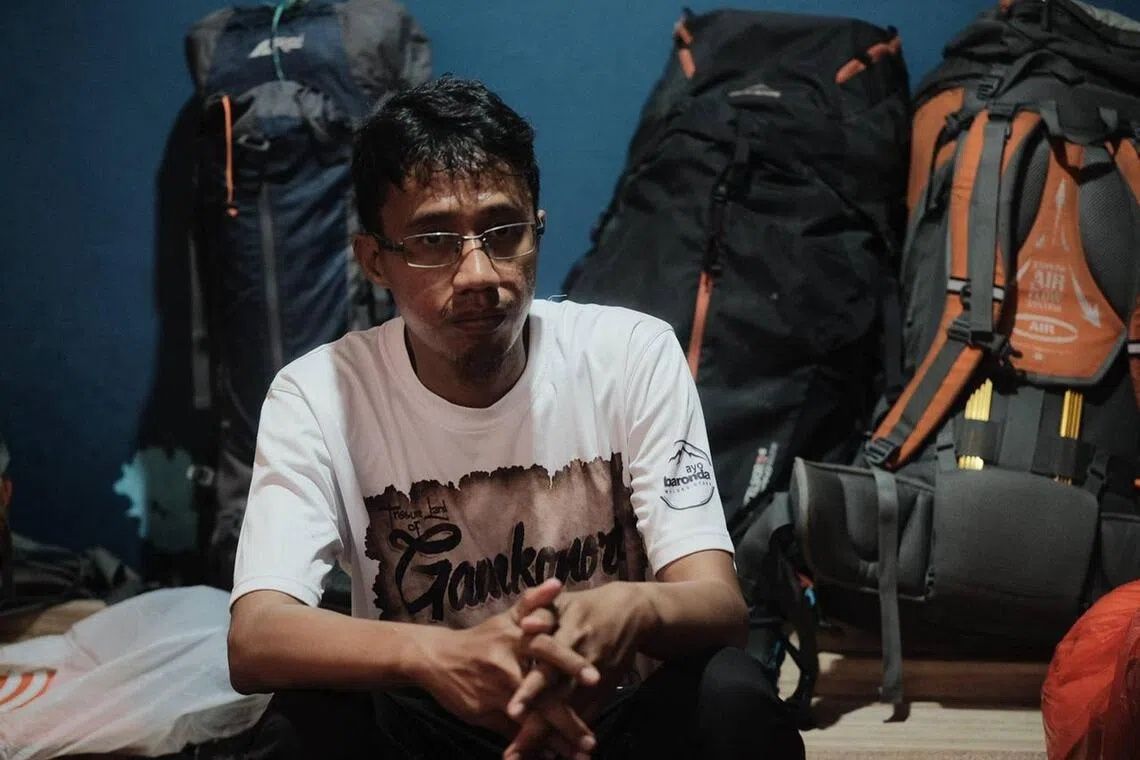
Reza, who is from the neighbouring Ternate island, admitted that he did not stop at the observation post, arguing that it only provides updates on the volcano’s status and “does not have the authority to issue permits for climbers”.
He said: “First, of course, I ask for forgiveness from the victims’ friends and families... of Angel, Timo and Shahin.
“Second, I didn’t enter (Mount Dukono) illegally. We did not receive the letter warning not to enter Mount Dukono before our climb.
He added that a guide he hired from Mamuya village did not inform him of the increased volcanic activity.
“The problem is that the community of climbers and different trip providers did not receive the same information. We did not get information about the eruption.
“In fact, trip providers based in Tobelo climbed Mount Dukono on May 1 and 2, on May 8, there were other climbers who reached Mount Dukono via the Ruko trail,” said Reza, who has been guiding people up different volcanoes on Halmahera island since at least September 2022.
Mountain guide Alex Djangu, 48, who has been in the business since 1996, said it is important for trekkers to check in at the observation post.
“You should not listen to the villagers because they live too near the mountain and they may not be aware of seismic activity.
“Only the observation post will be able to advise a guide on the latest weather information and potential dangers,” he said, adding that foreign climbers must register in Tobelo, the capital of the North Halmahera regency.
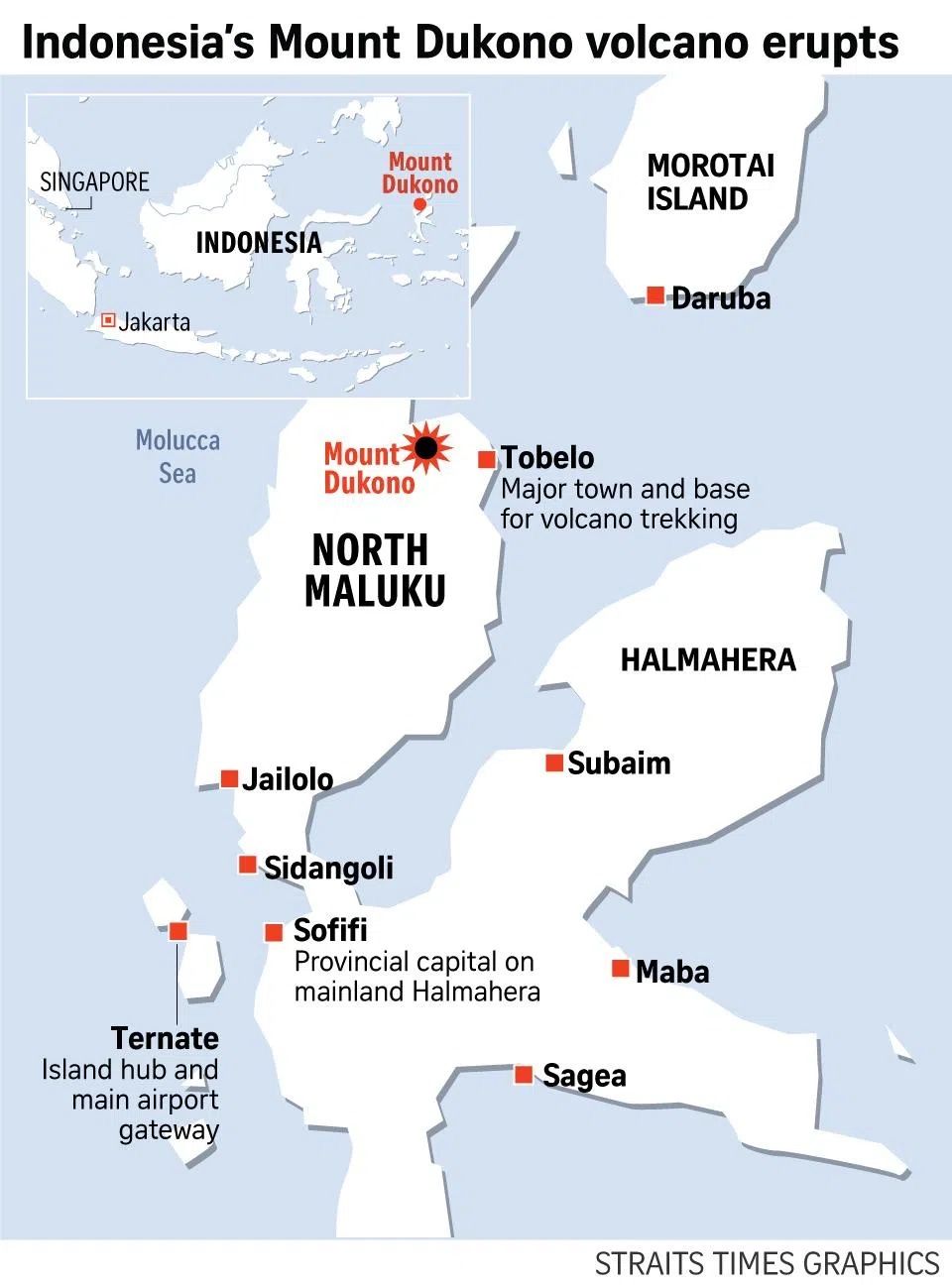
Tourists typically fly in to Ternate before taking a ferry to Sofifi, a town on Halmahera island. They then travel by car about four hours north to Tobelo.
From Tobelo, they head to Mamuya before starting the ascent. While there are two official entrances to Mount Dukono, via Mamuya and Ruko villages, there are several alternative routes as well.
The routes through the villages have checkpoints dotted across the trails.
In his recount, Reza said he and the 19 trekkers he was guiding had set out at about noon on May 7, making their ascent early the following day.
The group comprised 11 Indonesians and nine Singaporeans - Lim Shan De, Venessa Lee, Geraldine Tan, Selene Ong, Eugene Toh, Phoebe Lim, Iris Loh Hui En, Shahin and Heng, who organised the trip.
The Singaporeans had posted a group photo on a social media platform before they headed to Indonesia.
Among the Indonesians, three were tourists from other provinces, while the remaining eight were guides and porters.
They had embarked on the Mamuya trail, which starts from the village of the same name and stretches for about 15km.
Djangu took a different route from Ruko village, located about 8km away from Mamuya, which led him to the east of Mount Dukono.
He was guiding two German tourists that same day, and was able to see what he presumed to be the group of Singaporean climbers hiking up the mountain.
This alternate route allows visitors to observe the crater’s rim safely from 4km away, he said, adding that he takes about 100 foreign tourists each year.
He added: “Some tourists can be persistent, wanting to get closer to the rim of the crater. I tell them that you can see rocks landing in front of us. If it hits your head, even if you’re wearing a helmet, it will kill you.”
A video that Djangu captured of the larger group ahead of them at about 7.14am showed roughly a dozen people ascending Mount Dukono.
About half an hour later, at 7.41am, the volcano erupted, sending volcanic ash and rocks hurtling down the mountain.
A second video he filmed showed clouds of ash engulfing some of the climbers, while his voice can be heard in the background saying: “Oh my God, it has killed them.”
A separate video on social media showed the group of climbers fleeing to safety, with one heard yelling that “Angel was left behind”.
The body of the 28-year-old Indonesian national was the first to be found on May 9.
Rescuers found the remains of Heng, 30, and Shahin, 27, the next day.
Their remains are currently housed at the Tobelo Regional Hospital, and it will take about two weeks for the identification results to be completed, said the local government of North Halmahera on May 12.
It added that the families have yet to decide whether the victims will be buried in Indonesia or repatriated to Singapore.
Many licensed local guides are now concerned about the potential backlash and reputational damage to the region’s hiking industry following the fatal incident.
On May 8, the local authorities ordered the permanent closure of all entry points to the volcano, a tougher stance compared to the initial climbing ban imposed earlier.
Djangu said that unlike Reza, who uses drones, most of the other local guides do not.
While traditional guides may lack social media flashiness, he cautioned that drone footage does not provide the most accurate representation of conditions on the ground.
“That’s why we take foreign climbers to the observation post to show them the seismic data and warnings by the authorities. If it’s too dangerous, we will not summit the mountain,” he said.
Another guide, Sababil Parasaja, said climbers would have been informed at the post about whether it was safe to climb and reminded of safety perimeters, such as the 4km exclusion zone around the crater.
Choosing to ignore official guidelines is a personal choice, he said, adding: “If you choose to climb to the summit, even though there was no recommendation to do so, then you have to bear the risks and responsibilities if anything goes wrong.”
The 28-year-old from Mamuya did not lead anyone up the mountain on May 8, but assisted in the three-day recovery operations for the three victims.
Mountain guides
Foreign climbers rely on mountain guides because they know the terrain and have the experience to lead climbers on a trek safely.
Andyn Kadir, who has climbed active volcanoes in Indonesia such as Mount Rinjani, Mount Kerinci and Mount Raung, as well as peaks in Nepal, said guides are very important because foreign climbers are unfamiliar with the mountains.
“Active volcanoes are unpredictable and only local guides would know the activity level of the volcanoes,” he said.
“And when you take along other climbers who may not be competent, then guides become more important as they would know what to do in an emergency, or which routes to take when escaping danger.”
Andyn, 41, said on one expedition, his group was almost 100m away from Mount Kerinci’s peak when bad weather forced the group to abandon its push to the top in 2024.
Climber Kim Tsen, 60, who in January 2026 had climbed Mount Everest’s base camp, said in harsh conditions, a licensed guide can be your lifesaver.
“We trekked to the Everest base camp in minus 22 deg C,” said Tsen.
“If I wasn’t fit enough or showed signs of altitude sickness, the guide could have ended my hike early.
“The good thing about licensed guides in Nepal is they are able to get a helicopter to evacuate you in any emergencies.”
From start to finish, a guide handles a climber’s documentation, permits and registration at the start of a trek.
There are climbers on a budget who hire unlicensed guides. But that may be a risk you want to avoid, Tsen said. - The Straits Times/ANN