SEOUL (The Korea Herald/ANN): South Korea is expected to see the lovebug – a summer fly – emerge in large numbers slightly earlier in 2026, with the adult population forecast to peak around the same date as in 2025, according to local media reports citing the National Institute of Forest Science under the Korea Forest Service.
Lovebugs, or Plecia nearctica as they are more formally known, are expected to reach adulthood en masse between June 15 and 29, with their numbers peaking on June 24, local daily Seoul Shinmun reported.
The forecast puts their emergence two days earlier than in 2025, when adult lovebugs appeared in large numbers from June 16 to July 4. Their population in 2025 also peaked on June 24.
The prediction was based on temperature changes and observation data from 2023 to 2025 posted on Naturing, an online wildlife monitoring platform.
The institute attributed the earlier emergence to higher spring temperatures, as lovebugs develop at different speeds depending on climatic conditions.
The period of peak emergence is also expected to shorten from 18 days in 2025 to 15 days in 2026.
A shorter emergence period means adult lovebugs are likely to appear in a more concentrated burst, making swarms in certain areas more noticeable than in 2025.
Despite being harmless to humans, the summer insects have become a public nuisance, with large swarms causing discomfort, disrupting pedestrian traffic and drawing complaints from residents.
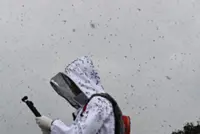
Photos and videos of lovebugs blanketing the slopes of Gyeyangsan in Incheon in 2025 drew alarm online. The Seoul Metropolitan Government has received an average of about 5,000 lovebug-related complaints a year since 2022, with complaints peaking at 9,296 in 2024.
Plecia nearctica are called lovebugs because they are often seen flying in mating pairs while searching for food.
Native to south-eastern China and the island of Okinawa, Japan, the insects prefer hot and humid conditions.
They have been reported in Seoul since 2018, with outbreaks concentrated around Gyeyangsan in Incheon and Seoul’s Eunpyeong-gu and Seodaemun-gu.
Lovebugs are considered ecologically beneficial because they help pollinate flowers and serve as a food source for fish, birds and other insects. Feeding on dew and nectar, they do not bite people or transmit disease.
The flies live for three to seven days after reaching adulthood, and a single pair can lay up to 500 eggs.
Seoul to test rose-scented traps
Seoul plans to install 1,300 insect traps using rose scents near parks and mountains in 19 districts in June and July, Mr Song Eun-cheol, director of the Seoul Metropolitan Government’s Infectious Disease Control Division, told local Korean-language daily JoongAng Ilbo.
The new control method is being piloted in 2026, based on research suggesting that certain species in the Bibionidae family, to which lovebugs belong, are attracted to rose scents.
The city plans to use the traps to lure lovebugs away from residential areas to outer areas.
Meanwhile, pest control teams have begun preventive work in mountain areas by spraying a control agent that targets fly larvae.
The control operations are also being used as part of research into the effectiveness of the agent and the habitat conditions preferred by lovebugs.
Pest control teams have left larvae untouched outside designated treatment zones marked with orange lines, while researchers collect samples from 16 areas with different environmental conditions, including altitude, direction and slope.
The city plans to use the results to identify high-risk areas through a geographic information system.
Some analyses have already suggested that lovebug habitats could expand to northern Gyeonggi Province in 2026.
“An analysis of 102 regions nationwide showed that Seoul and northern Gyeonggi had the highest concentrations of larvae,” an official at the National Institute of Biological Resources said.
The official added that lovebug larvae had been found in most parks across Seoul’s 25 districts, as well as in parts of southern Gyeonggi Province.
The official warned that lovebugs can expand their habitat by hitchhiking on vehicles. -- THE KOREA HERALD/ASIA NEWS NETWORK