
SINGAPORE: When night falls, a relentless thwacking begins against the lights of Tampines Changkat, as droves of cicadas dive into lit corridors and flats to the fear and fascination of residents.
The seasonal emergence of the orange-winged cicada (Asianopleura fulvigera) is just another day in the neighbourhood, where complaints about annual swarms of adult cicadas have mounted since late 2018.
While cicadas spend most of their lives underground, they emerge as winged adults for a few weeks to mate. Some species can end up in buildings at night as they rely on light to navigate.
In a bid to divert some cicadas away from homes, the recently formed cicada task force – led by Tampines Changkat MP Desmond Choo – has resorted to setting up light traps on an almost nightly basis since April 10.
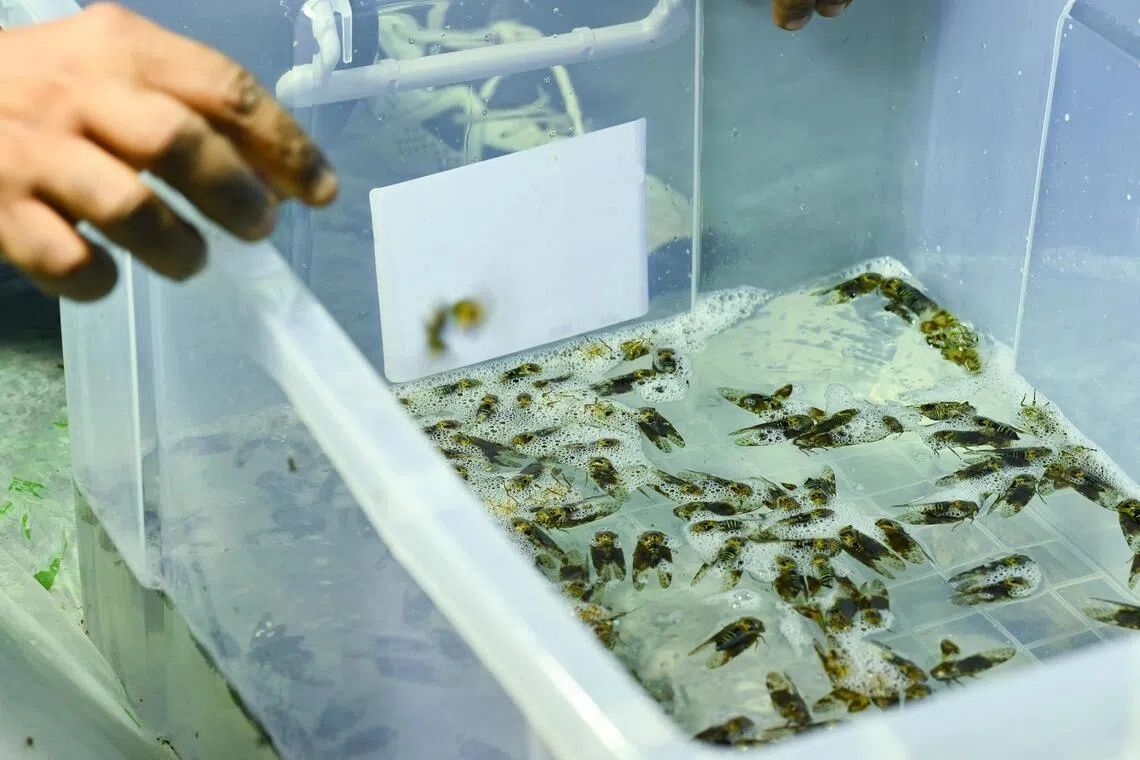
As at April 23, the task force has caught more than 7,000 orange-winged cicadas, which are native to South-east Asia, but possibly foreign to Singapore.
These figures were provided to The Straits Times by members of the group, a collaboration between the Tampines Town Council, insect scientists, and the volunteer-run Tampines Changkat Nature Kakis Chapter to study and address the neighbourhood’s cicada woes.
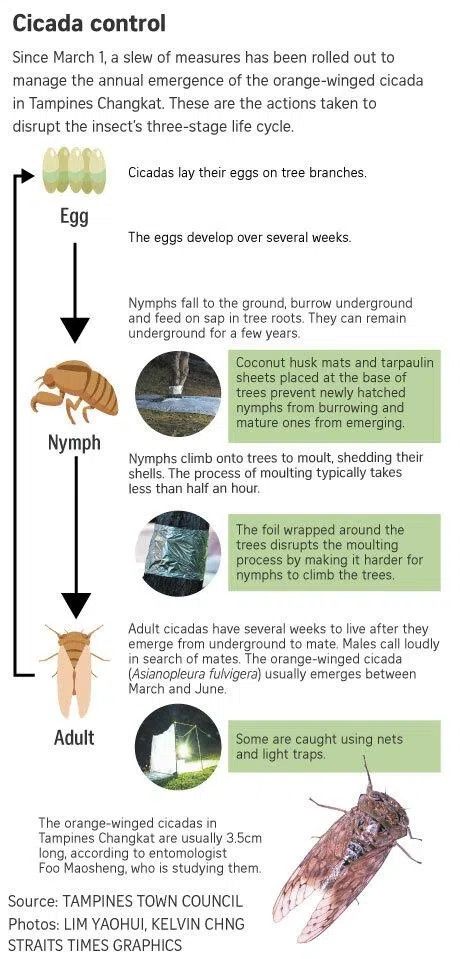
For a start, the task force launched on March 1 is trialling measures that disrupt the orange-winged cicada’s three-stage life cycle over a five-month period to put a dent in their numbers.
Entomologist Foo Maosheng, who leads the task force’s research, said the sheer volume of orange-winged cicadas caught by the traps suggests a possible ecological imbalance arising from the absence of natural enemies that help control the population. These include predators and parasitoids – organisms that develop on or inside hosts and eventually kill them – which are not well understood.
“Light traps are typically meant to survey an area’s insect diversity, especially nocturnal ones, so you will get all sorts of insects, like moths, ants and some leaf bugs,” said Foo, insect curator of the National University of Singapore’s Lee Kong Chian Natural History Museum.
“However, when I set up my traps, I realised only adult cicadas were flying in. Very few insects from other species were attracted.”
One possible explanation is that the swarms of cicadas, which feed on plant sap using their straw-like mouths, have crowded out other insects that occupy the same niches on the trees, he added.
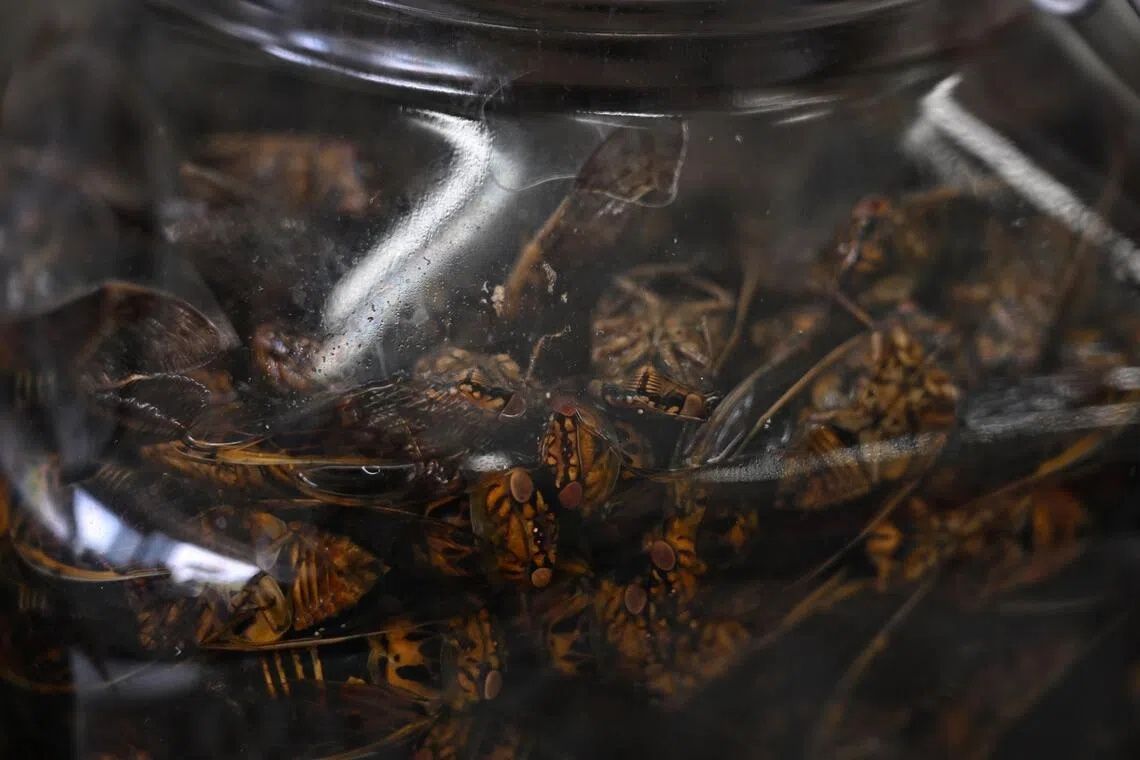
The extent of this interaction will need to be studied in detail, said Foo, who has collected more than 1,300 cicadas so far for research and education.
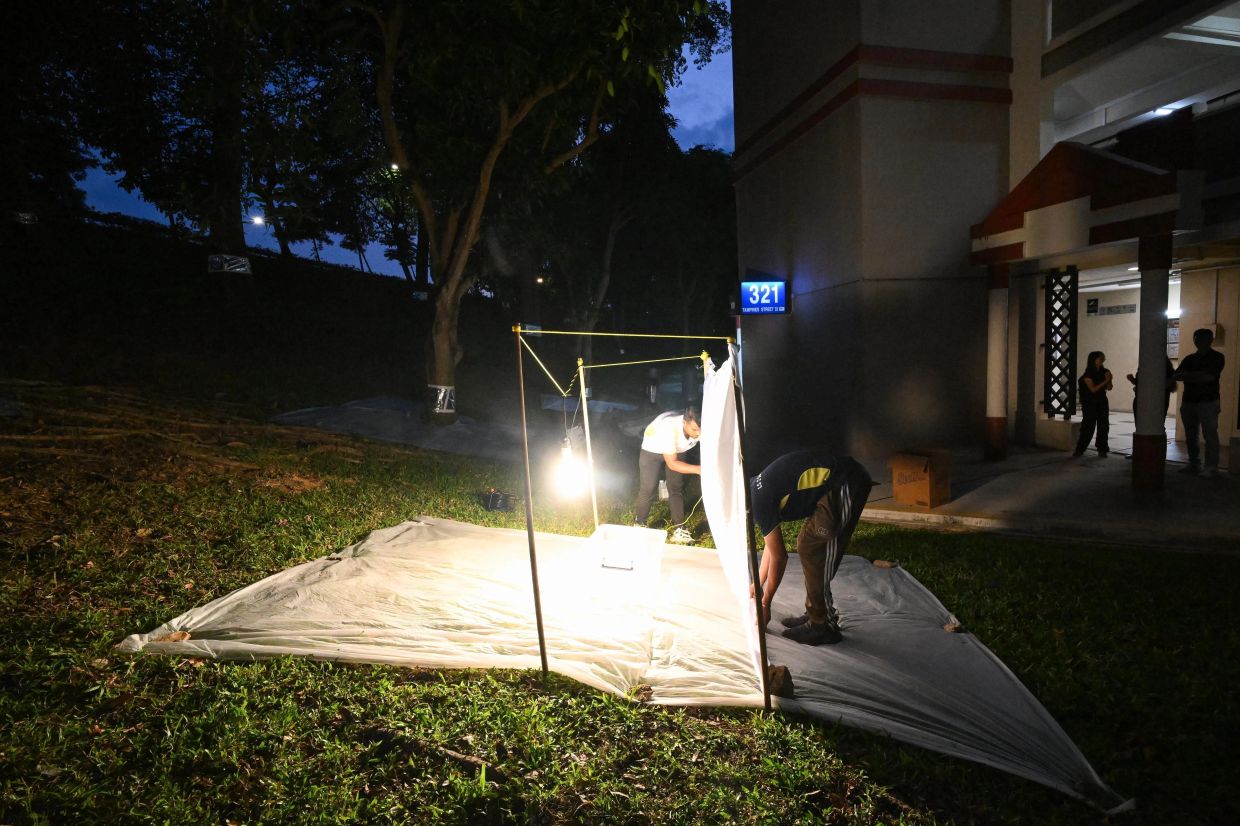
This is but a fraction of the cicadas emerging in the neighbourhood. On just two nights, some 2,000 cicadas were caught at the same hot spot, members of the task force told ST during an April 23 trapping operation near the HDB blocks in Tampines Street 22 and 33.
Following a brief chorus at dusk, the cicadas gradually emerged. The insects, roughly the length of a standard paperclip, hurled themselves into containers of soapy water placed inside the light traps, which often caught the attention of curious onlookers as well.
By the end of the three-hour exercise, about a thousand cicadas had been caught, counted and disposed of by town council contractors.
These contractors are occasionally joined by volunteers from the local chapter of Nature Kakis, who go door to door to gather feedback and teach residents about the insects.
Cicadas are one of the loudest bugs in the world, with males competing against each other to attract females by amplifying their songs.
Lilian Chia, who leads the Nature Kakis chapter, recalled that in the task force’s early days, frustrated residents would complain about the noise from 7am, with some calling for the trees harbouring the insects to be cut down.
However, tree removal has been ruled out as a long-term solution because the greenery is vital for dampening noise and cooling the estate.
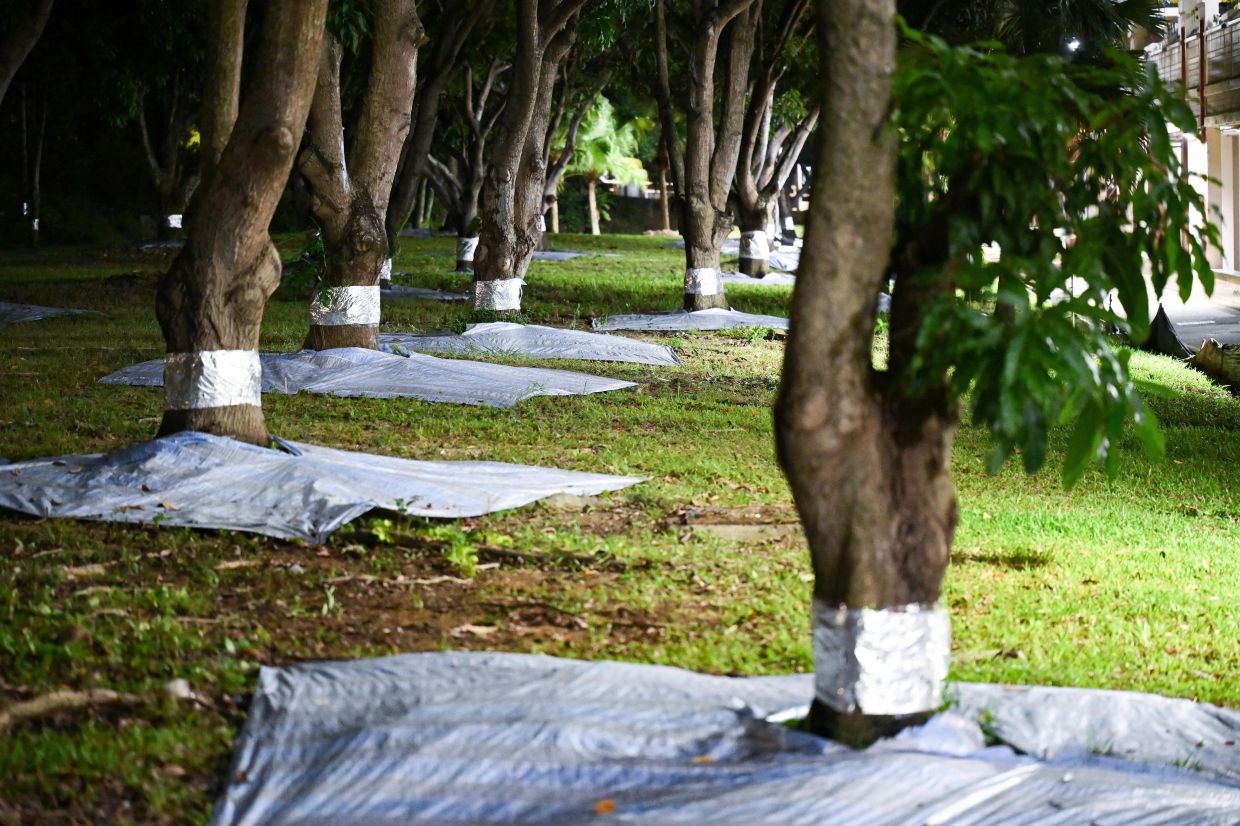
Instead, task force members have targeted hot spots by wrapping over 520 trees with aluminium foil and placing mats at their bases. The mats are expected to reduce the number of cicada nymphs emerging from the ground, while the aluminium foil prevents those that emerge from climbing onto trees to begin moulting, thereby hindering them from becoming winged adults.
“We want residents to know that cicadas are harmless: They don’t sting or bite and they play a part in the ecosystem,” Chia said.
Cicadas help keep trees healthy as their nymphs aerate the soil and their carcasses act as nutrients in the soil. The insects also feed wildlife.
Chia said residents generally become more understanding once they learn more about the insects’ behaviour, especially knowing that the period they emerge to search for mates is usually limited from March to June.
Some have even pitched in to help trap the insects. “The children enjoy it. They think it’s a game,” said the 70-year-old.
Following the slew of measures, complaints appear to have dipped.
Sales coordinator Esther Yap, a Block 343 resident, discovered the task force three weeks ago after cicadas began flying into her flat.
“The first week was the worst,” said the 55-year-old, who now volunteers to monitor the insects and wrap trees. “People could not sleep at midnight because the cicadas were too loud.”
Since the measures expanded beyond the initial hot spots, she said the noise has dropped considerably, and no cicadas have flown into her home.
However, Calvin Yong, a resident of Block 314, wonders if current efforts would simply drive the cicadas elsewhere.
While the number entering the 60-year-old healthcare professional’s home has halved following population control efforts, the sound of cicadas calling outside his balcony has intensified, a noise previously heard primarily in the carpark.
MP Desmond Choo told ST that residents have been given a platform to identify hot spots, enabling the town council to take prompt and targeted action to cover more areas.
Choo, who is also vice-chairman of Tampines Town Council, said: “A significant number of cicadas have been captured in (the light traps), and are being studied. Given their success, we will deploy more traps to the other estates.”
The task force is also piloting a project to change the intensity and colour of corridor lights in affected blocks, with the aim of reducing the number of insects flying there.
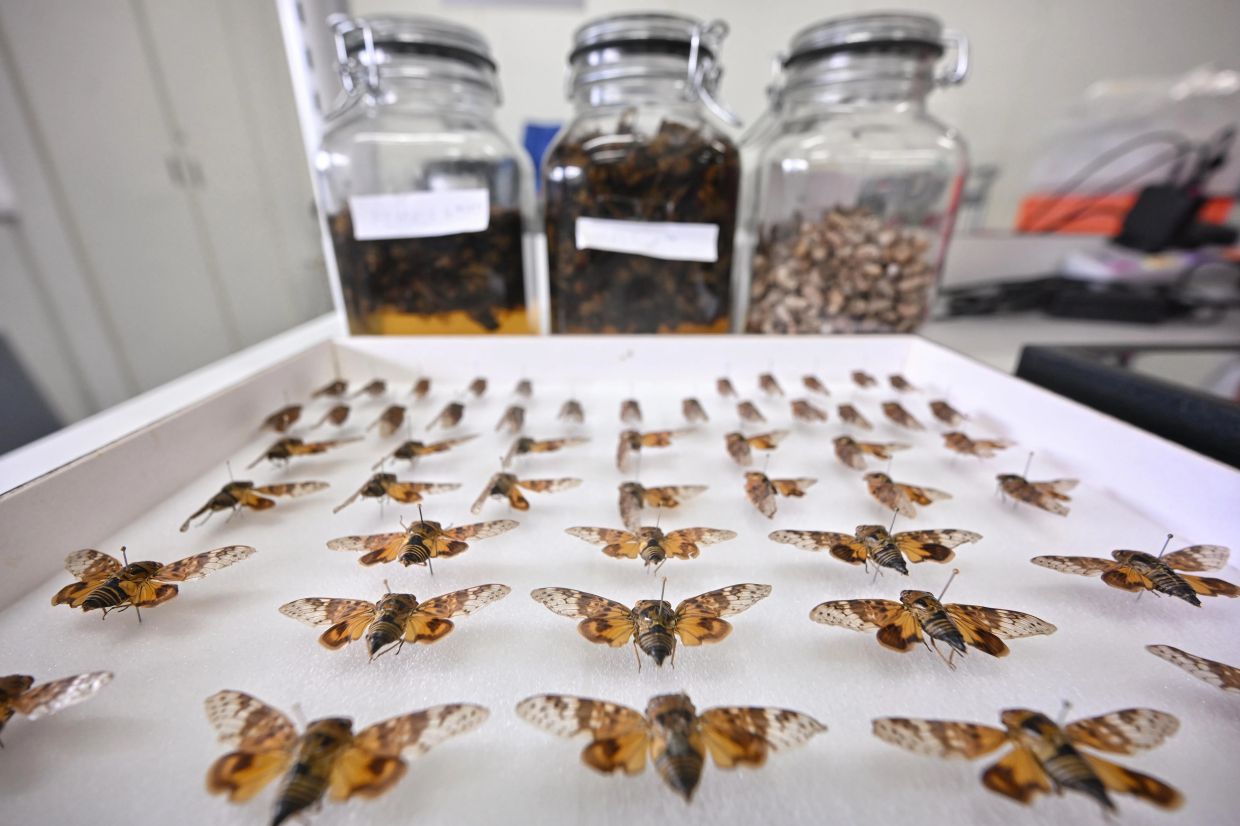
Meanwhile, the team is managing the situation through physical trapping and removal of cicadas to reduce the population, said Choo.
“We will continue to monitor the situation closely and refine our approach as we test and learn what works best,” he added.
Part of the reason why managing the cicada population is challenging lies in the fact that little is known about cicadas and the distribution of the 11 species recorded in Singapore so far.
It is unclear whether the orange-winged cicada, which has also been found in the Philippines, naturally occurs in Singapore, with several long-time residents in Tampines Changkat describing the swarms as a recent occurrence.
This forms a key part of the task force’s multi-year study, which will investigate how the cicadas arrived in Tampines Changkat, seemingly out of the blue.
Naturalist and nature guide Leong Tzi Ming, who has documented local cicada diversity and behaviour, first spotted the orange-winged cicada, formerly classified as Platypleura fulvigera, in Changi in 2018.
Dr Leong suggested the species could have arrived via imported plants and soil. “As much as some plants are quarantined, there’s no surefire way to eradicate all the larvae,” he noted. “Unlike the brown anole lizard, the cicadas have wings, meaning they can spread without a green corridor.”
Current observations suggest that the orange-winged cicada is common in the eastern part of Singapore, according to Foo, who has been studying the distribution of cicada species across the Republic.
Despite current measures to cut their numbers, some of the species do survive.
In the hour after contractors packed away their equipment at 10pm, ST observed two more cicadas shedding the shells of their youth on the trunk of a tree ringed with foil.
“It’s the first time I’ve seen this up close. It’s so interesting,” marvelled one worker, who stayed behind to watch the transformation. - The Straits Times/ANN