




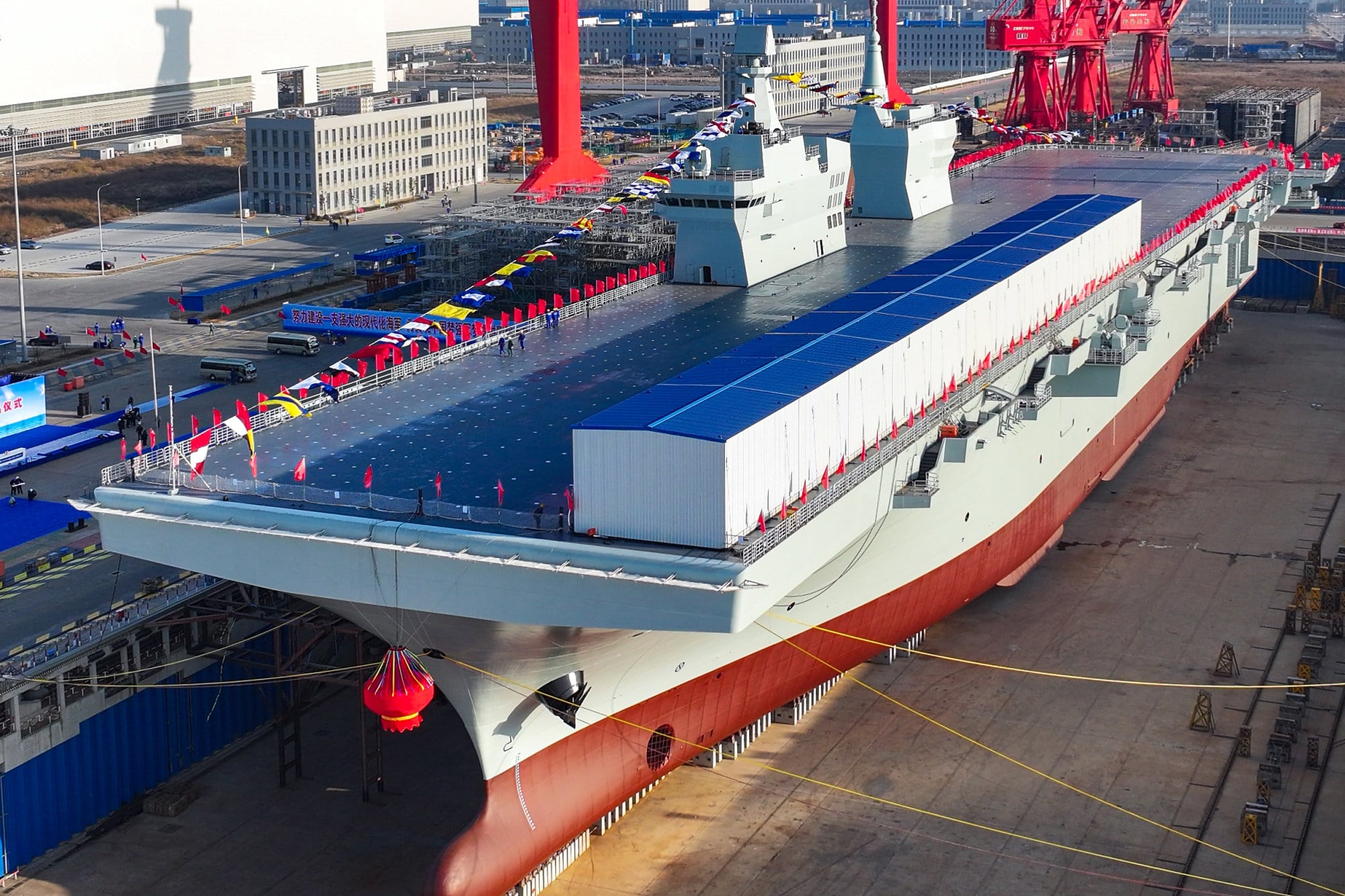
China’s next-generation “drone-carrier” amphibious assault ship is en route to the South China Sea for critical sea trials, the military announced on Tuesday, in the same waters where the US, the Philippines and Japan are conducting large-scale joint military exercises and the aircraft carrier Liaoning is apparently sailing to.
“The Sichuan, our country’s first Type 076 amphibious assault ship, has set sail from Shanghai for relevant waters in the South China Sea to carry out scientific research trials and training missions, testing the performance of multiple on-board systems and platforms,” the People’s Liberation Army (PLA) Navy’s official Weibo account said.
The brief notice added: “This is a routine cross-regional trial and training exercise organised in accordance with the vessel’s overall construction plan and is not directed at any specific target.”
The Sichuan completed its maiden sea trial in November and is viewed as a key asset in any potential move against Taiwan. It is designed to transport landing craft, troops, armoured vehicles and aircraft to support amphibious operations.
Taiwan’s ministry of defence said on Monday afternoon, before the Sichuan sailed, that the PLA’s first aircraft carrier, the Liaoning, had transited the Taiwan Strait earlier that day. Its course suggested the warship’s destination was also the South China Sea.
Photos released by the ministry on social media showed eight J-15 fighter jets and three helicopters on the Liaoning’s flight deck.
The PLA has yet to announce whether the Liaoning is taking part in any specific mission.
As the Sichuan and Liaoning head for the contested South China Sea, Washington and Manila are conducting their annual Balikatan exercise in the same waters.
While the drills are held across the Philippine archipelago, the main exercises are reportedly taking place in areas facing the South China Sea and Taiwan, including Luzon in the northern Philippines.
China has overlapping sovereignty claims in the South China Sea with several regional countries, including the Philippines. Vessels from Beijing and Manila have collided or come into close contact on multiple occasions over the past few years.
The exercise also marks Japan’s first active participation, with the Self Defence Forces dispatching multiple warships and aircraft, Type 88 anti-ship missile systems and roughly 1,400 personnel – making Japan the third-largest troop contributor to the drills, which run from April 20 to May 8.
This year’s drills also include participation from the militaries of Australia, Canada, France and New Zealand.
At a Senate Armed Services Committee hearing on Tuesday, Admiral Samuel Paparo, head of US Indo-Pacific Command, said the exercise involved close to 19,000 troops, making it the largest ever.
Paparo described deterring China as the US military’s “highest duty” in the Indo-Pacific, saying this year’s exercise reflected the deepening “alliances” and “partnerships” between the US and regional allies.
“The US-Japan alliance ... is absolutely the centrepiece of our system of network and alliances in the Indo-Pacific,” he added.
The exercises are expected to include maritime strike operations, counter-landing drills, and air and missile defence – capabilities that analysts often view as crucial for the US and its allies to stop the PLA in the event of a conflict in the Taiwan Strait.
Beijing sees Taiwan as part of China to be reunited by force if necessary.
Most countries, including the US and Japan, do not recognise Taiwan as an independent state, but Washington is opposed to any attempt to take the self-ruled island by force and is committed by law to supplying it with weapons.
On Friday, the Japanese destroyer JS Ikazuchi, en route to the South China Sea for the exercise, spent 14 hours navigating sensitive waters in the Taiwan Strait. Beijing condemned the transit, calling it a “deliberate provocation”.
The day happened to mark the anniversary of the 1895 Treaty of Shimonoseki – also known as the Treaty of Maguan – an unequal treaty that forced the then-ruling Qing dynasty to cede Taiwan to Japanese colonial rule.
In a commentary on Saturday, the military mouthpiece PLA Daily accused Tokyo of “harming the feelings of the Chinese people” by timing the transit to coincide with the anniversary.
In an apparent response to the transit, the PLA Eastern Theatre Command, which oversees the Taiwan Strait, sent a naval formation through the Yokoate Channel into the Western Pacific for “routine” combat training on Sunday.
The PLA said its movements through the channel, a strategic gateway to the open Pacific that is heavily guarded by Japanese forces, were “not directed at any specific country” and were in compliance with international law. -- SOUTH CHINA MORNING POST


