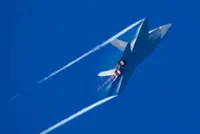
A Chinese university student has been charged with unauthorised photography of US military aircraft in Nebraska during a road trip through several states, which included a stop at an air force base in South Dakota.
Tianrui Liang, who is studying in Glasgow, was arrested at New York’s John F Kennedy International Airport on April 7 as he attempted to return to Scotland, court documents filed in the Eastern District of New York revealed.
The 21-year-old has been charged with photographing defence installations without authorisation, which is prohibited under US law.
On March 26, Liang flew to Vancouver, Canada, to meet a friend who attends university in New York. The pair drove across the US border in Washington state before the friend returned to New York to attend classes. Liang then drove to Ellsworth Air Force Base in South Dakota, the affidavit stated.
He then travelled from Ellsworth to Offutt Air Force Base near Omaha, Nebraska, where he told investigators that he had photographed several aircraft, including an RC-135, a reconnaissance plane, and an E-4B, the FBI said. The base is home to the US Strategic Command.
According to the US Air Force, the E-4B Nightwatch, commonly known as the “doomsday plane”, serves as a national airborne operations centre and is part of the national military command system for the president, the secretary of defence, and the joint chiefs of staff. In the case of a national emergency, it can act as a “flying Pentagon”.
A witness reported seeing a vehicle pulled off the road near the Nebraska base and a man holding a camera with a telescopic lens. “The witness observed an aircraft on the runway at the same time,” the affidavit stated.
The affidavit added that Liang used a “planespotter” website that provided locations of where individuals could view flightlines, giving guidance on where photography was permitted.
He told investigators that it was “legal to take pictures of the sky, but he knew it was illegal to take pictures of the planes on the ground”. The FBI said he admitted to taking such photographs, but stated it was for his personal collection.
“Liang had also heard that the FBI might seize his electronics and not give them back if confiscated while photographing the military bases,” the affidavit stated, while adding his travelling companion had warned him not to get in trouble while taking photos of the military installations.
It also stated Liang had expressed interest in going to Tinker Air Force Base in Oklahoma.
Liu Pengyu, a spokesperson for the Chinese embassy in Washington, said the government always asks its citizens to observe local laws and avoid illegal activities while abroad, but Liang’s lawyer, Jeffrey Thomas, declined to comment.
There have been other cases involving military sites in the US and university students from China in recent years.
In August 2023, five Chinese nationals were confronted in the dark near a remote Michigan military site, where thousands of people had gathered for drills. They were charged in 2024 with lying and trying to cover their tracks, but had graduated from the University of Michigan, reportedly returning to China months earlier.
“The defendants are not in custody. Should they come into contact with US authorities, they will be arrested and face these charges,” Gina Balaya, a spokeswoman for the US Attorney’s Office in Detroit, said at the time.
Additionally, two Chinese nationals, pursuing master’s degrees at the same university, were sentenced to prison in 2020 for illegally photographing sites at a naval air station at Key West in Florida.
Although Liang is not charged with espionage, which is difficult to prove in US courts, his case comes amid broader concerns among some Chinese-American advocacy groups about scrutiny in US espionage-related investigations.
A Committee of 100 study, which analysed Economic Espionage Act (EEA) filings from 1996 to 2020, found stark disparities in how individuals of Asian and Chinese descent were treated in such cases.
It concluded that around one in three Asian-Americans accused of espionage may have been falsely accused, while individuals of Chinese and Asian descent were found to receive harsher sentences, on average, than defendants with Western surnames. -- SOUTH CHINA MORNING POST