The US naval blockade of Iranian ports is not a tactic to force China to pressure Iran into a peace deal, according to analysts.
Rather, the US aimed to end the war through showing its maritime supremacy over the world’s most vital energy chokepoint, they argued.
Washington began to enforce the blockade on Monday, drawing threats of retaliation from Tehran.
It remains unclear how fully the blockade can be enforced. The US Navy currently has at least 15 ships in the region, including an aircraft carrier and 11 destroyers, according to CNN.
A formal notice issued by the US military on Monday said vessels travelling to or from non-Iranian ports would not be affected.
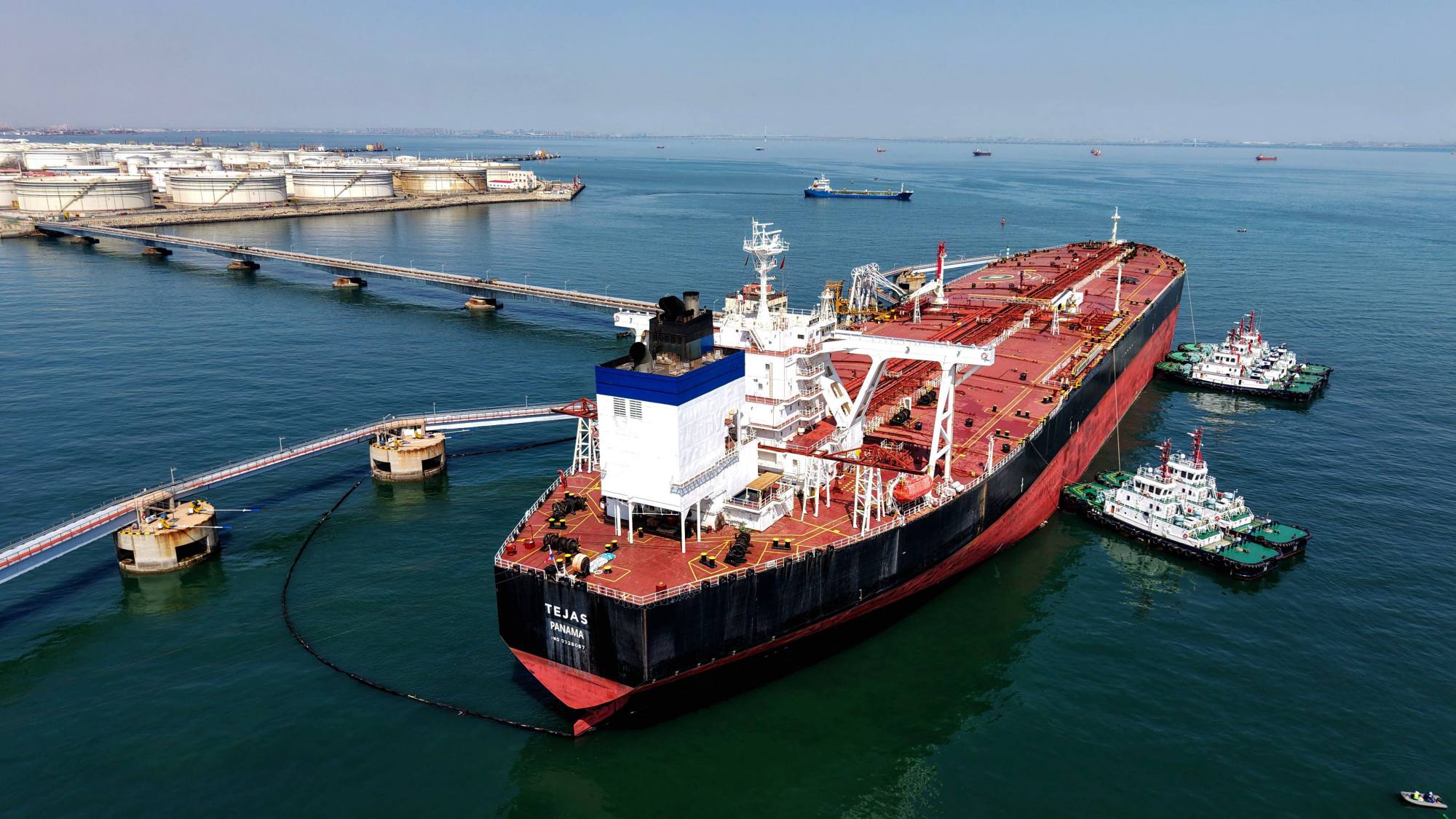
About one-fifth of the world’s supply of liquefied natural gas and a quarter of global seaborne oil exports passes through the Strait of Hormuz. Tehran has virtually closed the strait since US-Israeli strikes on Iran began on February 28, rattling global energy markets.
The Chinese foreign ministry on Tuesday said the US blockade was a “dangerous” and “irresponsible” action that risked “shattering the already fragile ceasefire”.
Speculation has been circulating that one of Washington’s aims with the blockade is to cut off the flow of Iranian oil to Beijing, the biggest buyer, thereby forcing it to put pressure on Tehran to strike a peace deal.
This idea was raised in recent articles published by the LA Times and Bloomberg.
Hu Xijin, former editor-in-chief of China’s state-backed Global Times tabloid, suggested in a social media post that the US “intends to use this opportunity to pressure China to help urge Iran to reach an agreement, although this action is not specifically targeted at China”.
But analysts are sceptical that this is Washington’s strategy.
Jesse Marks, founder of Rihla Research and Advisory, a Washington-based consultancy focused on the Middle East, said “Trump’s decision-making around Iran is about Iran” and was not directed at China.
“Trump’s core message through the Hormuz blockade is that the US can walk and chew gum by both carrying out kinetic strikes but also beating Tehran at their own game in an effort to exert control over the strait.”
He said the main reason the US launched the blockade was to prevent Iran from weaponising the strait and normalising any kind of toll.
Iranian officials had raised the idea of imposing a toll on ships transiting the strait after a two-week ceasefire was reached between the US and Iran on April 7, according to Reuters.
Independent political analyst Guy Burton argued that even if Washington was trying to force China’s hand, this may overestimate Beijing’s actual leverage over Tehran.
“In reality that influence is limited. Iran values its relationship with China but remains cautious about becoming overly dependent ... China is not in a position to compel Tehran to change course,” Burton noted.
Chinese state broadcaster CCTV previously dismissed the idea that Tehran only listens to Beijing, labelling it oversimplified.
Yuyuantantian, a social media account run by CCTV, said such claims were a “deliberate effort” to offload the burden of mediation onto Beijing while “unfairly categorising China as a partisan actor”.
Huang Jing, a professor at Shanghai International Studies University, said Trump’s move was a sign that “he has no more cards left to play”.
“The primary objective would be to force Iran into a ceasefire and compel them to accept his terms – essentially giving him a way to save face and exit the situation gracefully,” he said, adding that ending the war would strengthen his standing ahead of his May trip to China and the coming midterm elections.
The blockade came after a round of talks in Pakistan between the US and Iran over the weekend ended without a deal.
Despite the naval stand-off, diplomatic efforts continue, with Islamabad reportedly offering to host a second round of talks.
Although the US blockade presents a “de facto challenge” to Iran’s trading partners, China is not likely to forcibly break it, Marks noted.
“For Beijing, the capture of a few Chinese flagged ships moving smuggled oil does not rise to the threshold of a Chinese red line because any public exposure of such an event would likely yield negative public attention,” he said, adding that Beijing’s naval footprint was relatively small in the region compared to the US.
Beijing has repeatedly denied allegations it buys smuggled oil and says bilateral trade is conducted within the framework of international law.
Burton also agreed that China would avoid any entanglement with the US military, especially over Iran.
He particularly highlighted the recent passage of a US-sanctioned Chinese tanker through the Strait of Hormuz without interference, which suggested that “neither side is currently seeking direct confrontation”.
“Escalating against Chinese shipping would undermine any US effort to draw Beijing into a more cooperative or aligned position.”
At least three vessels, including a Chinese tanker, entered the Persian Gulf through the Strait of Hormuz on the first full day of the US blockade, according to Reuters.
Burton added that Trump had little consistency in his statements, offering conflicting justifications and explanations.
“He looks to be flailing around, trying to find some way of getting Iran to submit, but struggling to do so. That would appear to be the thinking over his current blockade – which if you recall, comes days, if not a week after he suggested that both the US and Iran might manage the Strait of Hormuz.”
Huang argued that China was unlikely to be coerced into action and emphasised that the country’s policy towards Iran was guided strictly by its own strategic judgment and national interests.
He said oil and gas exported through the Strait of Hormuz was not vital to China’s energy mix, which was relatively diversified. -- SOUTH CHINA MORNING POST