Rising tensions in the Middle East cast a fresh shadow over the opening of China’s largest trade fair, at a time when the impact of geopolitical shocks is being reflected in the nation’s trade figures.
In conversations across sprawling exhibition halls after the Canton Fair opened its doors on Wednesday in China’s manufacturing hub of Guangzhou, domestic exporters and foreign buyers sounded each other out, trying to gauge how far those shocks might ripple through global trade.
The threat of US tariffs continues to weigh on sentiment, and exporters across a range of industries discussed how they spent the past few years reducing reliance on the American market. Several have been pinning hopes on Europe as a lifeline, while growth in demand from emerging markets has also offered a cushion.
Yet, widening uncertainties amid Middle East tensions are forcing a reassessment. Chinese exporters say geopolitical risks, from disrupted air routes to energy-driven inflation, are exposing fresh vulnerabilities in the very markets that they had come to depend on.
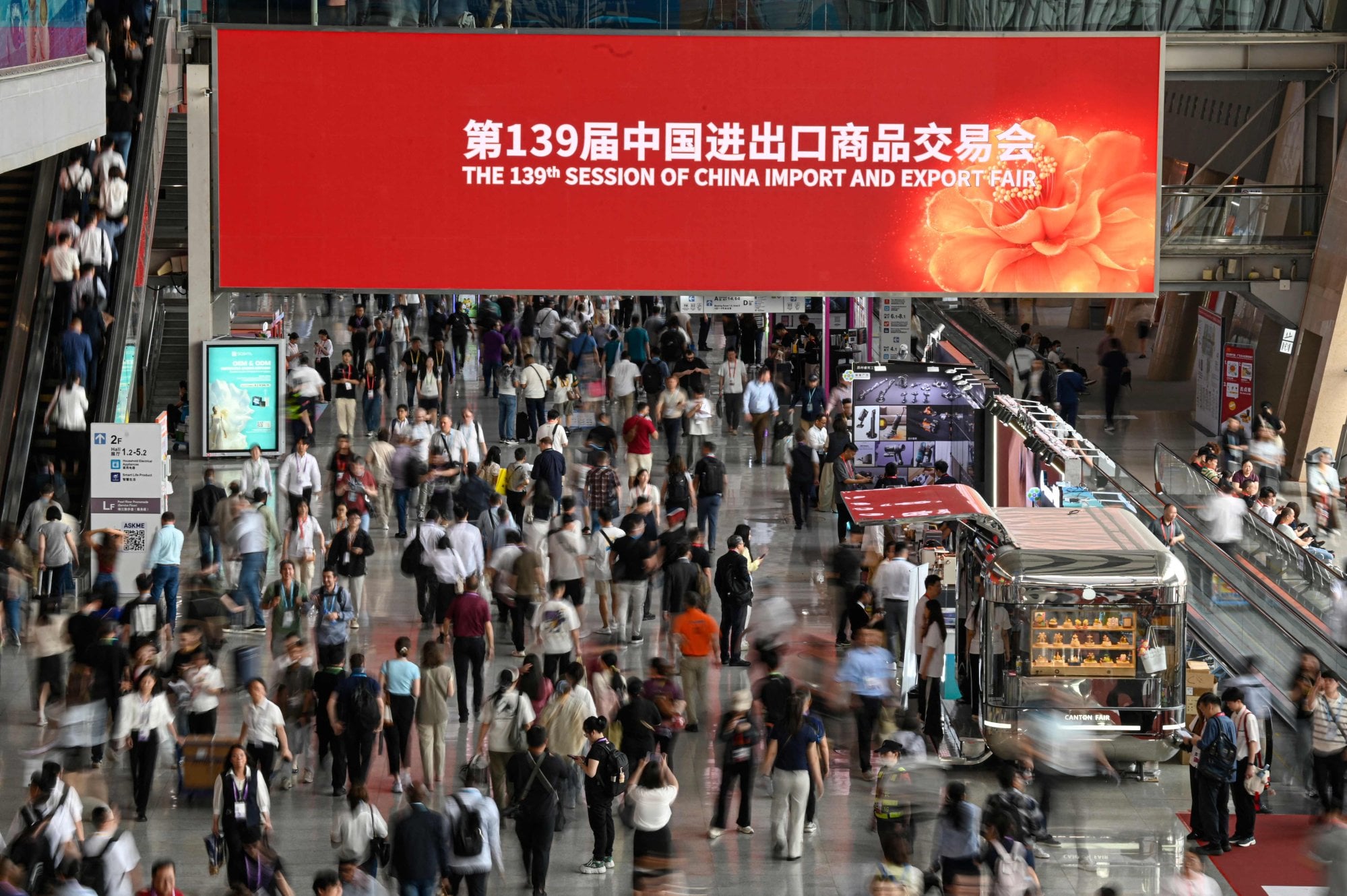
Spanning three weeks, the Canton Fair, formally known as the China Import and Export Fair, is widely seen as a bellwether for China’s vast export machine. This edition features a total exhibition area of 1.55 million square metres (16.68 million square feet), 75,700 booths and more than 32,000 participating companies – all exceeding records, according to organisers. There are also about 3,900 first-time exhibitors.
Jason Tan, a lighting exporter from Zhongshan, Guangdong province, said travel disruptions might affect buyer attendance. “Reduced flight frequencies and higher prices for routes via the Middle East have not only restricted Middle Eastern buyers, but also affected customers from Europe and parts of Asia, due to transit issues,” he said.
At the same time, cost pressures are intensifying. Tan pointed to sharp and unexpected increases in raw materials for his factory, with polycarbonate prices up 40 to 50 per cent and ABS plastic – the material used to make Lego pieces, among other items – up around 20 per cent since the US-Israel war on Iran began in February, pushing overall production costs up by roughly 15 to 20 per cent.
However, passing on those increases has proven difficult. “Major clients can accept, at most, a 5 per cent price increase,” he said. “If it goes higher, they will simply choose to delay placing orders.”
Tan added that European demand, once held in high regard, had begun to weaken. “I spent a month in Europe last month to visit buyers and retail channels; inventories are high, and sales are slow,” he said.
Other exporters echoed similar concerns. “Buyers may still come to look at new products, but order volumes will inevitably decline,” said Wu Sheng, a home-appliance exporter from Zhejiang province. “No one wants to take risks at the moment.”
Data from major trading hubs reinforces that caution. “In the past month, some merchants’ orders from the Middle East market have dropped by half compared with the same period last year,” Xu Yan, president of the Yiwu Cross-border E-commerce Association, was quoted as saying last week by the National Business Daily.
Xu added that everyone was waiting to see how the war unfolds.
Newly released macro data shows that the impact of the war has begun to appear in China’s trade figures. China’s exports rose in March by just 2.5 per cent, year on year, missing expectations, while imports surged 27.8 per cent – the fastest pace since late 2021, mainly driven by higher global energy and commodity prices.
Still, not all sectors are equally exposed.
“We expect that Middle Eastern buyers at this Canton Fair might increase, but the order situation is still hard to judge,” said Yan Wei, who exports new-energy agricultural machinery. “Affected by the rising prices of raw materials such as copper and iron, our comprehensive costs have risen by about 5 per cent.
“Our quotes will certainly have to increase accordingly.”
Additionally, he said: “European orders are fairly stable for now, since customers have low inventory. Combined with high oil prices, this may instead stimulate their demand for new-energy agricultural machinery.” -- SOUTH CHINA MORNING POST