As US President Donald Trump and Chinese leader Xi Jinping prepare to sit down in the coming weeks, negotiations on deliverables and scheduling have accelerated, including a possible visit to Beijing’s Temple of Heaven and a military parade, according to several people familiar with the planning process.
The lead-up for such a consequential summit has been compressed and rather disjointed given the Middle East war and Trump’s preference for making last-minute decisions based on his “gut”.
“This will be so interesting,” said one person knowledgeable about planning details. “You have the most predictable president and the least predictable president. God knows what will come out.”
Even the usual meetings between US cabinet secretaries and their Chinese counterparts may be shelved, US Trade Representative Jamieson Greer said earlier this month, just after the White House said they would take place.
Arrangements have built on a US working-level team that travelled to Beijing and a Chinese team that travelled to Washington in early March, shortly before the White House rescheduled the summit, citing the war, sources said.
“All I can say is President Trump’s decision to delay had been properly communicated to Beijing,” said a diplomatic source who declined to be named due to the sensitivity of the matter.
A lingering question as the Middle East crisis intensifies is whether the summit could be delayed again.
“The chances of postponement are better than 50-50 because the war will continue to consume Trump’s attention, the impact is increasingly being felt everywhere and cannot be dismissed, and flying off to China in the midst of an ongoing crisis will not be interpreted well at home,” said Jeffrey Moon, a former National Security Council official.
“Moreover, if the goal is stability with no breakthroughs, they can agree to continue observing the [trade] truce without a need to meet in person,” added Moon, head of consultancy China Moon Strategies. “If it turns out China is arming Iran, there’s a 90 per cent chance the China visit will be postponed indefinitely.”
Assuming the summit proceeds as planned, Trump is expected to arrive in Beijing on May 14 for bilateral talks and depart the following day. Chinese officials have also proposed during the 36-hour visit a May 15 tour of the Temple of Heaven – following Trump’s 2017 trip to the Forbidden City – which remains under consideration, according to a person familiar with the planning.
The latest schedule, shortened by a day from the original March 31-April 2 itinerary, signals the downgrading of deliverables and any rebooting of the fractious US-China relationship, analysts said.
Despite the war, Trump sees value in the summit. “This is going to be mostly pomp and circumstance,” said Bonnie Glaser, managing director with the German Marshall Fund of the United States. “Trump seems to want to be part of or witness part of a military parade. He’s very impressed by seeing” the People’s Liberation Army, she added.
The Chinese state banquet planned for May 14 is likely to include some US business leaders but their deeper involvement remains unclear.
Xi opted not to meet with US and other Western CEOs attending the March 22-23 China Development Forum in Beijing, a break with recent years as Beijing has sought to woo foreign investment amid Chinese economic headwinds.
Two top Chinese economic officials did, however: Premier Li Qiang, the country’s No 2 official, and Vice-Premier He Lifeng, who oversees many economic issues.
But a source who attended the forum said the Chinese side hinted that “the top-level engagement with the American business community” would take place during Trump’s visit to China.
“The message from the host was: China certainly welcomes high-level engagement with the American business leaders,” said the forum source notified by Chinese organisers.
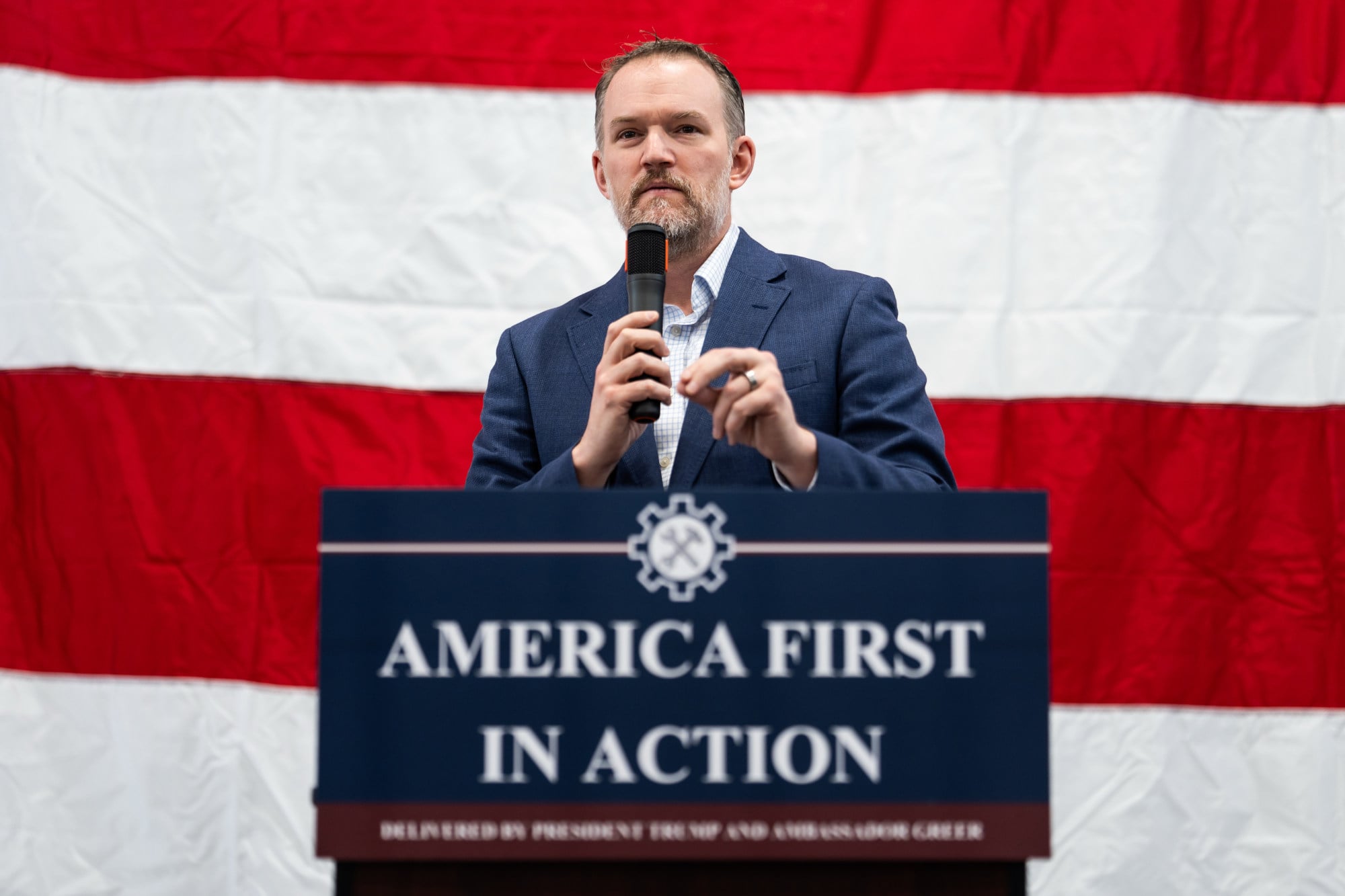
US Treasury Secretary Scott Bessent is taking the US planning lead but has delegated much of the work to Greer’s office, which has argued privately against a muscular US commercial presence in keeping with his hawkish trade views, said a person familiar with US planning.
“The Chinese want to be selling things to us and we’re willing to buy things like, you know, low-tech consumer goods,” Greer told Bloomberg late last month. “Establishing that type of mechanism at the leaders’ meeting ... that’s going to be a big deliverable.”
This apparent sidelining may reflect the optics of inviting US chief executives at a time when Greer appears to want fewer US companies in China and seeks to manage China trade under the proposed Board of Trade, despite the Republican Party’s traditional championing of free trade.
“How using trade tools to force the substitution of goods made in China with more expensive and sometimes inferior goods made in another country is good for the US economy or competitiveness is a mystery, especially in cases where made in America isn’t an option,” said a person familiar with summit planning.
One concern: a distracted Trump may only focus shortly before his plane leaves and demand a large chief executive retinue, hampering corporate planning and suggesting a possible Trump-Greer disconnect given Trump’s long-standing fondness for CEOs.
So far, the Commerce Department led by Secretary Howard Lutnick remains largely sidelined, said the person familiar with scheduling.
“He didn’t get an invitation to the party,” the person said. “So far, the decision to include him has not been made. The State Department is also stuck on the sidelines, for now.”
Analysts questioned the summit’s jumbled planning.
“Lutnick’s portfolio is American exports,” said Moon. “If he’s completely out of it, that doesn’t bode well for an American businesses delegation.”
With the clock ticking, attention has turned to deliverables, such as they are. Beijing was pushing for a “dozen” ranging from Taiwan to dialogue on global issues to people-to-people exchanges, but met with limited interest from the US side, a source said.
As a result, Beijing does not seem to be trying very hard to engage further because it has lowered its expectations and is largely satisfied with where things stand, said another person familiar with planning.
The US has pushed for “three B’s” – namely Boeing, beans and beef – although higher Chinese beef imports may be shelved given US political sensitivities over inflation as the US midterm election approaches.
Soybean purchases and Boeing aircraft were relatively painless concessions for China, analysts said. Washington is not demanding change to its state-led economy, and Beijing needs soybeans and aircraft anyway.
China, for its part, looks for respect and more stable relations, as voiced recently by Chinese Foreign Minister Wang Yi on the sidelines of the National People’s Congress.
“China and the US are both big countries. Neither side can remodel the other,” Wang said. “But we can choose how we want to engage – that is, to commit to a spirit of mutual respect, to hold the bottom line of peaceful coexistence, and to strive for the prospect of win-win cooperation.”
Somewhat more of a reach for Beijing, said those familiar with summit planning, is a change in Washington’s Taiwan language from “strategic ambiguity” to outright opposition to Taiwan independence and support for unification.
Multiple sources said Beijing sees the talks as a historic opportunity to alter the status quo. This slow-motion wrestling match played out in February when Washington removed from a US fact sheet language opposing Taiwanese independence, prompting Beijing to cry foul.
But others expressed doubt that Trump would cede ground, not necessarily because he understands or cares about the nuances of Taiwan policy, but because he knows enough to steer clear given strong views by Taiwan supporters in Congress and cabinet members.
“I don’t think he’ll say anything, he’s been incredibly cautious on Taiwan,” said Glaser. “I think he gets it.”
Beijing sees Taiwan as part of China to be reunited by force if necessary. Most countries, including the US, do not recognise Taiwan as an independent state, but Washington is opposed to any attempt to take the self-governed island by force and is committed by law to supplying it with weapons.
But Beijing is also relatively sanguine, said a person familiar with planning, given Trump’s accommodating steps, including delayed arms sales to Taipei.
Some say if little beyond soy and aircraft are announced, both of which the Chinese can easily cancel, it could leave unclaimed US gains on the table.
During Trump’s first term, then commerce secretary Wilbur Ross tried to sell Trump on a US$70 billion China purchase deal for soy, natural gas and other commodities that Trump slammed as insufficient, sidelining Ross.
“You compare that US$70 billion deal to what is likely to happen at this summit and you may have an unfavourable comparison,” said Moon, a former USTR official. “You may face the prospect that Trump is settling for a deal less than what he could have had in 2017 before the entire trade war.
“It’s very hard to describe that publicly as a triumphant visit or major achievement.”
Others said cautious Beijing policymakers had all but concluded, given China’s record US$1.2 trillion global surplus, that the US market was less crucial, China could weather tariffs and constraining trade would hurt Washington more than Beijing.
Part of Washington’s strategy, analysts said, was to build leverage through Section 301 investigations, including Beijing’s compliance with the Phase I trade deal hammered out during Trump’s first term.
“The Chinese don’t like tariffs,” but they are increasingly convinced that Trump’s “bark was worse than [his] bite”, said one person close to summit arrangements.
Following the October summit, the idea was floated that Xi and Trump might meet four times in 2026 – including a Trump desire for Xi to attend America 250 July 4 celebrations that Beijing flatly refused – but analysts said that seemed increasingly unlikely.
The White House had encouraged Xi to travel to Washington for a state visit in late summer or early autumn with China considering it, one person said, depending on the success of Trump’s May summit. -- SOUTH CHINA MORNING POST