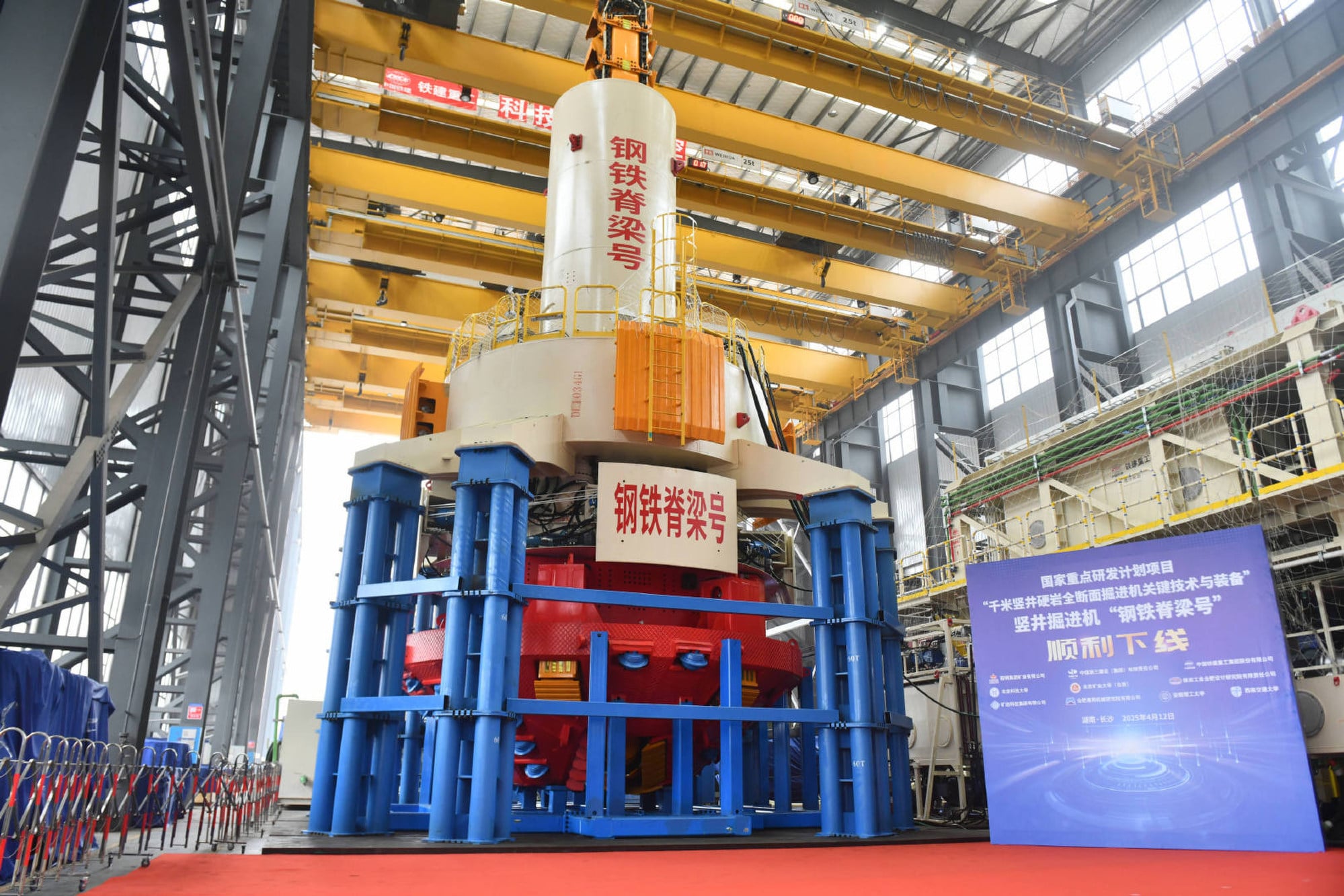
The fearsome-sounding “Gangtie Jiliang” is designed to do what no machine has ever done before: delve straight down, kilometre after kilometre, into the heart of the Earth.
Translated to English as “steel backbone”, Gangtie Jiliang is billed as the world’s first boring machine capable of excavating full-face shafts to depths exceeding 1,000 metres (3,280 feet) in hard rock.
Weighing about 500 tonnes and measuring 8.1 metres wide, the machine looks less like mining equipment and more like an “underground aircraft carrier”, according to the state-owned Science and Technology Daily on Tuesday.
Developed by the China Railway Construction Corporation (CRCC), the industrial leviathan has transitioned from its record-breaking assembly to full-scale operations and has been deployed to an iron ore project in northeastern Liaoning province.
Its mission is to unlock a hidden world of wealth buried beneath the Earth’s crust.
China’s deep-Earth mineral deposits are vast. Experts estimate there is twice as much mineral wealth deep underground than what has already been proved near the surface.
For instance, a 2018 estimate by the China Geological Survey said antimony resources located up to 2,000 metres deep are 5.3 times larger than known reserves. The metalloid is critical for batteries, semiconductors and metal alloys.
For lead, zinc and gold, the deep-underground resources are roughly four times larger.
As for tungsten – a dense, hard metal essential for aerospace and defence – its deposits located deep underground are about three times larger than those found near the surface.
The same three-to-one ratio of deep-to-shallow resources applies to lithium, rare earths and coal.
Miners have scraped at the Earth’s surface for these minerals for centuries, but the easy pickings are gone.
Unlike other methods for sinking deep shafts, Gangtie Jiliang is built specifically to tackle hard rock. It features a massive circular cutterhead that covers the full diameter of the shaft, drilling vertically from the surface like an oversized electric drill.
Chief designer Ding Zhangfei told Science and Technology Daily that the project overcame several major technical hurdles, resulting in multiple patents.
One of the most persistent challenges was how to efficiently remove enormous quantities of broken rock and muck.
Unlike a horizontal tunnel-boring machine, a vertical shaft borer must contend with gravity, which causes debris to accumulate directly in front of the cutterhead. For nearly six months, the team tried out various solutions without success.
The breakthrough finally came during a walk in a wetland park in Changsha, encountering a dragon-bone waterwheel.
Inspired by the ingenious wooden irrigation device used in China more than 2,000 years ago, engineers developed an intelligent, vertical muck-removal system based on a similar structure.
Its hourly transport capacity is equivalent to 10 trucks working simultaneously.
Excavating a kilometre underground often involves extreme ground stress and high water pressure. Without immediate support, rock walls can deform or collapse as soon as they are cut, a phenomenon known as the “safety curse” of deep construction.
Following joint research with several domestic scientific institutions, the team developed a way to reinforce the shaft walls in real time.
Ding said the team intended to apply the Gangtie Jiliang to a wider range of tasks in the future, helping China “seize the technological high ground” in the development of deep-underground excavation.
The necessity of such projects was highlighted in a 2022 paper in the journal Strategic Study of Chinese Academy of Engineering.
Several leading Chinese researchers pointed out that as China’s shallow mineral resources were depleted, the industry had to tap into resources at depths exceeding 1,000 metres to sustain growth.
China has already built more than 40 coal shafts and nearly 20 metal mining shafts deeper than 1,000 metres, with seven exceeding 1,500 metres.
To mitigate the occupational hazards associated with traditional drilling-and-blasting methods in volatile conditions, the paper’s authors called for urgent research into safer, high-end autonomous equipment.
Beyond mining, the boring machine could play a role in strategic infrastructure.
Chinese energy experts have suggested building an underground network across western China to protect vital energy and defence facilities.
They argue that critical assets should be embedded deep beneath the Earth’s surface at a level that is both safer and harder to detect. -- SOUTH CHINA MORNING POST