US President Donald Trump on Wednesday declared the US‑Israel war against Iran had delivered “decisive, overwhelming victories”, even as he signalled that key military objectives were still “nearing completion” and that further strikes could inflict heavy damage on targets in the country.
“We are going to hit them extremely hard. Over the next two to three weeks, we are going to bring them back to the Stone Ages, where they belong. In the meantime, discussions are ongoing,” he said in a televised address to the nation.
As the highly unpopular conflict has rapidly escalated into a regional and global crisis, Trump appeared to try to reassure the American public and ask for patience.
“Our objectives are very simple and clear. We are systematically dismantling the regime’s ability to threaten America or project power outside their borders,” he said, adding that “the core strategic objectives are nearing completion”.
“Armed forces have delivered swift, decisive, overwhelming victories on the battlefield – victories like few people have ever seen before,” Trump said.
“Never in the history of warfare has an enemy suffered such clear and large-scale losses in a matter of weeks,” he added, claiming that Iran’s navy was “absolutely destroyed” and the air force was in “ruins”.
“Their leaders, most of them terrorists, the regime they led, are now dead. Their command and control of the Islamic Revolutionary Guard Corps is being decimated as we speak,” Trump said.
He also suggested that the US would leave the Strait of Hormuz blockade to be managed by other countries, naming China, France, Japan and South Korea, which rely on the strategic chokepoint that handles about 34 per cent of global seaborne crude oil trade.
At the same time, he offered to “help” saying that “we don’t have to be there”.
“We don’t need their oil. We don’t need anything they have, but we’re there to help our allies,” Trump told the American people in his address from the Oval Office.
At least 13 American service members have died and around 200 have been wounded since February 28, when the US and Israel launched joint strikes on Iran.
“[They] laid down their lives in this fight to prevent our children from ever having to face a nuclear Iran,” Trump said on Wednesday.
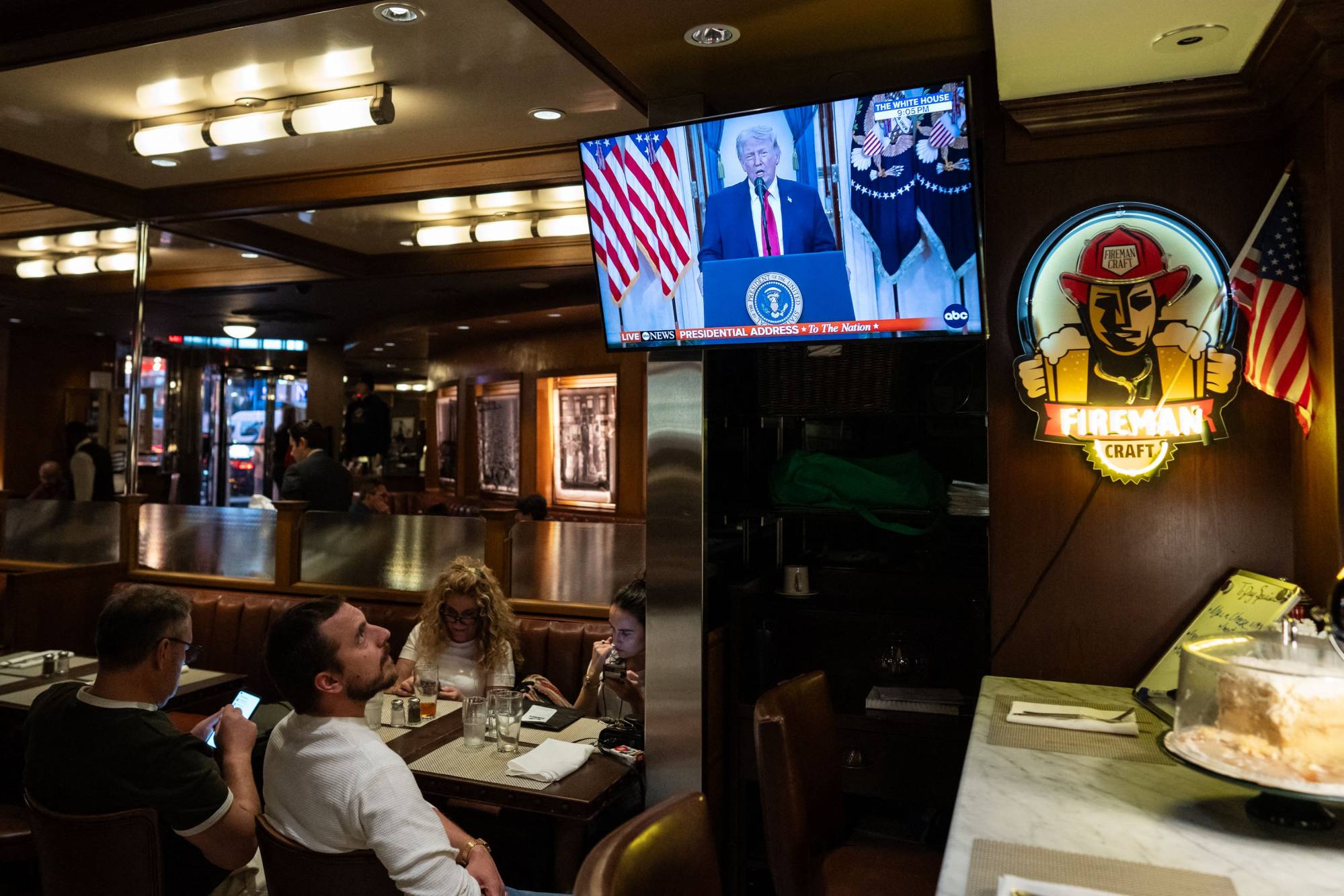
On social media, analysts criticised the speech as a “controlled escalation” but largely incoherent.
“This is not de-escalation. It’s controlled escalation,” Robert Pape of the University of Chicago observed.
Richard Haass, president emeritus of the Council on Foreign Relations, called it “a nothing burger of a speech that changed not a thing”. “Makes no sense,” he said.
Shortly after Trump’s speech, US Secretary of State Marco Rubio, who is also the national security adviser, appeared to try to persuade Americans of the necessity of the operation.
“The President’s leadership sends a message to the world that the United States will defend its people and its interests, and uphold peace through strength,” he posted on social media.
Meanwhile, Defence Secretary Pete Hegseth repeated Trump’s message, succinctly hinting at further escalation by saying that Iran could be sent “back to the Stone Age”.
Iranian state television reported on Wednesday night that, following Trump’s speech, “Iranian missiles struck the port of Haifa in the occupied territories”.
Less than an hour before Trump delivered his speech, the defence ministries of the United Arab Emirates and Saudi Arabia both reported missile launches from Iran.
Trump’s speech came amid mounting political pressure at home as rising oil prices and economic uncertainty have made him vulnerable ahead of the midterm elections. The approval rating on his handling of the economy has fallen to an all-time low of 31 per cent, according to a CNN/SSRS poll released on Tuesday.
Virginia Democrat Mark Warner, vice-chairman of the Senate Select Committee on Intelligence, said that Trump’s speech “did little to answer the most basic questions the American people deserve when our nation is engaged in a costly and dangerous conflict with Iran”.
Chuck Schumer, the Senate Democratic leader, slammed the speech as “rambling, disjointed, and pathetic”.
The New York Democrat said Trump’s actions were “one of the greatest policy blunders in the history of our country, failing to articulate objectives, alienating allies and ignoring the kitchen table problems Americans are facing”.
The president on Wednesday claimed US and Israeli forces had crippled Iran’s missile arsenal and production, “annihilated” its navy, cut off its proxy networks and ensured it would never obtain a nuclear weapon.
Speaking on regime change, Trump claimed it was not “our goal”.
“We never said regime change, but regime change has occurred because of all of their original leaders’ deaths,” he added.
In an open letter, Iranian President Masoud Pezeshkian urged the American public to “look beyond the machinery of misinformation”, adding that “the path of confrontation is more costly and futile than ever before”.
He described the attacks on Iran’s infrastructure as “war crimes” that pointed to “strategic bewilderment and an inability to achieve a sustainable solution”, Iran’s Press TV reported.
Although claiming that Iran “harbours no enmity towards ordinary Americans”, he warned the attacks on Iranian infrastructure of carrying consequences “far beyond Iran’s borders”.
Pezeshkian said the portrayal of Iran as a threat was “neither consistent with historical reality nor with present-day observable facts”.
Earlier in the day, Trump claimed that a “less radicalised” and “more intelligent” new “regime president” had requested a ceasefire, while warning that the United States would bomb Iran into “oblivion” unless the Strait of Hormuz was reopened to global trade.
The strategic waterway has been effectively blockaded by Tehran in retaliation, sending shock waves through global supply chains and rattling energy markets.
The Iranian foreign ministry denied any such request being made, calling the claim “false” and “baseless”.
As Trump concluded his speech, share index futures fell sharply, ending Wall Street’s rebound that had persisted for two days. Also on Wednesday night, oil prices once again surged above US$100 a barrel. -- SOUTH CHINA MORNING POST