
Like many Asian-Americans, US-born Tiffany Chin has faced her share of slights, including being treated as “other” or “foreign” and judged at times by her race rather than her accomplishments.
Growing up outside Chicago, she recalls that in primary school her musical talents were attributed to her “Chinese genes”, and she was told, “you’re probably so good at maths because you’re Asian”.
And as an adult on a family trip to Florida, people gave her nasty looks when she went jogging, wondering what she was doing there, while non-Asians during the pandemic would cover their mouths or walk away when they saw her.
“I hadn’t even visited China in over a year,” said Chin, a 30-something Los Angeles-based manager in the recording industry. “But I was still treated as if I had personally been the one to bring Covid to the States.”
Most Asian-Americans have had similar experiences.
According to a study released on Wednesday, over half of the Asian-American community living in the US have experienced some version of “assumed foreignness” on a monthly basis, confronted with such questions as “how did you learn to speak English so well?” and “where are you really from?” – even if they’ve lived in the US for generations.
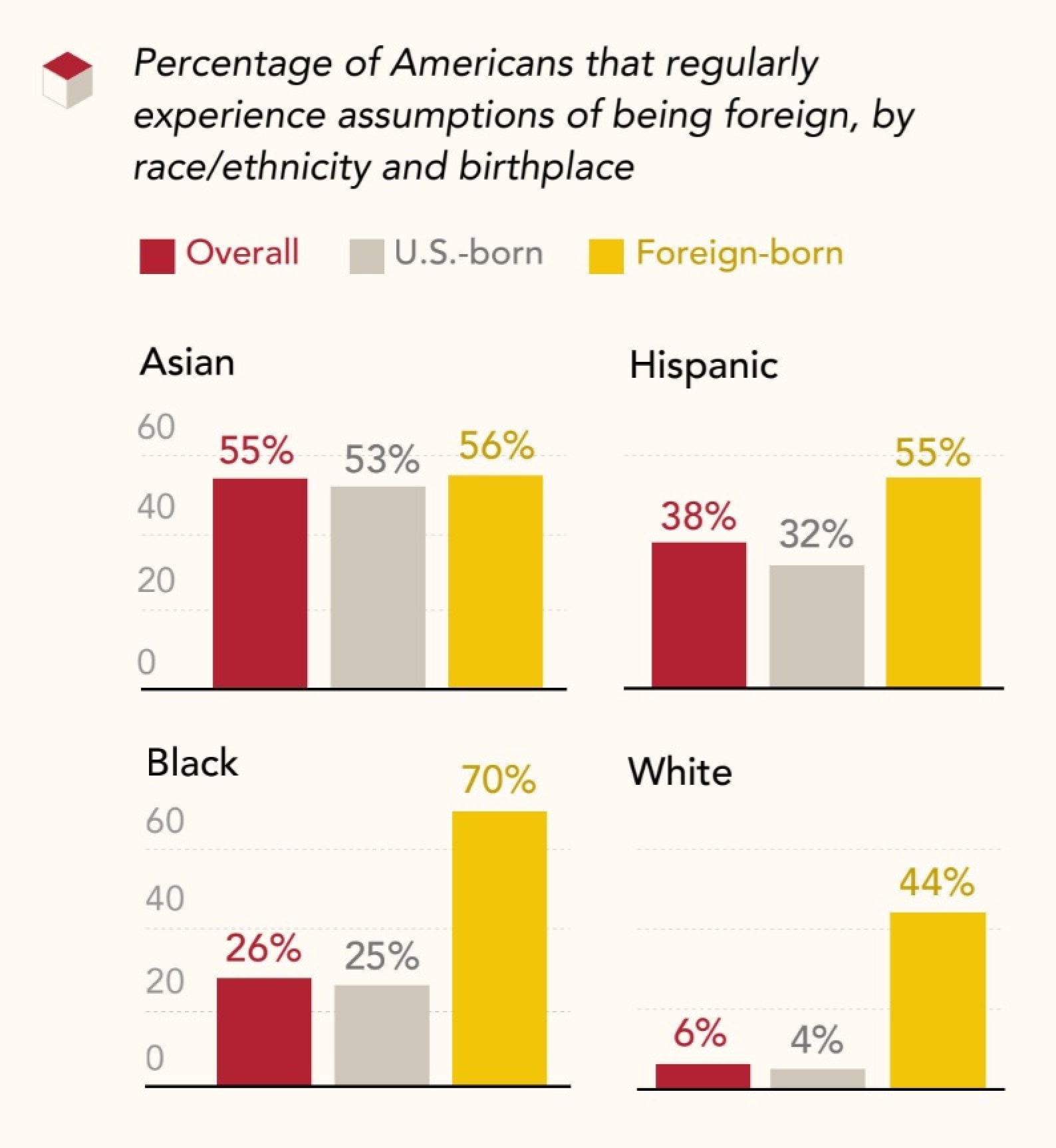
A survey by the Committee of 100 (C100) and NORC at the University of Chicago, an independent research organisation, found that respondents had nearly identical “perpetual foreigner” experiences whether born abroad or in the US, indicating the treatment was strongly tied to race and appearance.
The constant subtle and not-so-subtle xenophobia can result in notably higher rates of stress and mental health problems. US-born respondents who reported being treated like foreigners – some did not – experienced nearly twice the stress compared with those who experienced no such prejudice, based on a commonly used “psychological distress” test.
“Those who regularly encounter assumptions of being foreign-born or unable to speak English feel societally excluded at significantly higher rates,” the report said. For US-born Asian-Americans who frequently face assumptions of foreignness, 29 per cent feel like they only belong “a little” or “not at all”.
While perpetual foreigner treatment has been around as long as Asians have lived in the US, the report sought to compare the Asian experience with two other racially identifiable non-white US groups, namely Hispanics and Blacks.
Broadly speaking, not surprisingly, the research found that few whites faced similar “perpetual foreigner” stereotypes, even those who had just arrived and did not speak English.
“Asian-Americans are assumed to be foreign regardless of birthplace,” which is not as much the case with other groups,” said Sam Collitt, a C100 social scientist and co-author of the study.
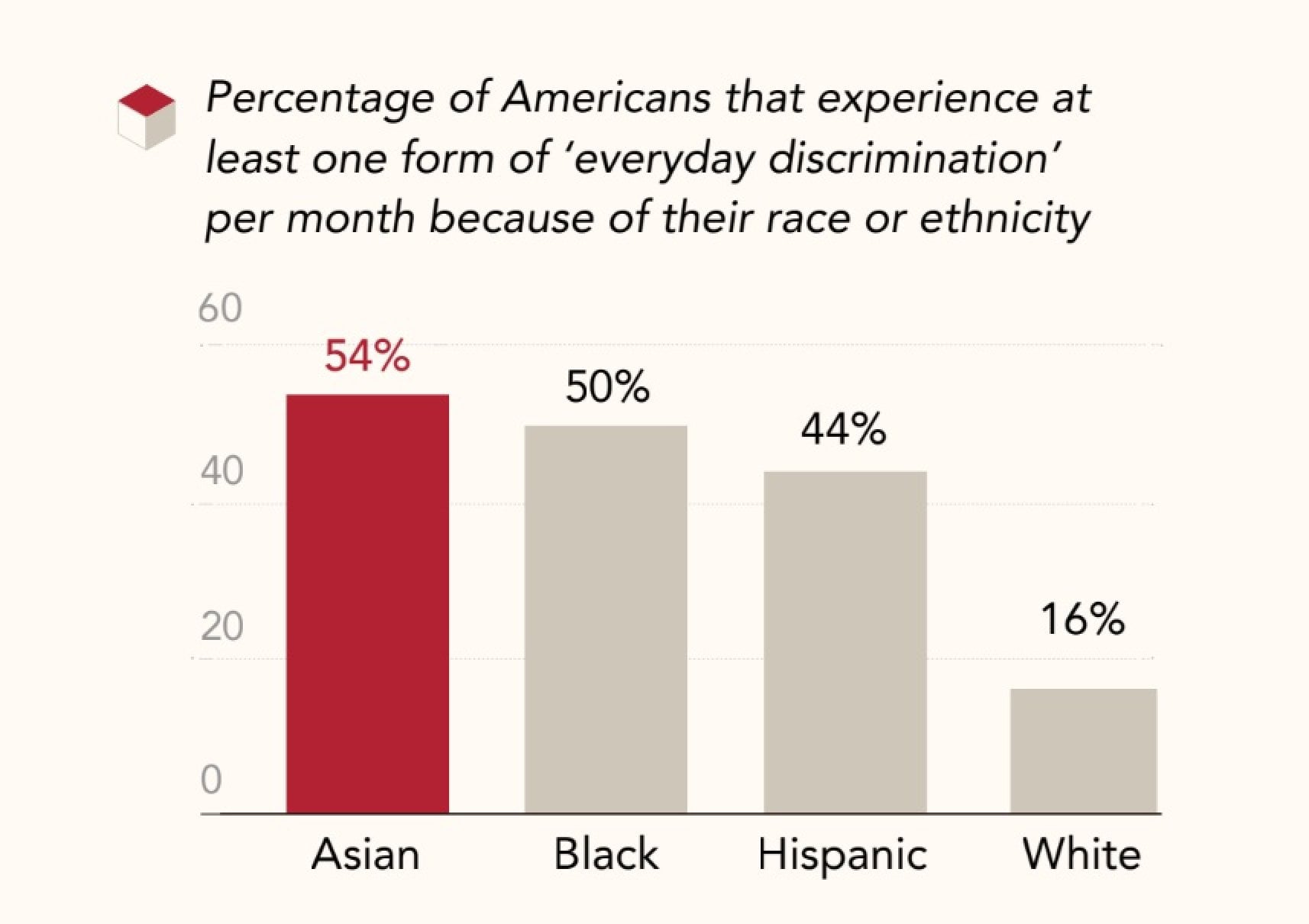
Most non-white Americans were subject to insults, harassment and poor treatment at stores or restaurants, with Asians and Hispanics facing similar levels of “foreignness” discrimination. While Blacks often face far worse forms of racism, they were not generally assumed to be foreign, even if they were new immigrants from Africa or the Caribbean, the study found.
Whether the “otherness” factor contributes to Asian-American voting rates and willingness to participate in the political process is less clear.
In the 2024 presidential election, the turnout was estimated at around 58 per cent for Asian-Americans and 54 per cent for Pacific Islanders, compared with 70 per cent for whites and 65 per cent for Blacks.
But Asian-Americans are the fastest-growing US immigrant group and recent arrivals often face significant adjustment issues.
These include when they immigrated, what nation they come from, how much information and disinformation they are getting from WeChat and, for mainlanders, limited experience in their country of birth voting or speaking out to safeguard your rights.
Also a factor are generational differences between immigrant parents and their US- or foreign-born offspring that affect political engagement.
“There’s this frustration between the parent and child, because their sources of information are not necessarily in sync,” said Cindy Tsai, C100’s executive vice-president and a survey co-author. “Though they may be civically engaged and want to encourage their parents and their elders to get involved, they’re kind of running into crossfires.”
Asian-Americans say they tend to run into the most “perpetual foreigner” problems in parts of their life where they are running into more outsiders or people less exposed to diversity.
Matt King, a 34-year-old graphic designer living in Brooklyn, New York, said some of the times he would run into this most obviously was dating.
“I stopped using online dating apps, it was terrible, people just trolling,” said King, whose father is white and his mother’s side is from Hong Kong. “But people would say “I don’t date Asians” or “I don’t usually date Bruce Lee types but I could do it with you.’”
It is hard not to have this affect your self-esteem, King said. “Years of therapy have helped,” he said. “It took me forever to realise that I was never going to find the role model. You just have to make it yourself, have my community, do my thing.”
And sometimes when people ask you where you’re from, King said, provided it is done in the right spirit, it may be a way to engage and start a conversation.
For many Asian-Americans, identity is a complicated issue. Despite growing up in an American suburb, she was also under parental pressure to excel, which often created distance from her classmates. Her schedule was packed from the start with piano and tennis lessons and weekly Chinese classes. She enjoyed kung fu rather than typical Asian female singing and dancing. And she was strong academically, which saw her selected for a special programme.
“I was an Asian-looking face speaking accent-free English,” she said. “I still felt out of place in any group I was plopped in.”
“People would look at me as if I was a freak, and generally avoided wanting to play with me on the yard/playground.”
When she was 10, her father was transferred to Beijing where she grappled with being an expat – technically a foreigner in international schools – while looking and speaking like local residents. She was also bigger physically than other girls while much of her classmates were religious and academically driven even as she leaned towards music and sports.
“I again felt out of place,” she said.
While Chin never runs into “foreignness” questions at work, she remembers meeting with a relative of her husband’s, who is not Asian, and being told that her English is “very good”.
“Maybe she thought I was born and raised in China,” Chin said. “I responded ‘I hope so, I was born and raised in the Midwest!’” -- SOUTH CHINA MORNING POST