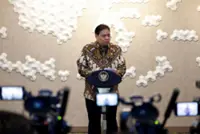
JAKARTA (Jakarta Post/ANN): The Indonesia government is set to implement a mandatory one-day-a-week work-from-home (WFH) policy for civil servants effective after the Idul Fitri (Hari Raya Aidilfitri) holidays, Coordinating Economy Minister Airlangga Hartarto has said.
The minister also recommended that the private sector enforce a similar rule, which aims to reduce energy consumption amid global market volatility.
Airlangga stated that while technical regulations were still being finalized, the policy’s rollout following the holiday was certain.
“The details of WFH will be discussed, but we will implement it after Idul Fitri,” he said on Saturday at the Tax Directorate General office in Jakarta, as reported by Kompas.com.
Airlangga stressed that public services must continue to operate without disruption. "The Manpower Ministry and the Home Ministry [will oversee] the implementation of the regulation," he added.
Amid the ongoing United States-Israeli war on Iran, which has disrupted global oil supplies and caused a price surge to above US$100 per barrel, higher than the state budget assumption of $70 per barrel, the government has been considering a WFH policy to cut fuel usage.
According to Energy and Mineral Resources Minister Bahlil Lahadalia, the policy could serve as a mitigation measure against fuel shortages and price increases.
Finance Minister Purbaya Yudhi Sadewa explained that preliminary estimates suggest the policy could save around 20 percent on fuel purchases.
However, he noted that the restriction to just one day a week is a measure to maintain work efficiency.
“[Regardless,] there are times when certain things just can't be done properly [from home],” he said on Saturday, as quoted by Kompas.com, justifying the limited implementation as a way to strike a balance between energy conservation and productivity.
The Indonesian Employers' Association (Apindo) has urged the government to be cautious in implementing its planned one-day-a-week WFH policy for civil servants and private sector workers, warning that a blanket approach could disrupt key industries.
"Many real sectors, such as manufacturing, logistics, trade and services that are directly related to field operations, still require a physical presence," Apindo chairwoman Shinta Kamdani said on Sunday, as quoted by Tempo.
While acknowledging that certain sectors, such as information technology and the creative economy, can adopt WFH more flexibly, Shinta stressed that individual companies should determine work patterns based on their operational needs and sectoral characteristics.
She called for in-depth discussions with business owners to ensure that energy conservation goals are achieved without disrupting economic activity.
On Saturday, State Secretary Prasetyo Hadi clarified that the policy would only target specific sectors, with public services, industry and trade continuing to operate normally.
"To avoid any misunderstanding, for example, that the service sector, industrial and trade sectors, might not be part of these policies," he said, as quoted by Kumparan.
Prasetyo dismissed speculation that the policy was driven by fuel supply concerns, stating that national energy stocks remain secure. Instead, he framed the initiative as a push for efficiency.
"We want to use this opportunity as a time for self-correction, improvement and efficiency," he said. -- Jakarta Post/Asia News Network