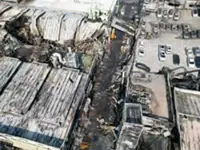
SEOUL: Friday’s fire at an automobile parts manufacturer in Daejeon was one of South Korea’s deadliest industrial accidents in recent years, leaving 14 workers dead and 60 others injured.
The magnitude of the losses and the speed at which the blaze engulfed the building have prompted urgent questions over why the fire spread so rapidly, whether the disaster was preventable and whether a series of overlooked structural and safety failings may have turned an ordinary workday into a mass-casualty event.
The blaze began at 1:17 p.m. on March 20 at the three-story industrial plant in Daedeok-gu, south of Seoul, when dozens of employees were resting during their lunch break.
Fire authorities believe the flames erupted on the first floor before black smoke surged through the stairwell and into the upper levels within minutes.
Authorities suspect residual cutting oil and layers of grease coating machinery acted as accelerants, fuelling the fire’s explosive growth.
Another possible factor behind the high death toll was unauthorised structures inside the building.
A mezzanine rest area on the second floor, where nine victims were found together, was not part of the original architectural plans and had been built informally within the factory’s high-ceilinged interior.
The space, used as a gym and nap area, was created by splitting the 5.5-meter-high floor into two.
This layout may have narrowed evacuation routes and, with only a few windows on the side, limited airflow.
“There were no windows on the front of the room, and only a single set along one wall, which meant ventilation was extremely poor," an official from the fire authorities said.
"Once the fire broke out, smoke likely had no effective way to escape, and that structural limitation appears to have contributed to the scale of the casualties," the official explained. "There were also obstacles below the side windows, making it difficult for anyone to jump to safety."
Police have formed a 130-member investigation team and are analysing CCTV footage, interviewing survivors, and conducting joint forensic examinations with fire authorities and the National Forensic Service.
Additional DNA analysis aims to speed up the identification process for the deceased, and families have been promised inclusion in the investigative process to ensure transparency.
The government has also launched a full-scale response, focussing on support for bereaved families and measures to prevent similar incidents.
Dedicated staff will be assigned to coordinate psychological, funeral and livelihood support for the families.
Authorities have also installed a joint memorial altar at Daejeon City Hall and approved an emergency allocation of one billion won (US$664,314) in disaster relief funds to aid recovery efforts, including debris removal and urgent assistance near the site.
Systemic safety reviews are also underway: The land ministry plans to reexamine building safety regulations, including sandwich-panel construction and illegal extensions flagged as factors that worsened the fire’s impact, while the National Fire Agency and Labor Ministry will conduct emergency inspections of similar facilities nationwide. - The Korea Herald/ANN