SINGAPORE: Singapore stands ready to implement contingency measures in relation to the energy market as the conflict in the Middle East has now turned “significantly more serious”, said Minister-in-charge of Energy and Science and Technology Tan See Leng on Friday (March 20).
While the Government has not yet needed to dip into its energy stockpiles of liquified natural gas (LNG) and diesel – which are enough to last for months – Dr Tan noted that the recent US strike on Iran’s main oil export hub and Tehran’s retaliatory attack on Qatar’s Ras Laffan facility will bring about longer-term effects.
The Ras Laffan facility, which typically produces around a fifth of the world’s supply of LNG, has taken significant damage and will take years to be rebuilt.
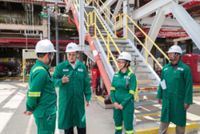
“These (events) have very serious implications for all of us. Even as we look at it, there doesn’t seem to be any end to the hostilities, notwithstanding the fact that President Trump said it was going to be a short war,” he said during a visit to the SLNG Terminal on Jurong Island.
“Even if tomorrow the war stops, the rebuilding of Ras Laffan would take between three and five years. So you can expect that kind of disruption,” he added, as an LNG tanker which arrived from Australia unloaded its cargo of fuel in the background.
Hostilities in the Middle East have also effectively closed the Strait of Hormuz waterway that connects the Persian Gulf to the Indian Ocean and handles a fifth of the world’s oil and 19 per cent of LNG supplies.
Dr Tan reiterated that Singaporeans can expect to see an increase in the electricity tariff, which is the way that most households pay for their consumption.
The electricity tariff is regulated by the Energy Market Authority (EMA) and revised quarterly. A revision is expected when the next quarter begins in April.
The current tariff is 26.71 cents per kilowatt-hour (kWh), lower than the 27.55 cents kWh rate offered in the previous quarter.
Dr Tan said: “We are stable for now, but as the situation evolves, as supplies continue to get truncated, the first thing that you would expect to see, would be the electricity tariffs will go up.
“There’s a lot of downstream impact, because we are one of the largest refinery complexes in the world. On top of that, downstream (supply of) fertilisers, even helium, would be affected.
“So you can imagine that this impact would really be amplified. We need to really brace ourselves for a bumpier ride ahead.”
LNG suppliers have recently issued a string of force majeure notices informing customers in Asia of unforeseeable circumstances that prevent the supplier from fulfilling its contract.
These have come from global energy firms such as Shell, one of Singapore’s licensed importers of LNG, according to reports by Bloomberg and Reuters.
Singapore imports almost all the energy to meet its needs. Around 95 per cent of the country’s electricity is generated from imported natural gas.
The Republic’s gas imports in 2025 comprised 43 per cent piped natural gas from Malaysia and Indonesia, and 57 per cent LNG from other countries including those in the Middle East.
The SLNG Terminal, operated by the Singapore LNG Corporation, stores the bulk of imported natural gas and regasifies it for electricity generation.
Power plants will then generate electricity using the natural gas and other sources of energy, before transmitting it to the national power grid, through which it is sent to consumers.
Dr Tan said the Republic’s strategy to diversify its sources of energy has so far “worked in an optimum fashion” as it has energy suppliers from all around the world.
He said the country’s short-term vesting contracts, which mandate power generation companies to sell a specified amount of electricity at a pre-determined price to discourage them from withholding supply “will be affected”, as the contracts are based on the short-term electricity spot price.
But longer-term vesting contracts continue to run and the Republic continues to import piped natural gas from Indonesia and Malaysia.
Dr Tan said: “We will not hesitate to step in to intervene and to help our businesses as well as our households.
“What we are looking at is how long this volatility, this crisis, will last. We are also making sure that we have enough dry powder for us to intervene when necessary.”
Dr Tan also called on households and businesses to conserve energy.
He said they could switch to more energy-efficient appliances, turn up temperature settings on their air-conditioning units, and turn off switches when appliances are not in use.
He added: “Every measure helps. People who are using cars can switch to EVs, for instance. We could try to reduce the number of private car trips, we could pool together (similar journeys), or we could even try to take more public transport.”
He also echoed comments made by Prime Minister Lawrence Wong on March 18, that households and businesses will soon feel the effects of the already-announced measures at Budget 2026. These include utility rebates and various business assistance measures.
PM Wong said the Government is ready to roll out measures beyond what was announced, and has the resources to do so decisively and quickly. - The Straits Times/ANN