



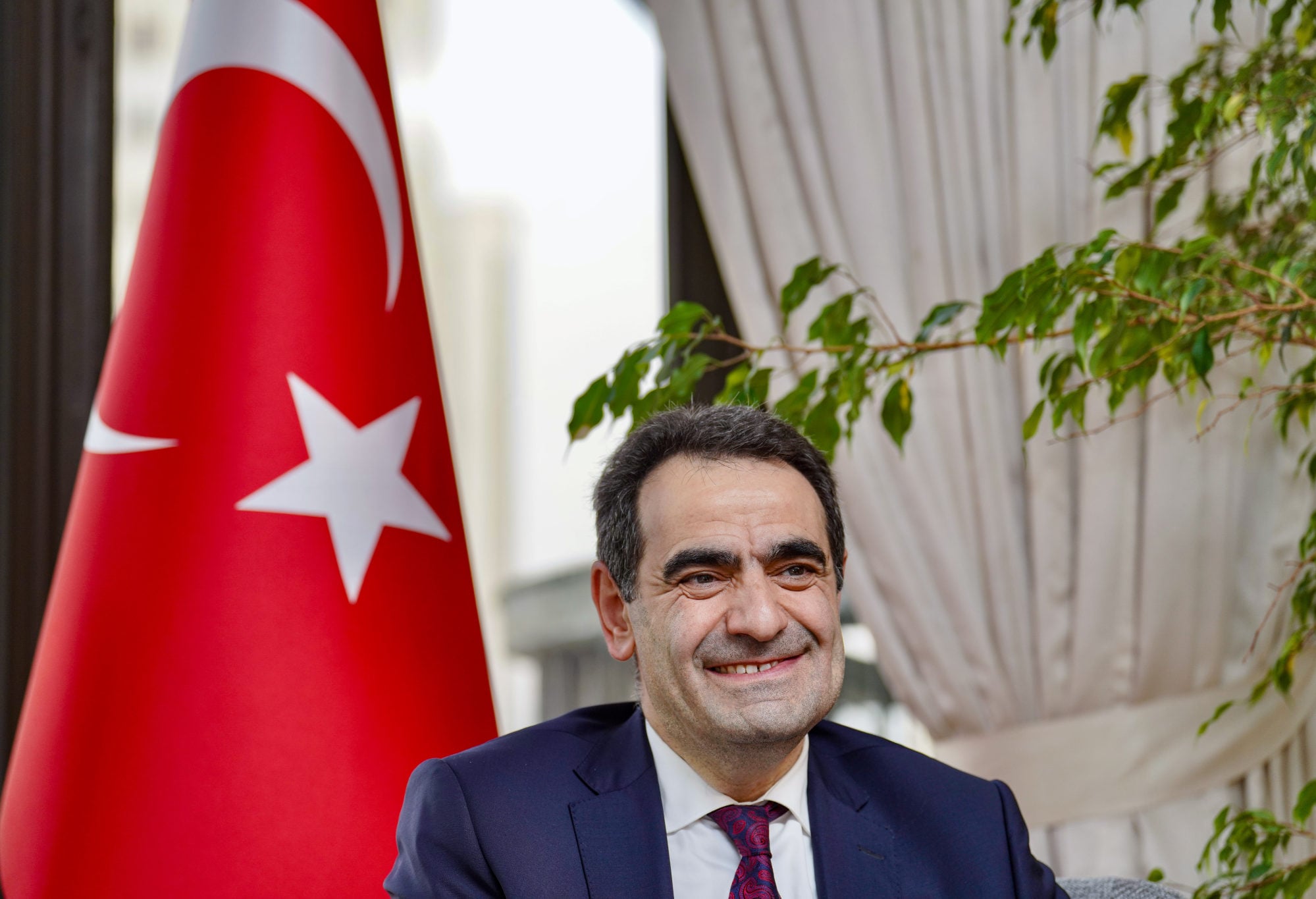
Turkey remains committed to becoming a full member of the Brics bloc, positioning itself as a bridge between Asia and Europe despite widening transatlantic rifts, according to the new Turkish ambassador to China.
Ankara, meanwhile, would continue to work with Beijing to deepen trade ties, promote high-level visits, expand cultural and academic exchanges and build political trust through dialogue on security, counterterrorism and other sensitive issues, the envoy told the South China Morning Post.
In an interview on January 24 during his first trip to Hong Kong, Selcuk Unal described the Brics grouping and its members as “rising economies” playing an increasingly important role across the world.
“That’s why we would really like to become a member one day,” Unal said, adding that the decision ultimately depended on the Brics members.
He presented his credentials to Chinese President Xi Jinping in Beijing last month after assuming the post in August last year. He previously served as ambassador to the Netherlands and Canada and as Turkey’s special envoy for Syria.
Turkey, a Nato member, officially applied for full Brics membership in 2024. Turkish President Recep Tayyip Erdogan, who had repeatedly expressed interest in joining the group, said Turkey could become prosperous and respected if it “simultaneously develops relations with the East and West”.
Ankara was instead offered “partner country” status in 2024 amid reported concerns about how Turkey’s Nato membership would align with Brics, which sees itself as a counterweight to the Western-led global order.
Founded by Brazil, Russia, India and China in 2009, the bloc later expanded to include South Africa, Egypt, Ethiopia, Indonesia, Iran and the United Arab Emirates. If admitted, Turkey would become the first member of the transatlantic security alliance to join Brics.
Turkey, which boasts the second-largest army in Nato after the United States, has long leveraged its geography and diplomacy to balance regional affairs.
Most recently, Ankara has been exploring a trilateral defence pact with Pakistan and Saudi Arabia, with Islamabad confirming last month that a draft agreement was under discussion.
In the wake of Russia’s invasion of Ukraine and rising tensions in the Middle East, Turkey has deepened cooperation with Beijing and Moscow, with Erdogan visiting China in August for the Shanghai Cooperation Organisation (SCO) summit.
According to Unal, Beijing and Ankara are also working to strengthen dialogue on security and counterterrorism, a priority established during Erdogan’s meeting with Xi on August 31.
Describing the two countries as “important members” of the Global South, Xi urged Erdogan to strengthen multilateral coordination, offer support on issues concerning each other’s core interests and major concerns, and “enhance counterterrorism and security cooperation”.
“Both countries have been hit by terrorism in the past. I think we have a common ground to talk and to have dialogue on terrorism issues as well. These talks will continue this year,” Unal said.
Beijing has expressed concerns about the large Uygur Muslim diaspora in Turkey and the East Turkestan Islamic Movement, an al-Qaeda-affiliated group China has accused of carrying out terrorist attacks in the Xinjiang Uygur autonomous region.
Turkey has deep cultural and religious links with the Uygurs in Xinjiang, and in 2019 it stood out as one of only a few Muslim-majority countries to voice concerns at the United Nations over Beijing’s treatment of the ethnic minority group.
But as economic ties have expanded following Erdogan’s trips to China last year and in 2019, Ankara has largely refrained from openly criticising Beijing over the issue.
During a rare visit to Xinjiang in 2024, Turkish Minister of Foreign Affairs Hakan Fidan was quoted as saying that Ankara did not allow activities within its borders that endangered China’s security and territorial integrity, nor did it support or take part in anti-China activities using ethnic issues.
Unal said the Uygur issue was “always a cultural issue” from Turkey’s perspective.
“Everything goes through dialogue. We understand the sensitivities of our Chinese friends, and we continue our dialogue with them,” he said.
“Of course, this issue is also two-way. We also have our sensitivities as well,” he added, without elaborating.
The Turkish diplomat declined to comment on how Ankara would address Washington’s concerns over its warming ties with Beijing, or how Erdogan’s government managed its delicate balancing act between the two superpowers amid heightened tensions between US President Donald Trump and his European and Nato allies.
Unal listed promoting high-level visits, reciprocal visa arrangements and expanded trade as his priorities for ties between Turkey and China this year, the 55th anniversary of bilateral relations.
He said both sides were planning several high-level visits this year. He added that he hoped Xi would visit Turkey again, noting there was “an open invitation” for the Chinese leader from Erdogan. Xi last visited the country in 2015.
He added that Turkey continued to welcome increased Chinese investment across a broad range of sectors such as transport, agriculture, technology, finance and energy.
China is Turkey’s third-largest trading partner globally and its largest in Asia, with annual trade nearing US$50 billion.
Turkey is also the only Nato member that has not banned Huawei Technologies from its telecoms networks, and was among the first countries to use Chinese Covid-19 vaccines during the pandemic.
Unal acknowledged the persistent trade deficit was “always a big issue”, citing frequent ministerial-level exchanges to seek Chinese investment and promote trade “in a more fair and equitable manner”.
However, he rejected the suggestion that Turkey was too economically dependent on China.
Unal called on Beijing to ease visa requirements for Turkish travellers. Ankara implemented a visa-free policy for Chinese citizens in January.
“We have always asked countries with which we value relations to ease visa issues for our citizens – merchants, tradesmen, businessmen, students, scholars. China is one of them,” he said.
“We have been in talks with Chinese authorities to facilitate visas for Turkish citizens doing business here. Our dialogue will continue.”
He stressed that Turkey’s unique geography made it a key gateway to markets beyond its borders.
“We have free-trade agreements with several countries. Chinese companies investing in Turkey would be well positioned to expand their trade with countries in adjacent regions.”
Turkey has played a key role in China’s Belt and Road Initiative thanks to its strategic location at the crossroads of Europe and Asia, serving as a hub for the land and sea routes connecting China’s western regions with European markets.
Cooperation between Beijing and Ankara also extends to the Middle Corridor, a Turkish-led trans-regional infrastructure project that aims to connect Central Asia and the Caucasus with Europe.
While touting his country’s growing power, greater connectivity and status as an emerging industrial production centre, the diplomat rejected the idea that Turkey harboured ambitions to rise as a unique Eurasian power.
“We have been working as a connecting power between East and West for decades. This is not a new thing, but it’s not an ambition. I think maybe we have to correct that narrative,” he said. “It’s our sincere wish to contribute more to world peace, stability and the global economy.”
Echoing Erdogan’s call that “the world is bigger than five”, Unal said reform of the United Nations and “a fair international system” were necessary, including an enlarged UN Security Council with more permanent members from different regions.
On the Middle East, he said China “could always play a bigger role” in ensuring a lasting ceasefire in Gaza, but stopped short of urging Beijing to intervene in Ukraine.
“I am sure other countries are doing their part to stop this war, but it will be up to them, including China, to do whatever they would like to do,” he said.
Unal also highlighted Hong Kong’s role as a commercial and cultural hub, noting that its strategic and geographic importance, similar to Turkey’s, would make it an important player in Turkey-China relations.
Cooperation between Hong Kong and Turkey has been underpinned by agreements to avoid double taxation and to protect investments.
Last week, Hong Kong Chief Executive John Lee Ka-chiu met visiting Turkish Minister of Treasury and Finance Mehmet Simsek. Lee encouraged Turkish enterprises to use Hong Kong as a gateway to Chinese and Asian markets and invited Turkish youth to pursue education and careers in the city.
Unal said one of his priorities during his tenure would be strengthening relations between academic institutions in Turkey and China.
There are now around 1,200 Turkish students studying in China – a number Unal said was good but “not that sizeable”. He added that he intended to increase the figure with more exchange programmes.
China has roughly 12 Turkish and Turkish literature departments across its universities, while Turkey is home to four Confucius Institutes, according to the ambassador.
“In every bilateral relationship, [people-to-people exchanges are] the most important part so that you can talk and know each other’s language, culture, history, tourism and more. That will make the relationship richer,” he said. -- SOUTH CHINA MORNING POST


