




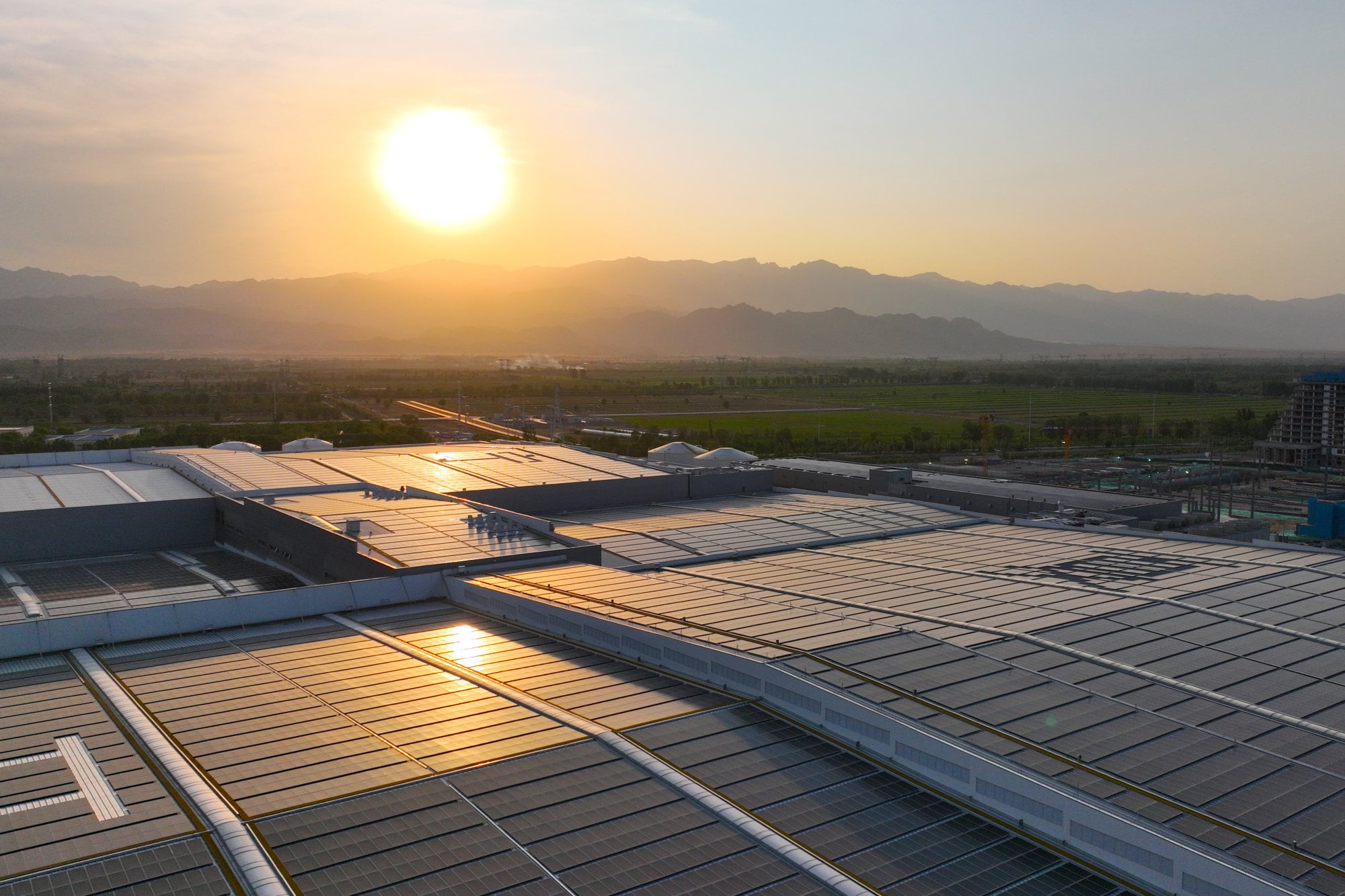
Elon Musk’s SpaceX has been sounding out multiple Chinese solar suppliers in recent weeks, industry insiders and companies confirmed, as the world’s richest man advances his vision for space-based data centres powered by constant solar energy – drawing fresh attention to China’s solar supply chain.
The discussions, which have not yet resulted in confirmed orders, triggered a rally in shares of several solar-related companies earlier this week, before sentiment cooled on Thursday.
Analysts and industry insiders said the talks underscored the competitiveness of China’s solar sector and ignited public interest in space-based photovoltaics, though they cautioned that multiple technological routes remained under exploration and warned against excessive capital market hype.
Companies that have publicly acknowledged contact include TCL’s subsidiary Zhonghuan, a maker of photovoltaic materials and solar cells; GCL Technology, a green-energy group with research in granular silicon and perovskite technologies; and Jinko Solar, a major photovoltaic module manufacturer. Solar heavyweight Longi Green Energy Technology and solar-equipment maker Maxwell Technologies have also been widely cited in market discussions.
Jinko Solar said on Thursday that “space-based [photovoltaic technology] remains at a very early stage of technical exploration, with no clear solution, commercial projects or revenue”, warning investors of risks. Its Shanghai-listed shares fell more than 6 per cent on Thursday, snapping a two-day surge.
Musk had repeatedly argued that space-based computing was the only viable way to scale artificial intelligence, saying that terrestrial infrastructure would struggle to support the vast power and cooling requirements of AI data centres.
He outlined plans of SpaceX and Tesla to separately build up to 100 gigawatts of solar panels annually within three years, when he spoke at the World Economic Forum earlier last month. SpaceX has also been seeking approvals to send 1 million solar-powered satellites into orbit. He forecast that within three to four years, space AI satellites could reach an annualised deployment rate of about 100GW.
Musk praised China’s solar manufacturing base amid the global AI infrastructure boom. “China is an amazing powerhouse of manufacturing and understands very well that solar is the future,” he wrote on X earlier this week.
China’s new photovoltaic installations were forecast to reach 180GW to 240GW in 2026, with average annual additions of 238GW to 287GW during the country’s next five-year planning period from 2026 to 2030, according to the China Photovoltaic Industry Association (CPIA), which held an industry conference on Thursday.
China added 315GW of solar capacity in 2025, bringing total installed capacity to 1.2 terawatts, making it the world’s largest solar power producer since 2015, data from the National Energy Administration showed.
Analysts at China International Capital Corp (CICC) urged caution, saying demand from space-based photovoltaics was unlikely to leap before 2030, even under optimistic scenarios for the deployment of space-based computing. CICC noted that multiple technological routes remained under exploration, from early silicon-cell iterations to gallium arsenide, and more recently to lightweight high-efficiency crystalline silicon and perovskite-based solutions, none of which had yet reached mature commercialisation.
Liu Yiyang, executive secretary general of CPIA, also warned against excessive capital-market hype, saying that “scalable high-efficiency manufacturing and long-term reliability verification” were prerequisites.
China is pursuing its own ambitions in space-based computing. In May 2025, it launched an initial batch of 12 satellites equipped with onboard computing systems and inter-satellite communication links, as part of the “Three-Body Computing Constellation” being developed by Zhejiang Lab. The ultimate goal is to achieve a total computing power of 1,000 petaflops – equivalent to a quintillion calculations per second.
Separately, Beijing-backed Astro-Future Institute of Space Technology said in November that it planned to launch an experimental satellite, Chenguang-1, as part of a broader space-computing initiative.
China’s main space contractor, China Aerospace Science and Technology Corporation, has also pledged to build “gigawatt-class space digital-intelligence infrastructure” under its latest five-year development plan. -- SOUTH CHINA MORNING POST


