US President Donald Trump wants to build his “Dream Military”. In January, he proposed setting military spending at US$1.5 trillion in 2027 while citing “very troubled and dangerous times”.
The move would increase the country’s defence budget by around 50 per cent amid growing concern at the Pentagon about China’s AI advancements.
As the United States and China race to develop the latest artificial intelligence, the use of AI technology in the military has become a battleground in its own right, with both powers vying to integrate the transformative technology first.
China’s apparent AI has unsettled many people in Washington, analysts said.
“Regardless of how much the US actually increased defence spending, there’s definitely going to be more money for companies developing AI-related technologies,” said Samuel Bresnick, a research fellow at Georgetown University’s Centre for Security and Emerging Technology (CSET).
Ukraine’s unexpectedly strong defence following Russia’s invasion and its innovative use of new technologies have also changed military doctrine and forced countries to rethink basic assumptions about military manufacturing.
“Frankly, the way that war is changing, China seems to have a big advantage because they’re able to manufacture much more military material and very quickly,” Bresnick said.
“A lot of people in the Pentagon are worried about that, and so you see this concern feeding into what’s going on with the various initiatives at the Pentagon.”
The US Department of War launched its Artificial Intelligence Acceleration Strategy in January, aimed at establishing the country as “the world’s undisputed AI-enabled fighting force”.
‘Intelligentised’ warfare
In an Association of the United States Army (AUSA) opinion piece published on January 5, US Army Captain Stafford Harmond encouraged the army to embrace AI, with a particular focus on China.
“The army must fast-track tactical AI development if it hopes to keep pace with rivals like China,” the military intelligence officer wrote.
Harmond, currently serving at the US southern border, stressed the urgency of competing with countries like Russia and China, saying that “to truly grasp what’s at stake, the army must study how rivals wield this technology”.
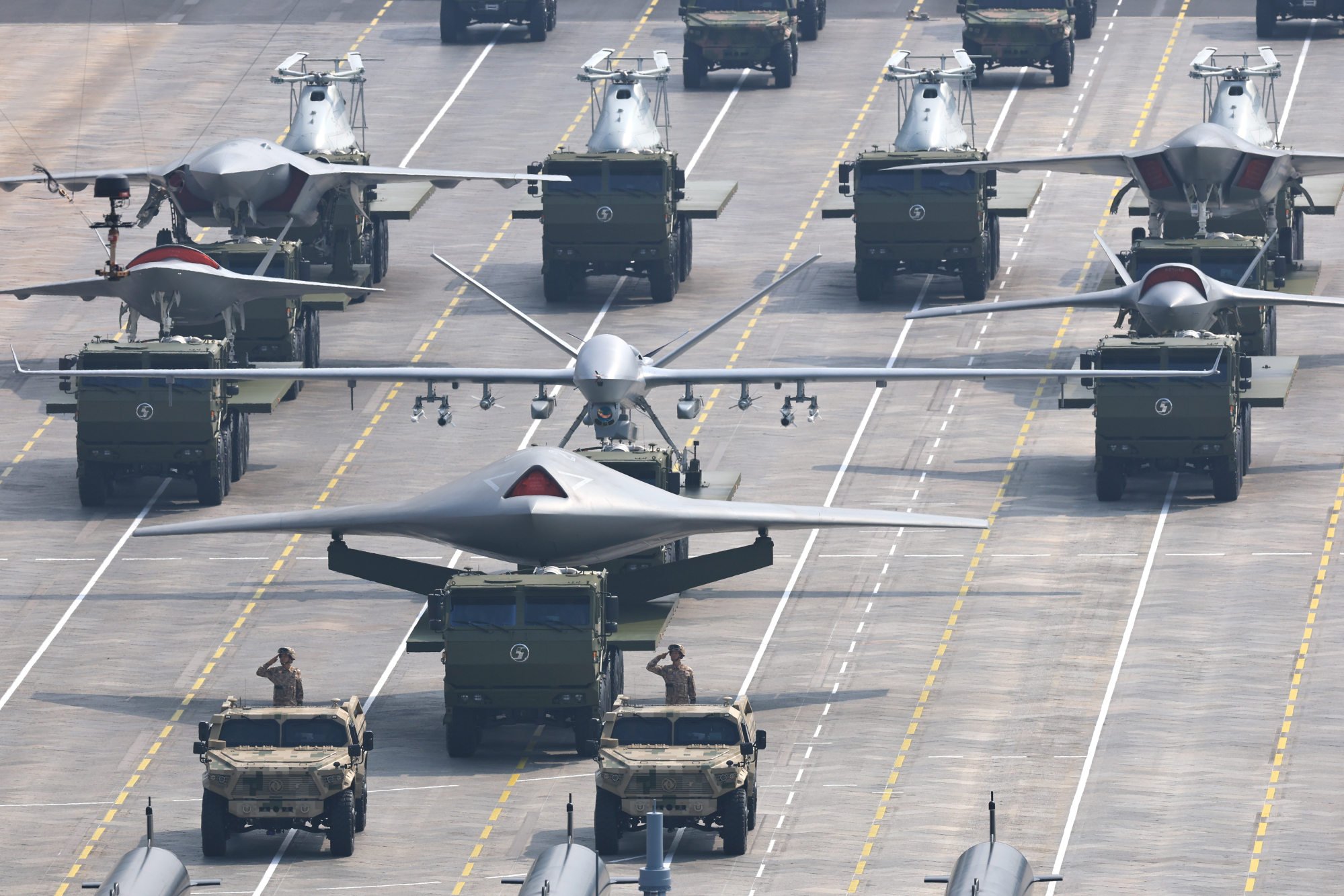
He described China’s strategy as one that “centres on ‘intelligentised’ warfare – a doctrine embedding AI from top to bottom”.
“The Chinese military’s doctrine of ‘intelligentised’ warfare isn’t just jargon; it’s a wholesale redesign of how it fights,” Harmond said.
“The Chinese are merging civilian and military technology efforts, giving them a head start in research and development and deployment. Their goal? Undermine US kill chains and exploit our human-machine coordination gaps.”
Same problem, different methods
Melanie Sisson, a senior fellow in the foreign policy programme at the Brookings Institution, said Harmond’s opinion piece highlighted how the US and China were addressing the same problem in different ways.
“China’s system is centralised, and the way they develop AI reflects that – they are told to design each element of the system with integration in mind,” she said.
“That has benefits but also drawbacks – it can narrow focus in such a way that designers are optimising for integration at the expense of discovering other features or functions that might be useful.”
The US approaches the problem very differently, Sisson added.
“We ask technologists to design a useful tool, and then we work to figure out how to get them all to work and play nicely with each other,” she said.
This has benefits: the bottom-up process allows for creativity and discovery that are not necessarily planned, according to Sisson. On the downside, however, it can complicate integration.
“I think the author here is asking for a happy medium, of keeping an eye on integration while also maintaining focus on discovering and delivering functionality.”
In September, analysts at CSET, including Bresnick, published a report titled “Pulling Back the Curtain on China’s Military-Civil Fusion”.
Beijing’s military-civil fusion is part of a national strategy that aims to develop a modernised PLA by 2035 and world-class armed forces by 2049.
Chinese companies and universities outside the traditional network were emerging as key suppliers to the Chinese military’s AI-related procurement, the report said, and in the process, playing a “consequential” role.
The findings were based on 2,857 AI-related contract award notices published by the PLA between January 2023 and December 2024.
This could present a monumental challenge for the US, analysts said, underscoring that the military-civil fusion programme was not just rhetoric and that there was now evidence it was happening.
In 2024, a report by the House Select Committee on the Communist Party looked into the “extent to which US federally funded research benefits China’s military modernisation”.
US federal research funds were allocated to researchers and institutions with close ties to China’s defence sector, the report found, partially as a result of the opaque relations with the defence sector.
This comes as Washington policymakers have increasingly encouraged US universities and companies to re-examine their connections to Chinese civilian universities and companies.
Why China’s military is attracting interest
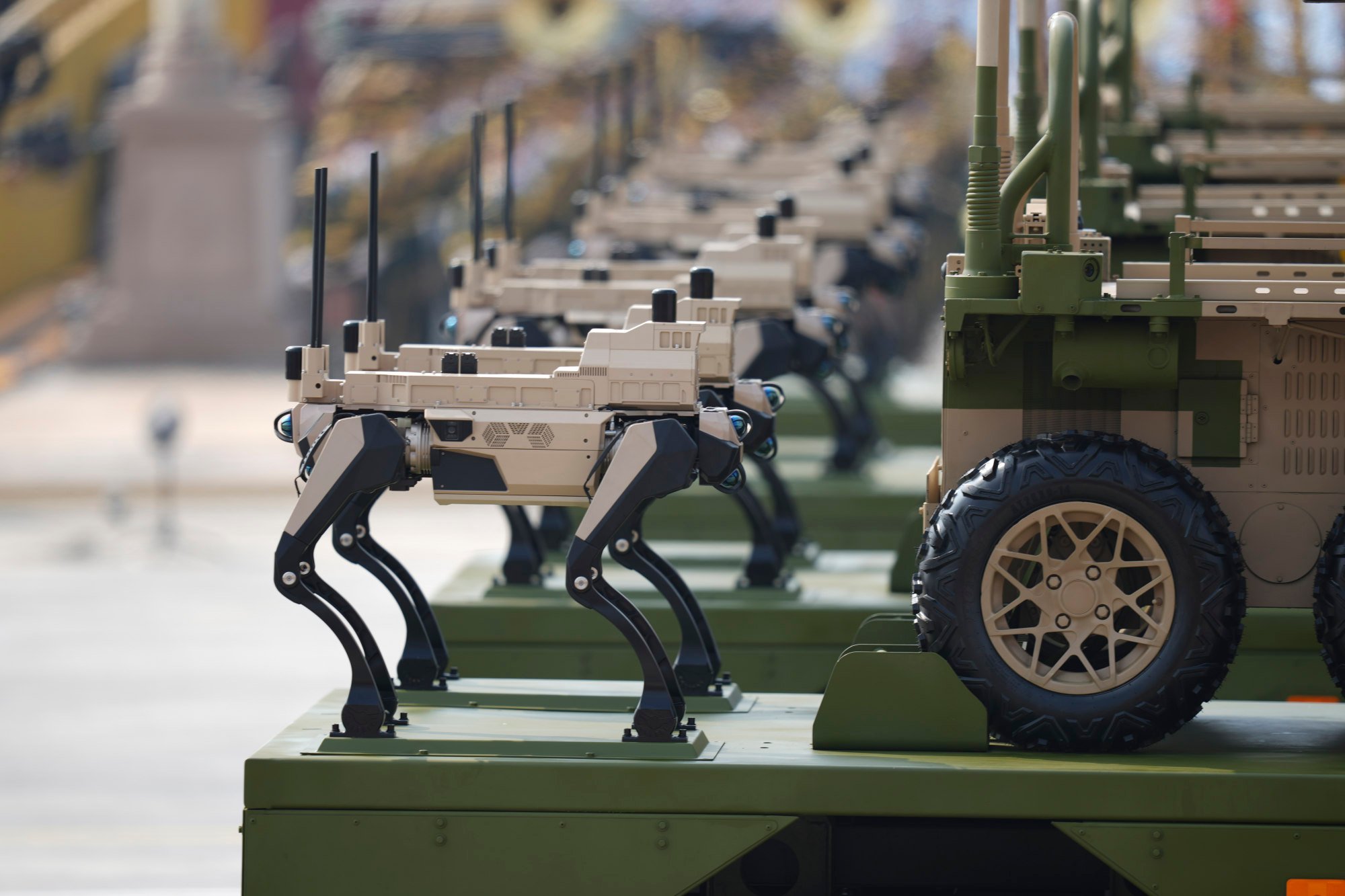
China’s military is in the early stages of what they call “intelligentisation”, and this is attracting considerable interest from other countries, Bresnick said.
“This is the use of emerging technologies like AI to better utilise use of the information the PLA gathers about the battle space. So we see a huge amount of interest in AI throughout the Chinese military,” he added.
The PLA’s progress in AI was on full display during China’s military parade marking the 80th anniversary of the end of World War II, where a variety of AI-powered uncrewed equipment was unveiled to the world.
“I think the Trump administration officials now see what’s going on in China and say, hey, to be competitive in these emerging technologies, we really need to figure out a way to get commercial technologies into the military because of their dual-use potential,” Bresnick said.
One example where this was playing out, analysts said, was with Palantir Technologies, a US-based company specialising in data analytics and artificial intelligence software, which was awarded a US Army contract in 2025 worth up to US$10 billion.
US and China spend big on defence
China’s military budget for 2025 was set at 1.78 trillion yuan (US$245.2 billion), making it the world’s second-largest military spender after the US.
Washington’s budget was around US$850 billion last year, compared to US$901 billion for 2026.
If Trump’s touted military spending reaches US$1.5 trillion next year, it will be the largest ever in history.
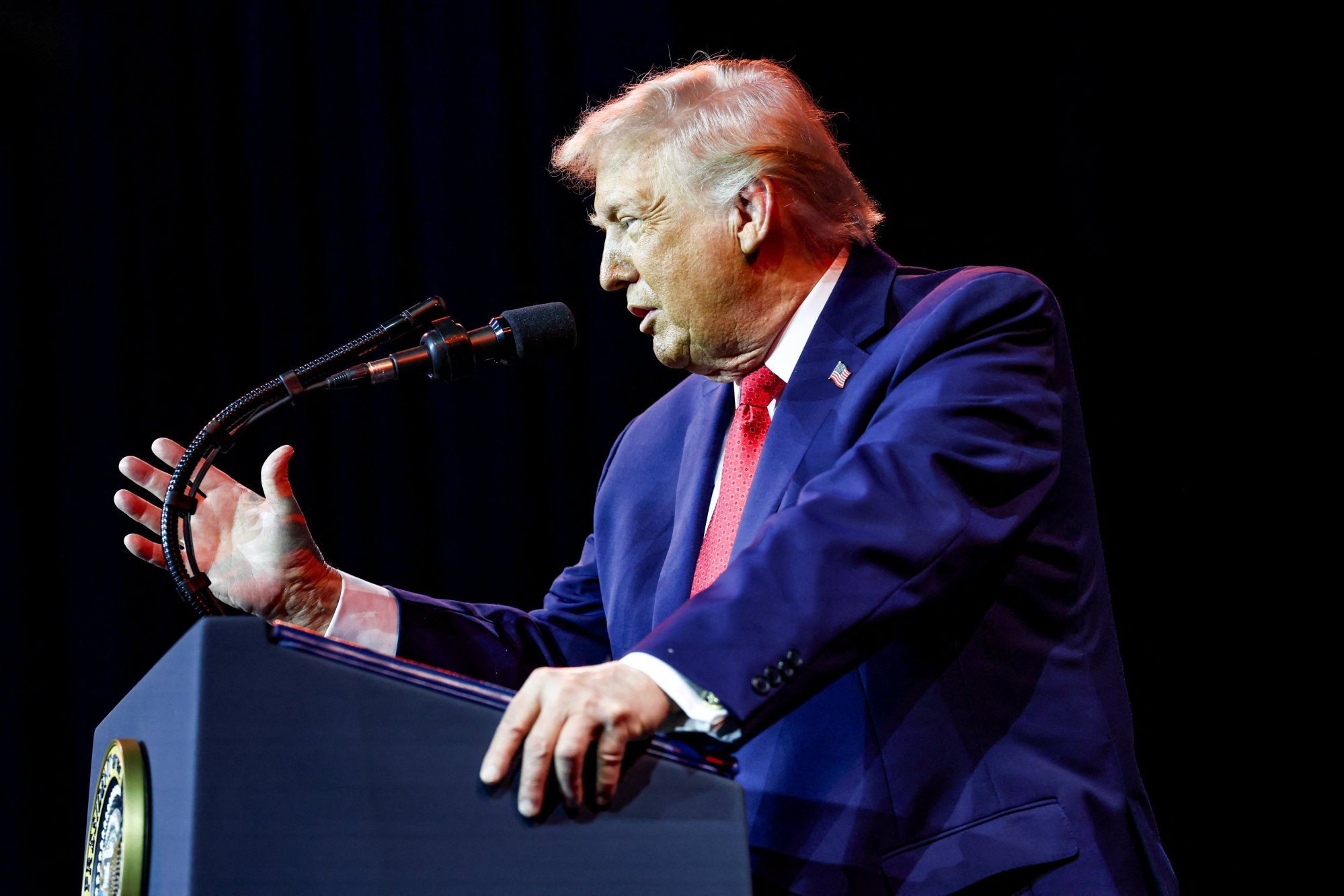
“This will allow us to build the ‘Dream Military’ that we have long been entitled to and, more importantly, that will keep us SAFE and SECURE, regardless of foe,” Trump said on Truth Social.
“The Pentagon believes that right now the overall military technology gap works in its favour,” Sisson said, but that narrows where AI is concerned.
“I don’t think anyone is really confident that the US is in the lead on military AI specifically – people really do see it as a highly contested race.
“It’s the Pentagon’s job to worry about China’s advancements,” Sisson concluded, adding that there was a huge push within the Pentagon to counter China’s perceived AI advances.
But measuring quantifiably whether Beijing or Washington is ahead in the AI military race is difficult.
This comes as both nations seek to integrate this transformative technology into their defence readiness, data analysis and the information that leaders need to make good decisions.
“The goal for both is to be able to use AI to get accurate information faster and to use it to achieve battlefield effects,” she said.
“In a lot of ways, they’re both struggling to get the same value from AI, even if they talk about it differently.” -- SOUTH CHINA MORNING POST