




China plans to power a world-class petrochemical complex under construction with ultra-high-temperature steam from an unprecedented three-reactor nuclear system.
The steam can reach up to 1,000 degrees Celsius (1,832 Fahrenheit) – high enough to break molecules apart.
Located in Lianyungang, Jiangsu province, the project combines two third-generation Hualong One pressurised water reactors with one fourth-generation high-temperature gas-cooled reactor (HTGR) for heating and electricity generation.
Never before has a single facility integrated multiple generations of nuclear technology to simultaneously provide both power and ultra-high-temperature process heat at industrial scale.
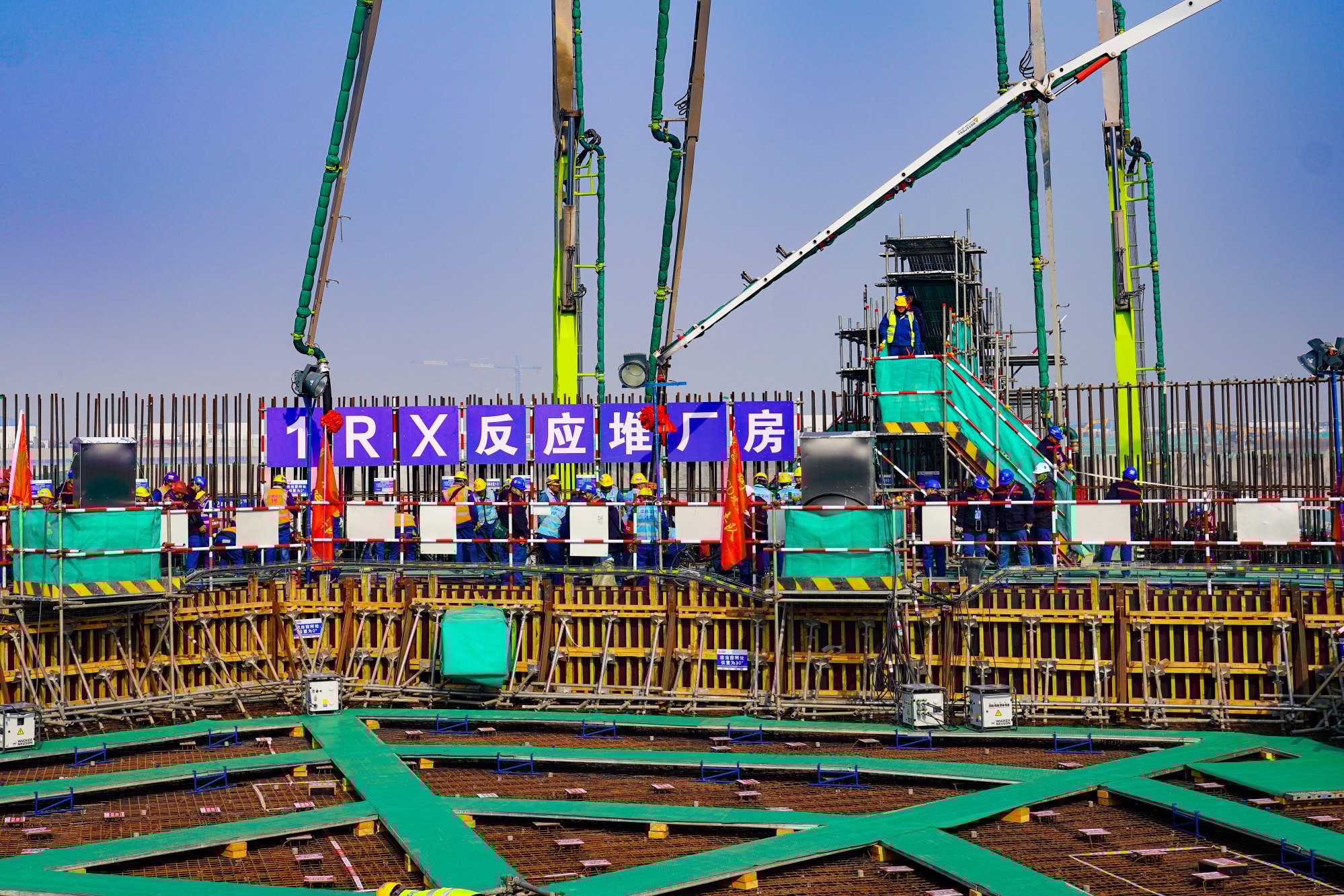
Construction of the nuclear island for unit 1 of the Xuwei nuclear heating and power project’s first phase began on Friday with the pouring of the first tank of concrete, according to Chinese media reports.
This means that Lianyungang’s petrochemical industrial base – one of the country’s major hubs – is transitioning away from numerous inefficient, scattered coal-fired boilers and towards a zero-carbon central heat source.
Unlike conventional nuclear power plants, this project uses nuclear energy to pump clean steam to the petrochemical industry while also supplying electricity.
The first phase of the project, developed by state-owned China National Nuclear Corporation (CNNC), comprises two 1208 MWe Hualong One units and one 660 MWe HTGR unit.
The Hualong One units are mature third-generation pressurised water nuclear reactors, which are mainly used for electricity generation and as an initial heat source. The HTGR unit – a fourth-generation nuclear reactor concept that can achieve core outlet temperatures of between 700 and 1,000 degrees – will help with secondary heating.
“The Hualong One models are million-kilowatt-level reactors that provide stable power generation, serving as the grid’s ‘cornerstone’,” according to CNNC in an article published on Monday. “The HTGR unit, meanwhile, produces high-temperature steam that meets the demands of the chemical industry.”
Upon completion, the facility will supply 32.5 million tonnes of industrial steam per year and generate a maximum of 11.5 billion kilowatt-hours of power.
It is expected to reduce the use of standard coal by 7.26 million tonnes per year and cut carbon dioxide emissions by 19.6 million tonnes annually – a reduction in emissions equivalent to taking nearly five million petrol-powered vehicles off the road for a year.
The Lianyungang site, one of China’s seven major petrochemical industrial bases under development, has grown rapidly in recent years.
According to state media, the hub is rapidly cementing its industrial status. While it boasts several world-first facilities, its 40 million-tonne annual refining capacity remains shy of the global peak.
The Jamnagar Refinery in Gujarat, India, owned by Reliance Industries Limited, boasts a refining capacity of about 62 million tonnes per year, making it the world’s largest single-site refinery complex.
In the refining and petrochemical industry, steam is indispensable for thermal stripping in crude oil distillation and for temperature control in processes like catalytic cracking.
According to state news agency Xinhua on Friday, Lianyungang base uses up to 13,000 tonnes of steam per hour but previously relied on fossil fuels such as coal to do this.
As China seeks to achieve peak carbon emissions by 2030 and become carbon neutral by 2060, Lianyungang’s industrial development ambitions are increasingly constrained by green goals. This prompted the local government in Jiangsu to collaborate with CNNC.
Xuwei’s first phase was one of five nuclear power projects approved by China’s State Council in 2024. As designed, the Hualong One reactors initially heat desalinated water to produce saturated steam.
The high-temperature gas-cooled reactor then superheats the saturated steam, generating higher-grade steam for industrial use.
Implementation, however, is no simple matter.
In an interview with the official Science and Technology Daily, Chen Gang, a project leader from CNNC, said implementation “requires precise coordination of three variables: ensuring reactor safety and meeting user steam demand while accommodating grid capacity constraints”.
CNNC added that the project was not merely about building an energy facility but establishing a self-reliant, technologically advanced industrial chain.
According to the nuclear giant, more than 60 per cent of equipment contracts went to domestic private enterprises, with a significant number of specialised innovative firms gaining entry to the high-end nuclear power market. -- SOUTH CHINA MORNING POST


