Hong Kong will expand drone patrols to all major police regions from Friday, including The Peak, Cheung Chau and Lamma Island, for crime prevention, crowd control and traffic monitoring.
Superintendent Tango Ko Chung-ying of the force’s key points and search division said the second phase of the patrols, which would join existing operations in Heung Yuen Wai and Kowloon West, aimed to further test the capabilities of the drones.
“Besides a more complex terrain, we will also be encountering more policing scenarios, meaning the drones will work more closely with ground officers,” Ko said.
Both automatic and manually controlled drones will be deployed on The Peak, Cheung Chau and Lamma Island as needed, depending on operational needs and prevailing crime trends.
Ko said the force chose the three locations as they were larger and more densely populated than the Heung Yuen Wai border area and had more signal sources than the flatter, less busy border zone.
The force will also expand its manual drone patrols in urban areas to Central, Sau Mau Ping, Yuen Long and Tsuen Wan from Friday, covering one district in each major police region on land.
Police began testing automatic and manual drone patrols in Heung Yuen Wai and Kowloon West in May last year.
Ko said the drone trials in Kowloon West had expanded from Yau Ma Tei and Jordan to include Yau Tsim, Mong Kok, Sham Shui Po and Kowloon City.
Between May and the end of last year, the force conducted 664 automatic patrols along the Ta Kwu Ling border area in the northern part of the city.
In urban areas, officers carried out 302 patrols from June to December, leading to 13 arrests – three for drug-related offences, four for theft, six involving wanted persons. One of those arrested was also found to be lacking identification documents.
“[The flights] were 100 per cent safe without any accidents,” Ko said, adding that the force had not received any complaints regarding the drone patrols.
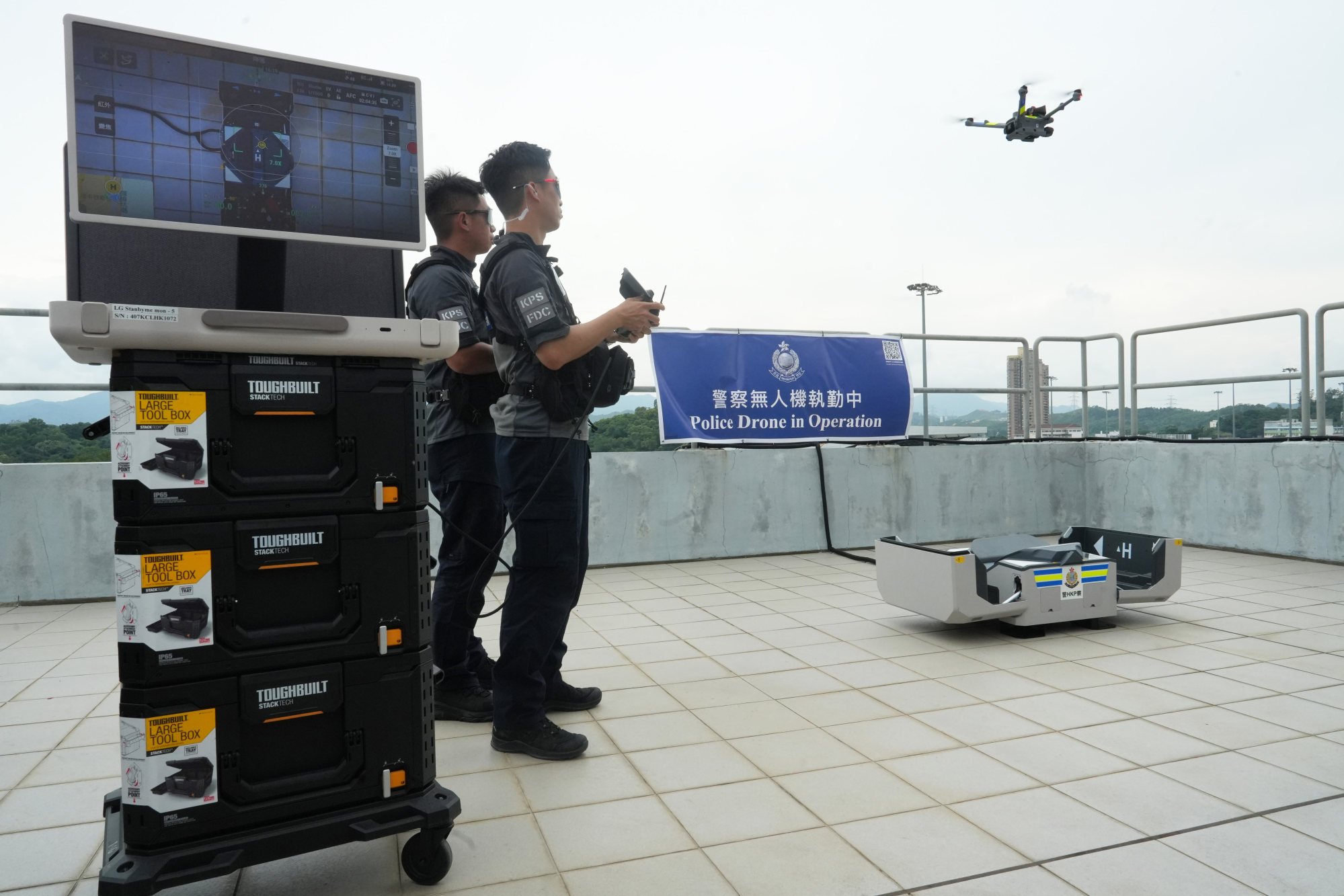
Automatic patrols use a docking system, allowing a drone to fly along a preset route without human intervention, while an officer monitors the flight and live footage transmitted during the patrol.
Manual patrols, meanwhile, require a two-officer team: one to operate the drone and the other to ensure flight safety.
The force currently has around 800 trained drone pilots and 10 docking systems.
From Friday, Cheung Chau and Lamma Island will each be equipped with one system, while The Peak will have another set.
Lau Kin-hang, divisional commander of Cheung Chau police division, said he planned to use the drones to cover elusive “blind spots” on the islands and monitor crowds during weekends and holidays.
Lau explained that Cheung Chau had densely built-up areas with many sequestered alleyways, while Lamma Island had slopes, hiking trails and residential buildings built on hills.
“Our preset routes’ flight times last for 15 to 30 minutes. That is sufficient to cover the scope of one to two hours of traditional foot patrols,” Lau said, adding that thermal imagery would be able to detect suspicious activity faster.
But Lau said the drones would not reduce manpower needs at this stage, as these flights were intended to work in tandem with traditional foot patrols rather than replace them.
The chief inspector added that the drones could be deployed to make crowd control announcements during the bun festival in May, when more than 20,000 Hongkongers flock to the island for the annual parade and bun scrambling competition.
“For things residents can’t see at ground level, we can use aerial broadcasts to tell them – for instance, how many people are ahead of you and how long you’ll have to wait for the next ferry,” Lau said.
Anthony Lee Kwok-yiu, subdivisional commander of The Peak, said the drones would help detect suspicious activities in areas with dense foliage.
“One drone patrol would last around 20 minutes, covering around 150 hectares – the size of seven Victoria Parks – and more than 100 housing estates,” Lee said.
The senior inspector said he might also use the drones to broadcast anti-burglary messages to residents in the area and monitor traffic and crowd conditions at tourist spots on The Peak.
Ko said this round of the pilot scheme had no set time frame, with the force reviewing operations periodically.
The officer added that the force could consider adding artificial intelligence functions – such as people-counting and automatic alerts – to the drones or their back-end processing systems. -- SOUTH CHINA MORNING POST