
BANGKOK: The Thai Structural Engineers Association has identified two causes behind the Rama II crane collapse - incomplete locking of crane parts and improper placement of support legs.
Chulert Jitjuajun, Vice President of the Thai Structural Engineers Association, visited the site on Friday (Jan 16) and conducted an initial analysis of the collapse.
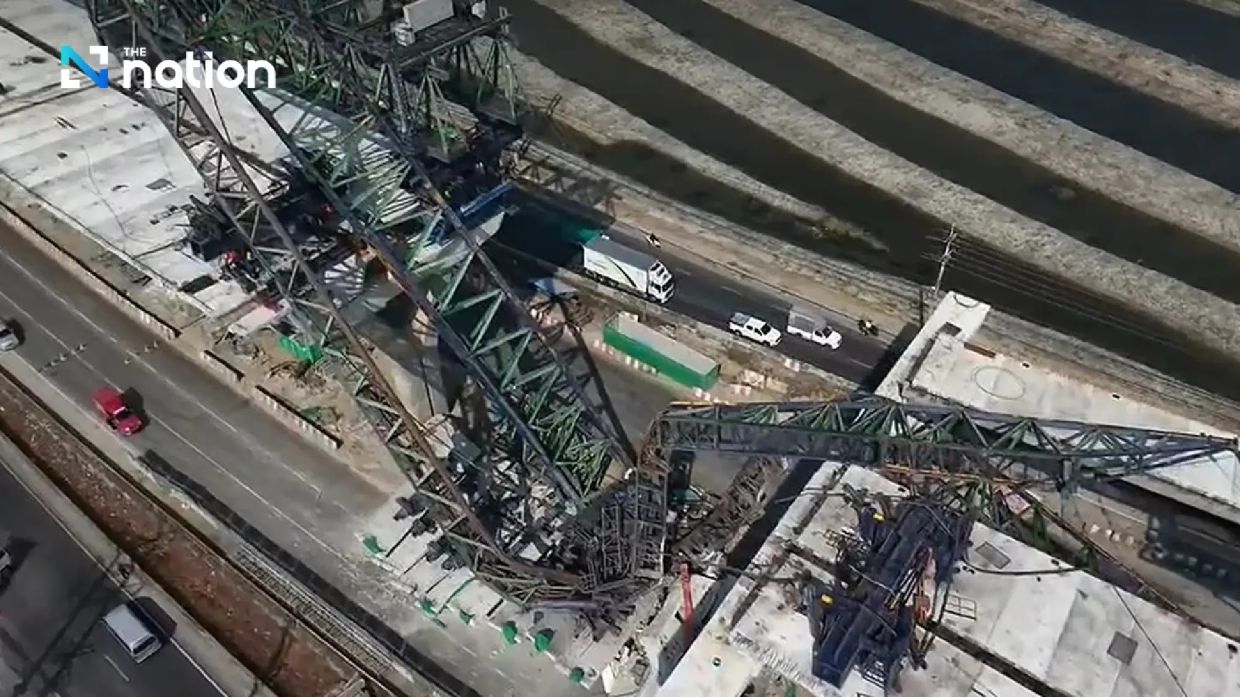
The crane collapse at the construction site of the Special Highway No. 82 elevated road project (Bangkhunthian-Ban Phaeo, Ekkachai-Ban Phaeo section, km 30+300) on Rama II Road, Tha Chin Subdistrict, Mueang Samut Sakhon District, Samut Sakhon Province, had resulted in fatalities and injuries.
Two main causes of the collapse
1) Carelessness in engineering processes
Upon inspecting the damage and reviewing aerial images as well as images before the incident, Chulert pointed out that the collapse was highly likely due to errors in placing the crane’s support legs in the wrong position.
The support legs were positioned on the thinnest part of the concrete segment rather than on the thicker and stronger areas.
This led to the support legs puncturing the back of the concrete segment, causing the structure to collapse.
2) Defective hydraulic equipment
There was also an issue with the hydraulic equipment, specifically the collar, which is meant to prevent the jack’s shaft from collapsing.
The collar was found to be incomplete, as it didn’t completely encircle the jack shaft (360 degrees) and lacked the required bolts.
This resulted in visible gaps where the jack shaft could be seen, affecting the stability of the structure.
Chulert further explained that, according to engineering principles, the collar should fully enclose the jack shaft and lock in place to prevent movement or detachment.
The defects observed in several photos could have led to the jack shaft collapsing or detaching, thus impacting the stability of the overall structure.
Summary of likely causes
Carelessness in the Engineering Process: The improper placement of support legs and the lack of force distribution beams to appropriately manage the weight.
Defective or Substandard Equipment: Hydraulic equipment, particularly the collar, did not meet engineering standards.
However, Chulert emphasised that this analysis is based on initial assumptions, as there are still no detailed data from the installation process, such as clear-scale photos or complete technical information.
Additionally, no discussions have yet occurred with the construction company.
If more information becomes available, a clearer cause can be determined, and it will be verified whether the procedures followed were in accordance with proper engineering standards. - The Nation/ANN