



Australia’s former prime minister and a prominent China scholar, Kevin Rudd, will step down as ambassador to the United States a year ahead of schedule, a move some analysts say underscores a fundamental shift in how Canberra must navigate a Washington increasingly centred on the personal rapport with US President Donald Trump.
The resignation follows a period of heightened friction between Rudd and Trump, punctuated by the “America first” leader’s blunt public declaration in October 2025 that he “didn’t like” the ambassador and “probably never will” over his past criticisms of Trump.
Before he was appointed ambassador in 2023, Rudd called Trump “the most destructive president in history” and a “traitor to the West” in now-deleted social media posts.
The Australian government has downplayed Trump’s comments to Rudd, which were made during Australia Prime Minister Anthony Albanese’s visit to the White House last year, calling them “lighthearted” and endorsing Rudd as doing a “fantastic job”.
During a press conference on Tuesday, Albanese said that the departure was entirely “Kevin Rudd’s decision”.
While the Australian government has not officially linked the departure to these comments, some experts argue that the exit is a pragmatic response to a new era where personal equation has shifted from a diplomatic soft variable to a central operating condition of US foreign policy.
Risk of having a marginalised ambassador too high to ignore
According to Denis Simon, a senior fellow at the Quincy Institute, a Washington-based think tank, Rudd’s position became increasingly difficult to maintain in an administration that views ambassadors not merely as professional diplomats but as “personal extensions of the president’s political authority”.
“Once the relationship crossed into open personal antagonism, it obviously became difficult for Canberra to credibly present Rudd as a fully empowered interlocutor,” Simon contended.
He argued that for an alliance resting on deep-level intelligence and defence coordination, the risk of having a marginalised ambassador was too high to ignore.
“An ambassador who lacks that personal standing can find themselves marginalised regardless of the formal strength of the alliance,” Simon said.
Emma Shortis, director of the International & Security Affairs Programme at the Australia Institute, said that Washington’s “traditional allies are all grappling with how best to deal with the chaos of the Trump administration”.
According to Shortis, the administration’s “assault” on the international rule of law is of “deep concern” to traditional allies, including Australia. She emphasised that the next Australian ambassador to the United States will face “acute challenges”.
“The fact that they do not yet have an equivalent in Australia speaks to the imbalance in the relationship and the Trump administration’s approach to allies more broadly,” Shortis observed.
A successor to Rudd in Washington has not yet been announced.
Rudd ‘one of the world’s most eminent’ experts on China
Rudd, a fluent Mandarin speaker and author of a 2022 PhD thesis on Chinese President Xi Jinping’s ideology, will return to his previous role as president and CEO of the Asia Society, a position he held from 2021 to 2023. Rudd will also head the society’s Centre for China Analysis.
On Tuesday, Albanese called Rudd “one of the world’s most eminent and sought-after experts on China and US-China relations” in a joint statement with Australia’s Minister for Foreign Affairs, Penny Wong.
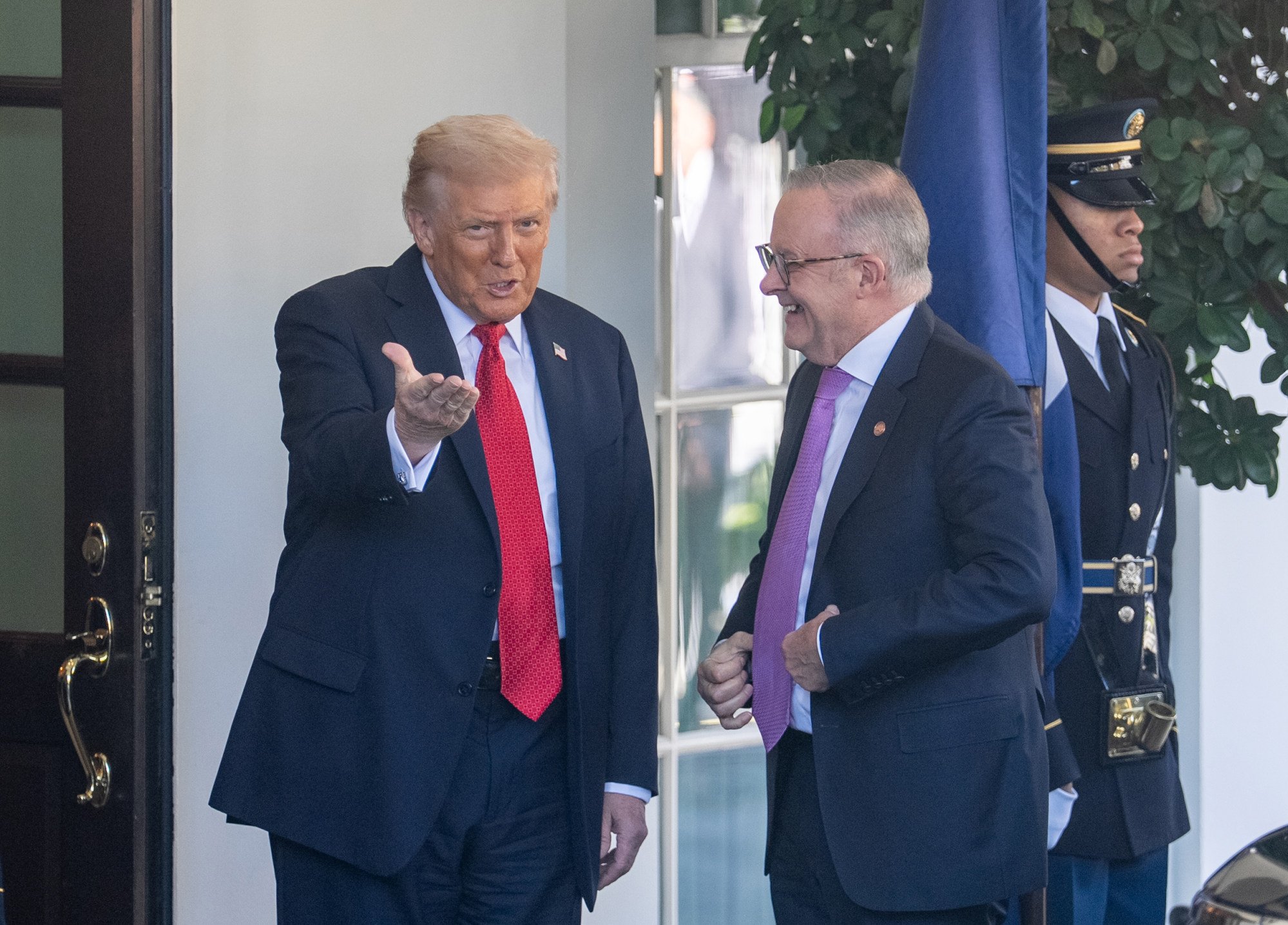
Some of the outgoing ambassador’s accomplishments during his tenure included securing support for the trilateral security alliance (Aukus), Julian Assange’s return to Australia and a US-Australia critical minerals framework aimed at curbing China’s dominance in the industry.
Jared Mondschein, director of research at the United States Studies Centre in Australia, called Rudd’s tenure as ambassador “effective in challenging circumstances”, while citing Aukus and the critical minerals deal.
“I don’t necessarily think that Donald Trump’s liking or disliking of someone is necessary for them to be effective in Washington,” he said.
Mondschein noted that both US Vice-President J.D. Vance and US Secretary of State Marco Rubio “did not necessarily like Donald Trump but eventually came to have warm and effective relations with him”.
However, Pauline Hanson, a right-wing senator from Queensland, Australia, often compared to Trump at home, described Rudd as not “up to the job”.
“That’s been clear since President Trump said ‘I don’t like you either’ to his face in October,” she said in a social media post.
She hoped that the Albanese government would pick “someone who has respect”.
“Our relationship with the United States is vital and needs the right person for the job, not just another Labor mate,” she added.
According to Australian media reports, the front-runner to replace Rudd is the Labor Party’s Stephen Conroy. A tough-talking politician, Conroy also has a history of slamming Trump, whom he once called “moronically stupid”.
Another name doing the rounds is former prime minister Scott Morrison, who is reported to have a strong relationship with Trump.
“In the Trump era, the effectiveness of the US-Australia relationship will hinge less on process and more on personalities, and Canberra’s choice of Rudd’s successor will be an early test of how well it understands that reality,” Simon of the Quincy Institute said.
As he steps away from his official position, Rudd plans to work between New York and Washington on the “future” of US-China relations. “Which I have always believed to be the core question for the future stability of our region and the world,” he said in a statement. -- SOUTH CHINA MORNING POST



