SIEM REAP: The tills at Siem Reap’s Old Market, which is popular with tourists, are usually busy ringing in December, the high tourism season in Cambodia.
Not this year.
The latest border clashes between Thailand and Cambodia have scared off tourists, with shopkeepers and tour agents alike reporting a plunge in business.
Pheng Tittararaksmey, 44, who runs a shop at the market selling clothes and souvenirs like magnets, told The Straits Times that business has been “very bad”.
“Before the (border) explosions, there were many customers, just like last month. Now, there are very few,” she said. She has seen a 40 per cent drop in business since both countries resumed border hostilities on Dec 8, following a five-day clash earlier in July.

Vanchan Nary, 41, a jewellery shop owner at the same market, said she used to be able to make US$100 (S$129) a day easily in December. Now, she is lucky if she can get US$10 a day.
“Before the fighting at the border, business was normal because it is the high season. Now, during the war, it is very quiet.”
Sitting idle in the shop, her husband, Vong Somony, 41, said: “If the war continues for a long time, it will seriously impact the tourism business.”
Though the city of Siem Reap is about a two-and-a-half hour drive from the nearest border clash site, some foreigners are erring on the side of caution and staying away.
VLK Royal Tourism, a tour agency based in Siem Reap, said four out of 10 tour groups due to visit in December have been cancelled.
Instead of travelling to Cambodia and Thailand as part of a two-week regional tour that also includes Vietnam and Laos, tourists now prefer to visit just Hanoi, said Mr Phy Sopheak, a travel agent from the agency.
If the fighting continues, tourists will be afraid of visiting Cambodia and there will be more cancellations, said Sopheak, 33. “No tourists, no income,” he added.
Angkor Wat, the renowned Unesco world heritage site in Siem Reap, has seen a 10 per cent fall in visitor numbers since the border clashes, a ticketing office staff member told ST.
Chan Syth, a tour guide for Angkor Wat, said he usually earns about US$30 a day, but is now hard-pressed to earn even a dollar a day.
Previously, there were large groups of tourists from Thailand, Laos and Vietnam, said Syth, a guide of 15 years. “At the weekends, they travel over land across the border. But now, (it’s) quiet.”
It is not just foreigners – locals are also staying away from Siem Reap city, observed Nary. Some are scared of the border clashes, she said, while others “are mobilising themselves to donate supplies to refugees and soldiers (at the border). So they’re not coming to buy”.
Fighting has continued as Thai Prime Minister Anutin Charnvirakul doubled down on his promise to “continue to perform military actions until we feel no more harm and threats to our land and people”, rebuffing US President Donald Trump’s ceasefire overtures.
On Dec 14, the Cambodian authorities said 400,000 people have been displaced due to the conflict.
Cambodia’s Interior Ministry said 11 civilians have died, with about 60 injured. It has not revealed the fatalities and injuries suffered by its military.
On the Thai side, more than 125,000 civilians have had to flee from the border. At least 16 Thai soldiers have died, with more than 300 people injured, said the Thai authorities on Dec 14.
Some tourists have stuck to their plans to visit Cambodia despite the border conflict.
Randy Sundell, 56, a former teacher from Chicago, flew into Siem Reap after travelling in Thailand.
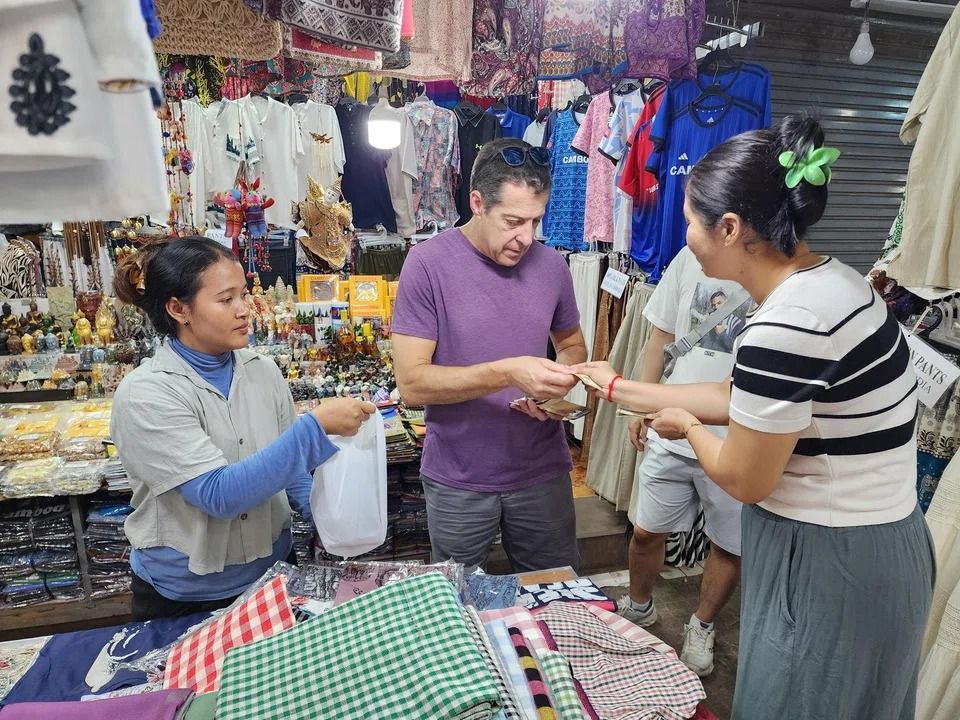
“We planned this trip over the fall and we’re aware of the situation, but I’m not concerned. We are far away from the fighting that I don’t feel like we will have any problems.”
His travelling companion, 32-year-old Danny Park, an education business owner, noted that fighting seemed to be only along the border. “We talked to some people here, some friends here, and they said mostly everything is fine.”
Cambodia has already had to deal with bad press from scamming syndicates in the country before the latest conflict. Earlier this week, Cambodia state media reported that the authorities worked with South Korean law enforcement officials to arrest about 50 suspects, dismantling an online scam syndicate in Sihanoukville in Preah Sihanouk province, south-west of the country.
Park, a Korean American, said: “A lot of my Korean friends were telling me that you should be careful going to Cambodia right now, because people are getting kidnapped and being forced to work in the scam compounds.”
Even before the latest clashes, Cambodia had seen a decline in tourist arrivals.
Between January and October, it received 4.75 million foreign visitors, down by 11.6 per cent from the same period in 2024, local media reported. Officials attributed the decline to a drop in visitors from neighbouring countries owing to Thai military actions.
Park, who noted that micro-businesses make up most of Cambodia’s economy, said: “I hope they resolve the border crisis as soon as possible. Hopefully we can get things back on track and all of these micro-businesses and the families that depend on the businesses (can go back to) earning money.”
Besides the negative impact on Cambodia’s tourism industry, some fear that the clashes might damage heritage sites in the border areas.
Cambodia has alleged that the Thai military attacked the grounds of the Preah Vihear temple complex and the area around it, damaging some of its buildings.
While the International Court of Justice affirmed Phnom Penh’s authority over the temple and the land around it in 1962 and 2013, Thailand has continued to claim ownership over Preah Vihear, a Unesco World Heritage Site about three hours away from Siem Reap city.
India has expressed concerns about the reports of damage to the conservation site, as it has been involved in helping to preserve the facilities.
Unesco, too, has called for the “urgent protection of the region’s cultural heritage in all its forms” and “reminds all parties of their obligations and commitment to respect international law”. - The Straits Times/ANN