
China has postponed the return of the Shenzhou-20 space mission following a suspected impact by small space debris, the China Manned Space Agency said on Wednesday, adding that it was carrying out an impact analysis and risk assessment.
“To ensure the safety and health of the astronauts and the success of the mission, it has been decided that the Shenzhou-20 return mission, originally scheduled for November 5, will be postponed,” according to the announcement.
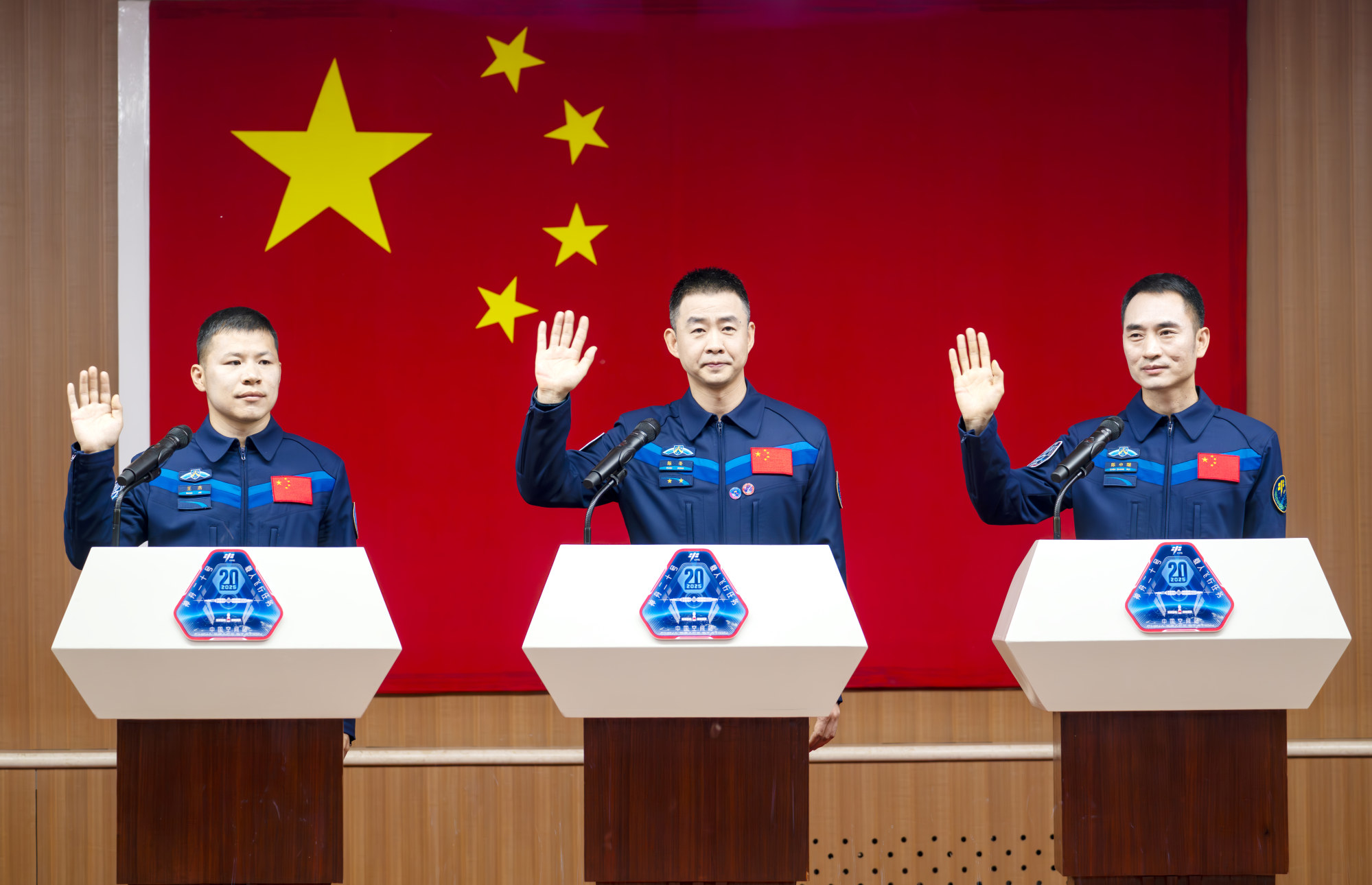
The incident occurred days after the three astronauts were joined on board the Tiangong space station by their relief crew, with a handover ceremony transferring the keys to the facility taking place on Tuesday.
There are currently two spacecraft docked at the station, with the Shenzhou-20 return vehicle believed to be affected by the space debris.
Mission Commander Chen Dong, Wang Jie and Chen Zhongrui, the Shenzhou-20 trio, have been in orbit since April and were scheduled to return to the Dongfeng landing site in Inner Mongolia in northern China on Wednesday.
The landing site has been the scene of multiple rounds of drills preparing for their arrival, according to Xinhua. These have included systems tests for air search and rescue, ground response, communication support, and medical monitoring and aid.
According to the Chinese space authorities, there is an emergency rescue system designed to support visiting spacecraft at the space station. Under the emergency protocol, a backup spacecraft would remain on standby for rapid deployment if necessary, from the moment a craft is launched until it returns to Earth.
In October last year, China Manned Space Agency spokesman Lin Xiqiang said the Chinese space programme prioritised its astronauts’ safety when he was asked about the delayed return of crew members from the International Space Station.
The press conference also covered the possibility of space debris striking the space station. “Compared with the early stages of the space station’s operation, the time available for emergency response by astronauts has increased fivefold, improving the safety of both the space station and the astronauts,” Lin said.
“In extreme circumstances, astronauts can return to Earth earlier than planned aboard an in-orbit spacecraft. [We can also] launch an emergency spacecraft on standby for rescue,” he said.
The Long March carrier rocket and Shenzhou spacecraft were on standby at the launch centre, he added. “If necessary, they can quickly be ready for launch to carry out emergency rescue missions to the space station and ensure the safety of astronauts.”
Richard de Grijs, executive director of the International Space Science Institute-Beijing, said the incident showed that “in the current era of station operations, even a suspected hit prompts mission control to wait, inspect and ensure safety before returning”.
“The Shenzhou-20 delay indicates that the Chinese mission operators consider even a suspected small-debris strike, which may not have caused visible damage yet, worth delaying for risk assessment,” he said.
According to de Grijs, who is also a professor of astrophysics at Australia’s Macquarie University, small debris strikes are common and essentially unavoidable, with many of the objects less than a centimetre in size, making them impossible to track.
Despite their size, they can travel fast enough to cause damage. However, it would be impractical to shield every part of a spacecraft against all debris, de Grijs said.
“While mission‐ending impacts are rare, debris is a growing concern and has tangible operational effects. Small debris poses a real operational risk to crewed and uncrewed missions,” he added.
The delay to the astronauts’ return is not unprecedented, de Grijs pointed out, noting that previous Chinese space missions had been postponed because of weather or landing‐site conditions, as well as for technical checks.
“What is more unusual is a delay triggered by a suspected debris impact in such a direct way, which raises additional safety and engineering questions [and] signals that they are treating [the matter] seriously and erring on the side of safety,” he said.
Meanwhile, the affected astronauts were likely to carry on with scheduled experiments, maintenance tasks and station management until a safe window for their return was established.
“Human space flight always has contingencies and fixed landing windows that can be moved for safety, weather or technical reasons,” de Grijs said.
He added that the Chinese astronauts had trained for a long stay – the Shenzhou-20 mission was intended to set a national duration record for the Tiangong – but noted that changes and uncertainty in schedule could add to their psychological stress.
“From a medical perspective, staying longer [in space] means ensuring consumables, radiation exposure, muscle and bone maintenance, and psychological support remain all in order,” de Grijs said.
“From a human‐interest perspective, more time in orbit means more data for long-duration human space flight for China’s programme.”